Open almost any sketchbook, and you’ll spot the same problems. A smudged corner. A line that skipped halfway through a curve. One sad blotch where the pen simply gave up. Sometimes, the problem isn't your drawing technique but the way your pen handles the paper.
If you’re hunting for the best pen for sketching, choosing one can be harder than it seems, because every pen on the shelf promises smooth lines. For Pentonic, practical details such as ink flow, drying time, and grip are worth considering when choosing a pen for everyday sketching. This guide covers what actually matters before you spend a single rupee.
Why the Best Pen for Sketching Looks Different for Every Artist?
Ask multiple artists, and you’ll get several different answers. A commuter who doodles on the metro wants a pen that won’t leak in a bag. A student shading in class wants control. A journaler wants speed and clean lines. The best pen for sketching depends on how you draw, the details you want to capture, and the paper you use.
Start with your own habits. Do you press hard or barely touch the paper? Do you work in quick, loose strokes or slow, careful hatching? Do you sketch at a desk, or on your knee in a park? Your answers narrow the field faster than any review. Pentonic keeps its range simple and dependable for exactly this reason, because people draw in different places, not perfect studios.
Ink, Tip, Grip and Drying Time: What to Check First?
Packaging tells you little about how a pen will perform. Before buying one, check its ink flow, tip size, drying time, and grip.
● Ink flow: Steady ink gives even lines. Skipping or blobbing can ruin a drawing halfway through.
● Drying time: Fast-drying ink protects your work from the side of your hand, which matters most for left-handers.
● Tip size: A 0.7 mm tip can work well for everyday outlines and broader strokes, while finer tips offer more control for small details.
● Grip comfort: A comfortable body lets you draw for an hour without cramping your fingers.
Whatever you call the best pen for sketching, test it on the paper you’ll actually use. Thin copier sheets and thick sketchbook pages react differently, so a pen that glides on one may scratch on the other. Draw a few lines, a circle, and a patch of shading.
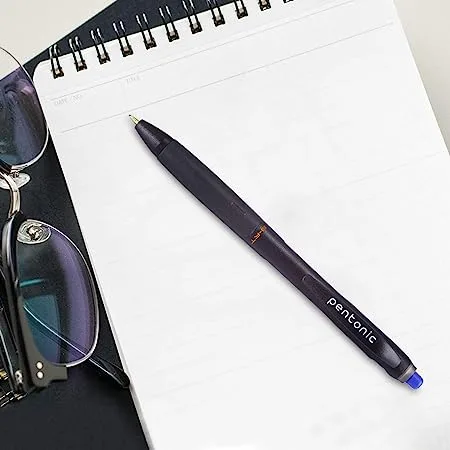
A quick test can reveal whether the pen skips, smudges, or feels uncomfortable to hold. The Pentonic BRT uses low-viscosity, fast-drying ink, which can be useful when making quick lines and notes in a sketchbook.
Ball Pen vs Gel Pen: Which Works Better for Sketching?
Walk into any stationery shop, and this question follows you around. Both types work. They just behave differently.
A ball pen gives a controlled, slightly textured line. It can be a good choice for outlines, cross-hatching, and travel sketching, as the ink generally dries quickly. A gel pen glides with almost no pressure, so shading looks richer and colours pop. Gel ink can take longer to dry and may leave marks on the other side of thin paper.
Neither wins every time. Plenty of artists carry both: one for structure, one for finishing touches. Think of it as choosing between a pencil and a brush rather than picking a winner.
Why Pentonic Is Worth Considering for the Best Pen for Sketching?
Let’s be honest: Different pens work better for different drawing styles. But if you want something reliable and comfortable, Pentonic is worth a closer look. Every Pentonic pen sticks to what matters on paper: smooth ink, quick drying, and a body that feels natural in the hand. Used as a ball pen for linework, it’s steady enough for outlines and relaxed enough for doodles.
The Pentonic BRT adds a few extras worth noting. It has an aerodynamic matte body with an ergonomic grip, a push-button retractable design so there’s no cap to lose, and ink that lasts up to 800 metres of writing. For regular sketching practice, its stated writing capacity may also be worth considering alongside its grip and ink performance.
A Pentonic pen can be useful for everyday activities such as:
● Quick doodles in a pocket notebook
● Bullet journaling with clean headers and borders
● Class notes with small margin sketches
● Rough practice drawings before the final inked version
Simple Habits for Better Sketching Results
Even the best pen for sketching needs to be handled properly. A few simple habits can help you keep your lines cleaner and your pen in good condition.
Cap or retract your pen after each session so the tip stays clean. Warm up with a few loose lines before you start the real drawing. Don’t press harder than you need to, because pressure wears tips and tires wrists. And if you pick a gel pen for shading, give it a few extra seconds to dry before your palm drags across the page. Small stuff, but it adds up. For everyday doodling and note-taking, a Pentonic pen can be a convenient option to keep close at hand.
Conclusion
Choosing the best pen for sketching comes down to a few honest questions. How do you draw, where do you draw, and what annoys you most about your current pen? Check the ink flow, drying time, tip size, and grip before anything else, and test on the paper you actually use.
Both ball and gel options have their place, so pick the one that matches your style, or carry one of each. Pentonic keeps things refreshingly practical, and a Pentonic pen like the Pentonic BRT gives you fast-drying ink, a comfortable grip, and a design that suits notebooks, journals, and sketchpads alike.
Find the one that feels natural, keep sketching often, and the lines will improve on their own. Start small, test honestly, and trust your hand.