Sales teams can spend hours building lists, checking contact data, researching accounts, writing emails, sending LinkedIn messages, updating CRM records, and chasing follow-ups. Then the results still depend on whether the right person was contacted with the right message at the right time.
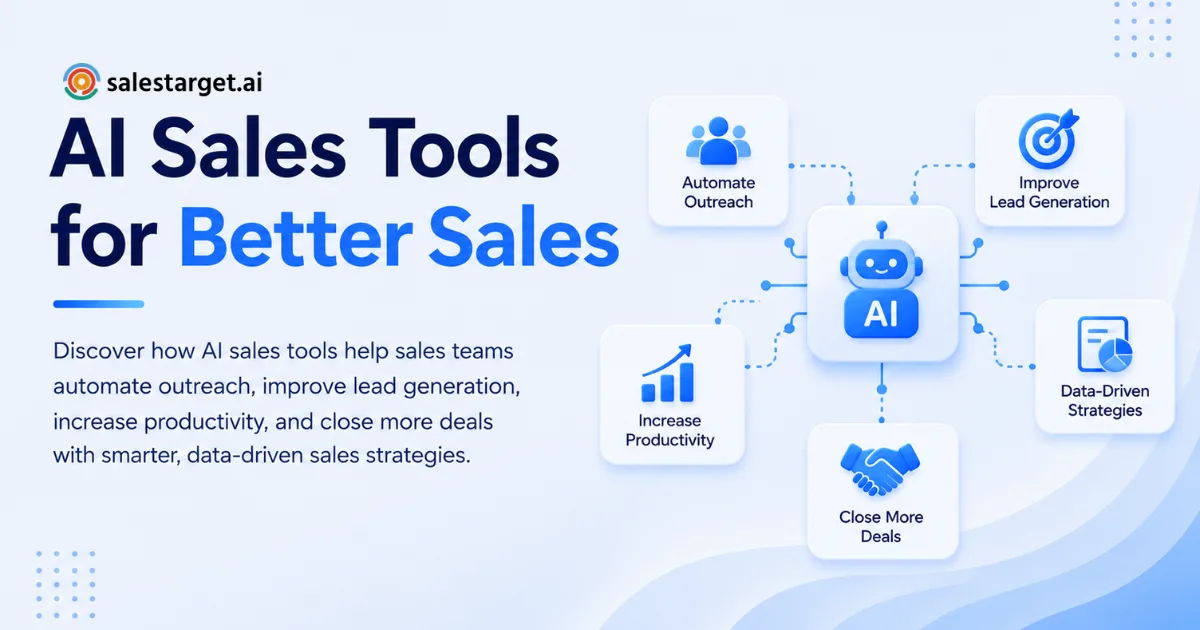
AI sales tools reduce that manual load by helping teams find better prospects, automate outreach, prioritize sales activity, and keep pipeline data current. The best platforms connect these jobs instead of creating another disconnected tool for every task. For B2B teams, the real value comes from shortening the path from prospect discovery to qualified conversation and keeping that process measurable.
What Are AI Sales Tools and What Do They Actually Do?
AI sales tools use artificial intelligence to support sales activities such as prospect research, lead qualification, outreach, follow-ups, CRM updates, forecasting, and sales coaching. Current sales platforms increasingly use AI across multiple stages instead of limiting it to email writing or chat assistance.
The practical difference is workflow speed. A rep can define an ideal customer profile, identify matching accounts, enrich contacts, create personalized messages, launch a sequence, monitor responses, and move interested prospects into a pipeline without manually moving data between several systems.
The strongest setup does not mean automating every human interaction. It means removing repetitive work so sellers can spend more time on qualification, objection handling, discovery, and closing.
How Do AI Sales Tools Improve Prospecting?
AI prospecting helps sales teams identify accounts and contacts that match their target profile, enrich missing information, and prioritize prospects using firmographic, behavioral, and intent data. This gives reps a better starting point than a static spreadsheet or an old contact list.
Modern AI sales software can support this process by combining company information, professional profiles, contact details, buying signals, and enrichment in one workflow. SalesTarget.ai, for example, provides a Lead Explorer with 840M+ professional profiles, 146M+ business entities, 4,000+ intent signals, and data from 50+ sources.
A useful rule is to automate research, not judgment. AI can surface a prospect that matches your ICP, but the rep should still decide whether the account has a real business reason to buy.
Which AI Sales Tools Are Best for Sales Automation?
The right tool depends on the bottleneck in your sales motion. A prospecting-heavy team needs strong data and enrichment, while a team with enough leads may gain more from outreach automation, CRM intelligence, or conversation analysis.
Sales needTool capability to prioritizeWhat to measureProspect discoveryAI-powered database and enrichmentQualified contacts foundLead prioritizationIntent and engagement signalsPositive opportunitiesEmail outreachAutomated sequences and personalizationReply and meeting ratesLinkedIn outreachMultistep actions and schedulingConversations startedData qualityEmail verification and risk scoringBounce rateCRM managementAutomated activity and task updatesFollow-up completionSales assistanceConversational AI and workflow actionsTime saved per repForecastingPipeline analysis and predictive signalsForecast accuracyThe key is avoiding overlapping subscriptions. Research across current AI sales roundups shows that many tools now specialize in different parts of prospecting, outreach, conversation intelligence, CRM, and forecasting.
How Do AI-Powered Sales Tools Work Across the Sales Process?
AI can support the sales process from the first search to the next pipeline action.
Step 1: Define the target audience
Start with firmographic and role-based criteria. Specify company size, industry, geography, job title, technology usage, or other traits that describe a qualified account.
Step 2: Find and enrich prospects
The platform identifies matching contacts and fills gaps in the record. SalesTarget.ai can enrich leads with professional email, personal email, phone, and mobile details, then verify contact information before outreach.
Step 3: Create the outreach sequence
The rep provides an audience description or campaign objective. AI can turn that input into a multistep sequence, then adjust messaging around the prospect's role, company, and industry.
Step 4: Coordinate multiple channels
Email and LinkedIn can run as one sequence rather than separate campaigns. SalesTarget.ai supports connection requests, messages, follow-ups, engagement actions, and email steps with conditional branches based on prospect activity.
Step 5: Track responses and pipeline activity
Replies, calls, tasks, and deal activity should flow back into the CRM. This gives sales managers one place to see which campaigns generate conversations and where leads are getting stuck.
What Features Should You Look for in AI Sales Automation Tools?
Good AI sales automation tools should remove repetitive actions without making your outreach look automated. That means checking both the feature list and the workflow behind each feature.
Look for accurate prospect data, enrichment, email verification, sequence automation, personalization, multichannel support, CRM synchronization, reply management, task automation, and reporting. Deliverability controls matter too. Automated outreach is only useful if messages reach the inbox and the underlying contact data is reliable.
SalesTarget.ai combines prospect discovery, enrichment, email validation, email outreach, LinkedIn outreach, CRM management, and AI assistance in one workspace. Its email workflow includes inbox rotation, AI warm-up, SPF/DKIM/DMARC checks, content generation, spintax generation, and a unified inbox.
Want to reduce the number of tools your reps have to manage? Map your current workflow from lead discovery through closed deal and identify every manual handoff. Then test whether one connected platform can replace several separate steps.
Which Sales Engagement Tools Help Teams Increase Outreach Capacity?
Sales engagement tools are most useful when they help reps execute consistent follow-up without forcing every prospect through the same message path.
A strong sequence should have multiple touches, different message angles, sensible delays, and branches based on what the prospect does. Someone who replies should leave the automated follow-up path. Someone who clicks but does not reply may need a different message from someone who never engages.
LinkedIn outreach adds another layer. SalesTarget.ai supports connection requests, DMs, follow-ups, and engagement actions alongside email. Its sequences can react to replies, actions, or no response, giving teams more control than a fixed email-only campaign.
Current AI prospecting guidance similarly points toward personalization, lead prioritization, and buyer signals as important areas for AI-assisted selling.
What Are the Benefits of AI Lead Generation Tools?
The biggest benefit of AI lead generation tools is not simply producing more contacts. It is helping sales teams spend more time on prospects that fit the buying criteria.
AI can reduce list-building work, surface relevant buying signals, enrich records, and prepare prospects for outreach. SalesTarget.ai combines these functions in Lead Explorer, where teams can search using plain English or stack business and people filters.
There is another benefit that gets less attention: consistency. When lead criteria, enrichment, validation, sequencing, and CRM updates happen inside one workflow, fewer opportunities disappear between tools.
For outbound teams, that can matter more than raw lead volume. Ten thousand poorly matched contacts create work. A smaller set of relevant, verified prospects can create conversations.
How Can an AI Sales Assistant Help Reps Work Faster?
An AI sales assistant works best when it can act on sales data rather than simply answer generic questions. Reps need help finding prospects, creating sequences, checking campaign performance, retrieving CRM information, and managing tasks.
SalesTarget.ai includes an AI Copilot that can perform these activities through conversational prompts. A rep can ask it to find leads, generate an email sequence, query CRM information, track campaign revenue, or create and assign tasks.
This creates an important operational advantage: the rep does not need to learn a new interface for every small action. They can describe the task in natural language and let the system handle the underlying workflow.
How Should Teams Measure AI Sales Tool Performance?
Do not judge a sales platform by the number of AI features listed on its homepage. Judge it by changes in the sales workflow.
Track qualified leads created, contact verification rates, positive reply rates, meetings booked, follow-up completion, time spent on research, campaign creation time, pipeline movement, and revenue attributed to campaigns.
SalesTarget.ai reports 35% faster campaign creation, 90% of emails validated before sending, 3.2X faster deal cycles, 91% follow-up completion, around six hours saved per rep each week, and 2.4X more meetings from the same leads. These figures are provided by SalesTarget.ai and should be evaluated against your own baseline and sales process.
The most useful metric is often time-to-action. If a rep receives a qualified lead and still needs ten manual steps before contacting it, the automation is not solving the real bottleneck.
What Mistakes Should You Avoid When Choosing AI Sales Tools?
A common mistake is buying tools by feature count. More AI features do not automatically produce better sales outcomes.
Another mistake is treating contact volume as pipeline quality. More records can create more bounce risk, more irrelevant outreach, and more work for reps. Data verification should happen before contacts enter an active sequence.
Teams should not automate personalization without reviewing the inputs. AI can generate polished copy from weak or outdated information. A grammatically perfect email sent to the wrong buyer is still a bad email.
Tool fragmentation is another hidden cost. If one platform stores leads, another sends email, another handles LinkedIn, another validates contacts, and a separate CRM records activity, your team spends time maintaining connections between systems.
Sales teams should evaluate how data moves through the entire outbound process, not just how impressive a single feature looks during a demo.
What Are the Best Practices for AI Sales Automation?
Start with a narrow ICP and one measurable campaign objective. Build the workflow around a real sales motion rather than trying to automate every activity at once.
Use AI for research, enrichment, prioritization, drafting, and repetitive execution. Keep human review for positioning, qualification, important replies, objections, and high-value opportunities.
Set rules for data quality before launching campaigns. Verify emails, remove risky contacts, define suppression criteria, and monitor bounce and reply patterns. For LinkedIn, use sensible limits, human-like delays, and safeguards that reduce excessive activity.
Your sales workflow automation should make the next action obvious. A positive reply should create a task or move the lead into a pipeline stage. A booked meeting should update the CRM. A non-response should trigger the next approved follow-up rather than leaving the rep to remember it manually.
For sales managers, review campaign performance by segment. A campaign can produce a strong reply rate from one industry and perform poorly in another. That difference tells you where to refine the ICP, offer, or messaging.
How Do You Compare AI Sales Tools Before Buying?
A useful comparison starts with workflow coverage rather than brand recognition.
CapabilityStandalone toolsIntegrated AI sales platformB2B prospect dataOften separateBuilt inContact enrichmentMay require another toolIncluded in workflowEmail validationFrequently separateBuilt into prospect workflowEmail outreachStrong in specialist toolsIncludedLinkedIn outreachMay require another platformIncludedCRMOften separateNative CRMAI assistantVariesAvailable across workflowData movementMultiple integrationsCentralizedReportingSpread across systemsUnified viewTools such as Salesforce, HubSpot, Gong, and other platforms cover different parts of the sales workflow, so the best choice depends on the team's existing stack and operational gap. Current industry comparisons also show that AI sales software spans CRM-native agents, prospecting, engagement, conversation intelligence, and forecasting rather than one uniform category.
If your team already has a mature CRM and specialized tools, adding another point solution may make sense. If your outbound process is split across several systems, an integrated platform can reduce the number of handoffs.
What Sales Productivity Gains Can AI Create?
Sales productivity tools can give reps back time by reducing research, administrative updates, list preparation, and follow-up work.
SalesTarget.ai reports that its CRM workflow saves around six hours per rep per week. Its CRM automatically brings campaign leads into the system, logs emails and calls to the lead timeline, and creates follow-up tasks. The platform includes an AI dialer with automatically logged call notes.
That matters for sales managers too. A CRM that captures activity automatically gives managers better visibility without asking reps to spend more time updating records.
The goal is not to make reps perform more automated activity. The goal is to give them more time for activities that require judgment and human interaction.
How Can AI Improve Sales Forecasting and Pipeline Management?
Sales forecasting software can use pipeline data, activity patterns, historical performance, and deal signals to help managers identify risks earlier.
AI does not remove the need for sales judgment. A forecast is only as useful as the data feeding it. If opportunities are not updated, follow-ups are missed, or activities live outside the CRM, any forecast becomes less reliable.
That is why CRM connectivity matters. SalesTarget.ai keeps prospecting, outreach, calls, tasks, and deal activity in the same workspace. Its CRM can connect with Google Calendar, Google Meet, Calendly, Slack, Zapier, HubSpot, Salesforce, and Zoho.
Final Thoughts: Choosing the Right AI Sales Tools for Growth
The best AI sales tools are not the ones with the longest feature list. They are the ones that remove the biggest source of friction in your sales process while keeping data, outreach, and pipeline activity connected.
For a B2B outbound team, that can mean finding better-fit prospects, verifying their contact details, launching coordinated email and LinkedIn sequences, managing replies, creating follow-up tasks, and moving qualified leads into a CRM without constant manual work.
SalesTarget.ai brings those functions into one outbound platform, including Lead Explorer, email and LinkedIn outreach, contact validation, CRM workflows, an AI dialer, and AI Copilot. For teams tired of stitching together separate prospecting, outreach, validation, and CRM products, that integrated approach can make the sales process easier to operate and measure.
Ready to see which capabilities belong in your outbound stack? Review this practical guide to AI sales prospecting and outreach platforms and use it to compare your current workflow against the capabilities your team actually needs.