
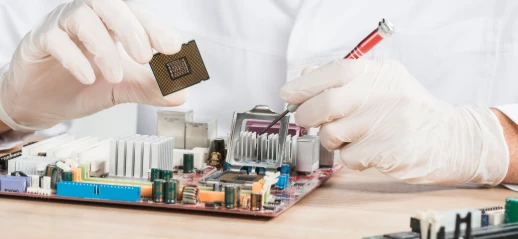
Have you ever thought about what drives or powers the modern world and keeps everything working smoothly? From the smartphone in your pocket to the smart traffic lights that keep cities moving, to AI-powered assistants as well as even EV, everything relies on a seamless blend of hardware & software. But here is the exciting part- behind every “smart” technology is an engineer who understands both the circuits that power it and the code that drives it. That is where a BTech in Electronics and Computer Engineering comes into the picture.
Unlike degrees that lean heavily toward just coding or just hardware, this one gives you the best of both worlds. Just think, you could design a microchip and then write software for it that makes it intelligent. You could design a robot that does not just walk in a straight line, but responds intelligently to its environment. This degree gives you the ability to innovate in virtually any industry.
If you are somebody who enjoys problem solving, exploring how things work & creating solutions that improve them, you will find working in the field of engineering tremendously fulfilling. The combination of electronics and computer science makes for a challenging academic endeavour, but the challenges can also help you stand out in today’s tech-centric competitive environment. The best part is that when you graduate from your engineering programme, you will be equipped not only to use technology but to modify & reshape it.
What This Degree Really Teaches You
At its core, BTech in Electronics and Computer Engineering blends digital electronics, communication systems and embedded hardware with algorithms, operating systems and modern programming. You’ll pick up the fundamentals of circuit theory, signals and systems, microprocessors and then layer on computer science essentials like data structures, databases and machine learning basics. By the time you’re halfway through, you’ll realise you can design a device and write the code that powers it. That dual fluency is your competitive edge.
A Quick Look at the Curriculum
Most universities structure the programme to build you up from strong fundamentals to specialised electives. Expect a mix of classroom learning, labs and projects across four years. You will typically start with math, physics, basic electronics & introductory programming. From there, you move into microcontrollers, VLSI, computer architecture, operating systems, computer networks and control systems. Electives often include IoT, robotics, edge computing, AI, cloud computing and cybersecurity.
If you’re checking prospects, it helps to search specifically for the BTech Electronics and Computer Engineering syllabus. This phrase usually leads you to official course outlines, lab components, credit structures and suggested electives, so you can compare universities easily.
Skills You Actually Use in the Real World
Hardware-Software Co-Design- You will learn to choose components, design PCBs, write firmware as well as integrate it all with application software.
Problem Solving at Scale- From optimising code to reducing power consumption, you’ll practice making trade-offs that matter in real products.
Systems Thinking- You will see how sensors, networks, databases & interfaces come together as well as where bottlenecks hide.
Tooling & Best Practices- Expect to work with HDL (like Verilog/VHDL), C/C++ for embedded, Python for prototyping, Git for version control & MATLAB, similar for modelling.
Labs and Projects
As part of your projects, you could create practical things like a weather station that sends information online, a special chip (FPGA) to speed up image processing or an energy meter that tracks usage and sends alerts to your phone. These projects force you to think about constraints, latency, power, cost, security as well as teach you to document, test & iterate like an engineer.
Internships and Career Paths
With ECE, your options are wide. You can join product companies as an embedded developer or systems engineer, step into chip design, work on networks or move into software roles like full stack or DevOps where your hardware understanding gives you an edge. Fast growing fields like self driving systems, wearable gadgets, electric vehicles, healthcare technology and factory automation need engineers who understand both electronics hardware and coding software.
Who Thrives in This Programme?
You’ll do well if you enjoy building things, can handle abstraction (from logic gates to cloud APIs) and like learning by doing. ECE isn’t about memorising formulas, it’s about designing, testing, breaking and fixing until your solution works reliably.
Final Thought
A BTech in Electronics and Computer Engineering teaches you to design both the hardware and the software. If you want a degree that’s hands-on, future-ready and genuinely useful across industries, this is a smart bet. You won’t just learn how technology works, you'll learn how to make it work better.