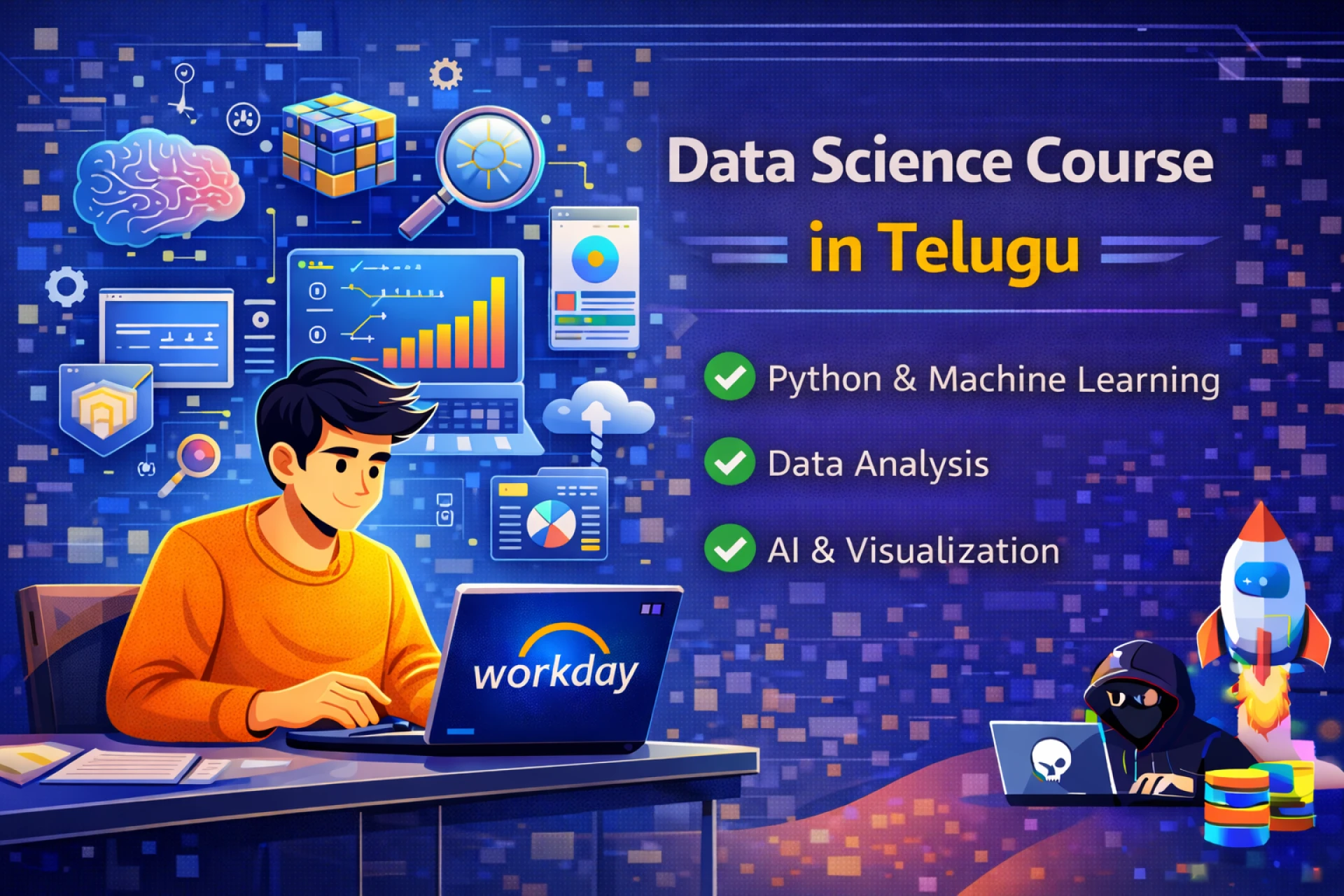
AutoML (Automated Machine Learning) is transforming the way machine learning models are built and deployed. Traditionally, building ML models required deep knowledge of algorithms, feature engineering, hyperparameter tuning, and model evaluation. However, AutoML simplifies this entire process by automating key steps in the ML pipeline. In a Data Science Course in Telugu, learning AutoML tools like H2O, Google AutoML, TPOT, and No-Code ML platforms helps students and professionals build powerful models with minimal manual effort.
What is AutoML?
AutoML stands for Automated Machine Learning. It automates tasks such as:
- Data preprocessing
- Feature selection
- Model selection
- Hyperparameter tuning
- Model evaluation
Instead of manually trying different algorithms and tuning parameters, AutoML systems search for the best-performing model automatically.
This is especially useful for:
- Beginners in data science
- Business analysts
- Startups with limited ML expertise
- Rapid prototyping of ML solutions
Why AutoML is Important
In real-world projects, selecting the right model and tuning it properly can take days or even weeks. AutoML reduces this time significantly.
For example, hyperparameter tuning often involves minimizing a loss function such as Mean Squared Error (MSE):
MSE = (1/n) Σ (yᵢ − ŷᵢ)²
AutoML tools automatically search for parameter combinations that minimize such error metrics.
This improves:
- Productivity
- Efficiency
- Model accuracy
- Deployment speed
In a Data Science Course in Telugu, students learn how AutoML balances automation with model understanding.
H2O AutoML
H2O.ai provides a powerful AutoML platform widely used in industry.
Key Features of H2O AutoML:
- Automatic model training
- Automatic hyperparameter tuning
- Leaderboard of models
- Support for classification and regression
- Built-in stacking and ensemble models
H2O AutoML tries multiple algorithms such as:
- Gradient Boosting Machines
- Random Forest
- Deep Learning models
- XGBoost
It ranks them based on performance metrics and selects the best model automatically.
Students in a Data Science Course in Telugu learn how to:
- Load datasets into H2O
- Run AutoML experiments
- Interpret leaderboard results
- Export production-ready models
Google AutoML
Google AutoML is a cloud-based solution offered by Google Cloud.
It allows users to build custom ML models without writing complex code.
Key Capabilities:
- AutoML Vision (image classification)
- AutoML Natural Language
- AutoML Tables
- AutoML Translation
Google AutoML is ideal for businesses that need scalable ML solutions with minimal infrastructure management.
Advantages include:
- Cloud scalability
- Easy integration with APIs
- Enterprise-grade security
- Automated model deployment
In Telugu-based data science training, students understand how cloud-based AutoML tools are used in real-world enterprise systems.
TPOT – Automated ML with Genetic Programming
TPOT (Tree-based Pipeline Optimization Tool) is an open-source AutoML library built on top of scikit-learn.
TPOT uses genetic programming to optimize ML pipelines.
How TPOT Works:
- Generates random pipelines
- Evaluates their performance
- Selects best-performing pipelines
- Applies mutation and crossover
- Evolves better pipelines over generations
This evolutionary process continues until the best pipeline is found.
TPOT is particularly useful for:
- Research projects
- Academic learning
- Understanding automated pipeline design
Students gain hands-on experience in automated feature selection and model optimization.
No-Code Machine Learning
No-Code ML platforms allow users to build ML models without programming knowledge.
Examples include:
- Drag-and-drop model builders
- GUI-based ML platforms
- Business intelligence tools with ML integration
No-Code ML platforms are helpful for:
- Business professionals
- Domain experts
- Non-technical teams
However, it is important to understand that while No-Code ML simplifies implementation, understanding core ML concepts is still necessary for responsible deployment.
In a Data Science Course in Telugu, students learn both:
- Conceptual foundations
- Practical automation tools
This balanced approach ensures strong fundamentals along with modern tools.
Benefits of AutoML
AutoML provides several advantages:
- Faster model development
- Reduced human error
- Efficient hyperparameter tuning
- Improved productivity
- Democratization of AI
It allows organizations to focus on business problems rather than technical complexities.
Limitations of AutoML
Despite its benefits, AutoML has limitations:
- Limited interpretability in some cases
- Computationally expensive
- Less control over model internals
- Risk of overfitting if not monitored
Therefore, AutoML should complement human expertise rather than replace it.
A strong Data Science Course in Telugu teaches students when to use AutoML and when to manually build models.
Industry Applications
AutoML is widely used in:
- Banking (credit risk modeling)
- Healthcare (disease prediction)
- Retail (sales forecasting)
- Marketing (customer segmentation)
- Insurance (fraud detection)
Companies prefer AutoML for rapid deployment and scalable ML systems.
Career Opportunities
After learning AutoML tools, students can pursue roles such as:
- Data Scientist
- Machine Learning Engineer
- AI Analyst
- Business Intelligence Developer
- AI Consultant
AutoML knowledge enhances productivity and makes professionals more efficient in real-world projects.
Why Learn AutoML in Telugu?
Learning AutoML in Telugu provides:
- Clear conceptual understanding
- Strong foundation in ML basics
- Better confidence in interviews
- Ability to apply ML to local business problems
Students can grasp complex ideas like hyperparameter tuning, ensemble learning, and pipeline optimization more easily in their native language.
Conclusion
AutoML is revolutionizing machine learning by automating complex processes like feature engineering, model selection, and hyperparameter tuning. Tools like H2O, Google AutoML, TPOT, and No-Code ML platforms make AI accessible to a wider audience.
In a structured Data Science Course in Telugu, students not only learn how to use these tools but also understand the theory behind them. This combination of automation and foundational knowledge prepares learners for real-world AI challenges.