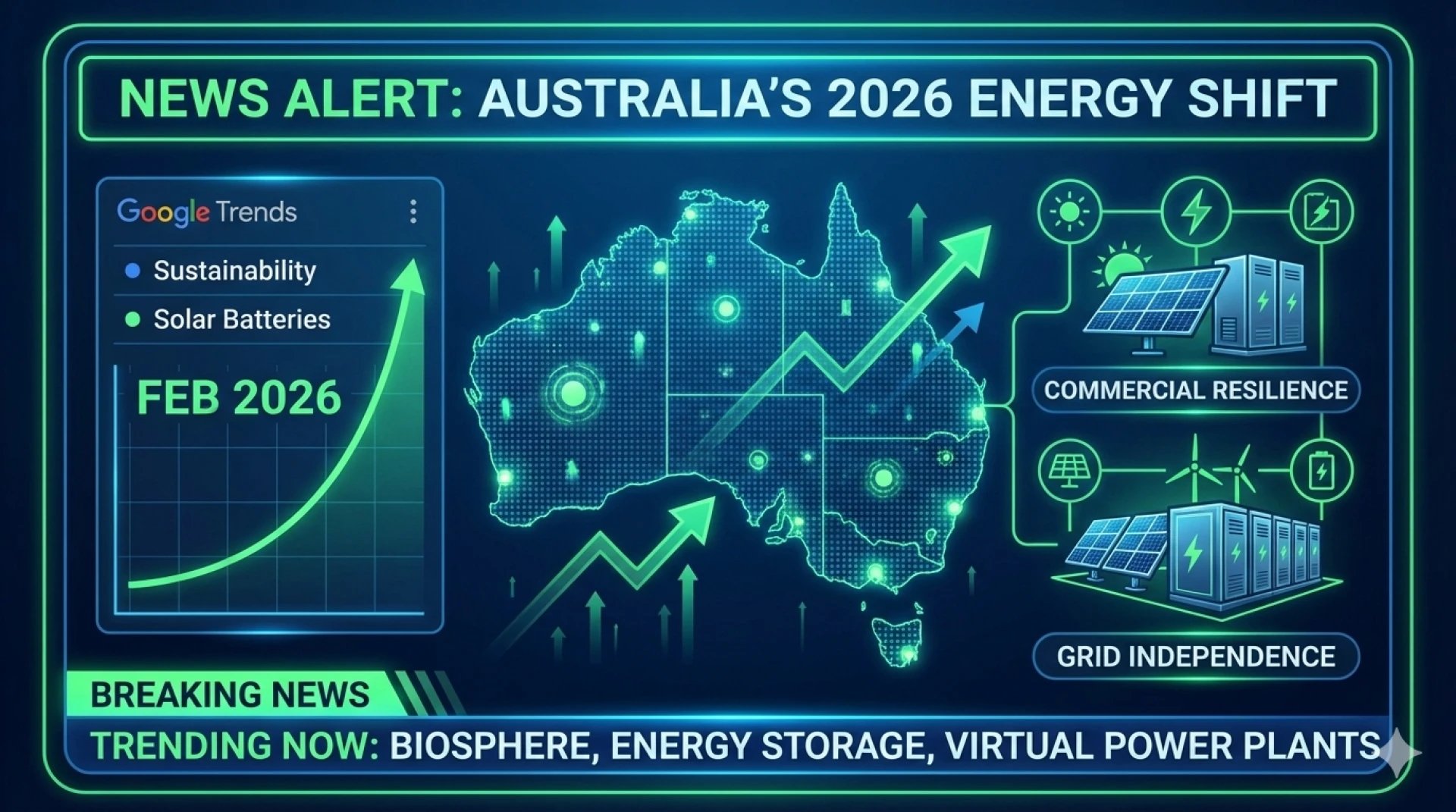
As we navigate the early months of 2026, a quick glance at regional data reveals a compelling story about the Australian mindset. Search interest for the term "Sustainability" has reached unprecedented peaks, and it isn't standing alone. Closely trailing this trend is a massive surge in queries regarding "batteries for solar panel."
For a nation that has long led the world in rooftop solar adoption, this dual spike in interest signals a maturing market. We are moving beyond the era of simple generation and entering the era of total energy management. But why is this happening now? Why has the "biosphere" and "energy storage" suddenly become the focus of morning commutes and boardroom discussions? To understand this, we have to look at how individual choices are finally aligning with environmental necessity and economic strategy.
Moving Beyond the Buzzword
Sustainability used to be a term reserved for environmental activists or corporate annual reports. In 2026, however, it has become a household and business fundamental. The recent peaks in search trends suggest that Australians are no longer looking at sustainability as an elective choice, but as a framework for resilience.
When we discuss the health of our local ecosystems, we are essentially discussing the infrastructure that supports our lives. The surge in interest reflects a growing awareness that our current consumption patterns must adapt to the planet's capacity to regenerate. This is where the concept of a "nature-positive" lifestyle comes in.
One of the most important things for a modern consumer or business owner to understand is the mechanics of this balance. It’s about realizing that every kilowatt-hour of energy saved or stored is a direct contribution to the stability of our biosphere. For those looking to dive deeper into the "why" behind this movement, understanding how sustainability meets the needs of the environment provides the essential context for everything that follows.
The Battery Boom: Why 2026 is the Year of Storage
If 2024 and 2025 were the years of "solar curiosity," 2026 is officially the year of the battery. The Australian energy market has reached a tipping point where generating power is only half the battle; storing it is where the real value lies.
The recent expansion of the federal "Cheaper Home Batteries" program to $7.2 billion has certainly added fuel to the fire. However, there is a clock ticking. With the upcoming May 1st deadline for certain rebate adjustments, thousands of Australians are racing to understand how to right-size their storage.
For the average homeowner, the interest is clear: they want to stop exporting their excess solar power to the grid for a pittance, only to buy it back at peak rates after sunset. But for the commercial sector, the stakes are even higher.
Commercial Resilience: The New Business Standard
While residential trends often grab the headlines, the real "buzz" in the commercial world is about energy security. Business owners across Australia are facing a dual pressure: rising operational costs and the increasing demand for ESG (Environmental, Social, and Governance) transparency.
A business that relies solely on the grid is vulnerable to price volatility and potential outages. This is why the search for solar batteries is peaking in industrial hubs. A commercial property equipped with solar storage isn't just "going green"; it’s building a moat around its finances.
However, scaling energy storage from a 10kW home unit to a commercial-grade system requires a different set of rules. You have to consider "peak shaving," "load shifting," and the specific requirements of heavy machinery or large-scale HVAC systems. For any business owner looking to navigate these waters, a comprehensive guide for solar battery storage for commercial properties is no longer optional reading, it is a strategic requirement.
The Social Impact of Individual Storage
There is a broader reason why this trend matters to the community. As more businesses and homes install batteries, we are collectively creating a decentralized energy network. In 2026, we are seeing the rise of Virtual Power Plants (VPPs).
When a commercial property stores energy during the day, they aren't just helping themselves. They are reducing the "peak load" on the national grid during the hottest parts of the day. This helps prevent blackouts for everyone and reduces the need for the grid to turn on expensive, high-emission gas peaking plants. This is the ultimate expression of sustainability: a system where individual financial interest creates a positive outcome for the entire community.
Navigating the Technical Landscape
As interest peaks, so does the volume of information, and misinformation. In 2026, the savvy "energy prosumer" is focusing on three key areas:
- Capacity vs. Output: Understanding that a battery’s total storage (kWh) is different from its power delivery (kW).
- Chemistry and Safety: With the Australian climate becoming more extreme, the focus has shifted toward Lithium Iron Phosphate (LFP) for its thermal stability and longer life cycle.
- Smart Integration: The most successful installations this year are those integrated with AI-driven energy management systems that automatically decide whether to store, use, or sell power based on real-time market prices.
Why You Need to Know This Now
The window of opportunity for the current energy transition is unique. Between the government incentives, the maturing of battery technology, and the current search trends, the stars have aligned for those looking to make a move.
We are living through a period where the "cost of inaction" is becoming higher than the cost of the technology itself. Every month spent without storage is a month of paying inflated peak rates and relying on an aging energy infrastructure.
Conclusion: A Sustainable Path Forward
The data from Google Trends is more than just numbers on a screen; it’s a reflection of our national priorities. Australians are choosing a path of resilience, independence, and environmental stewardship.
By understanding the deep connection between our energy choices and the biosphere, and by equipping our businesses with the tools they need to thrive, we are setting the stage for a much more stable future. Whether you are a homeowner curious about the environment’s needs or a developer looking into large-scale commercial storage, the time to educate yourself is now.
The energy revolution isn't coming, it’s already here. The only question is how you will announce your participation in it.