Market Overview
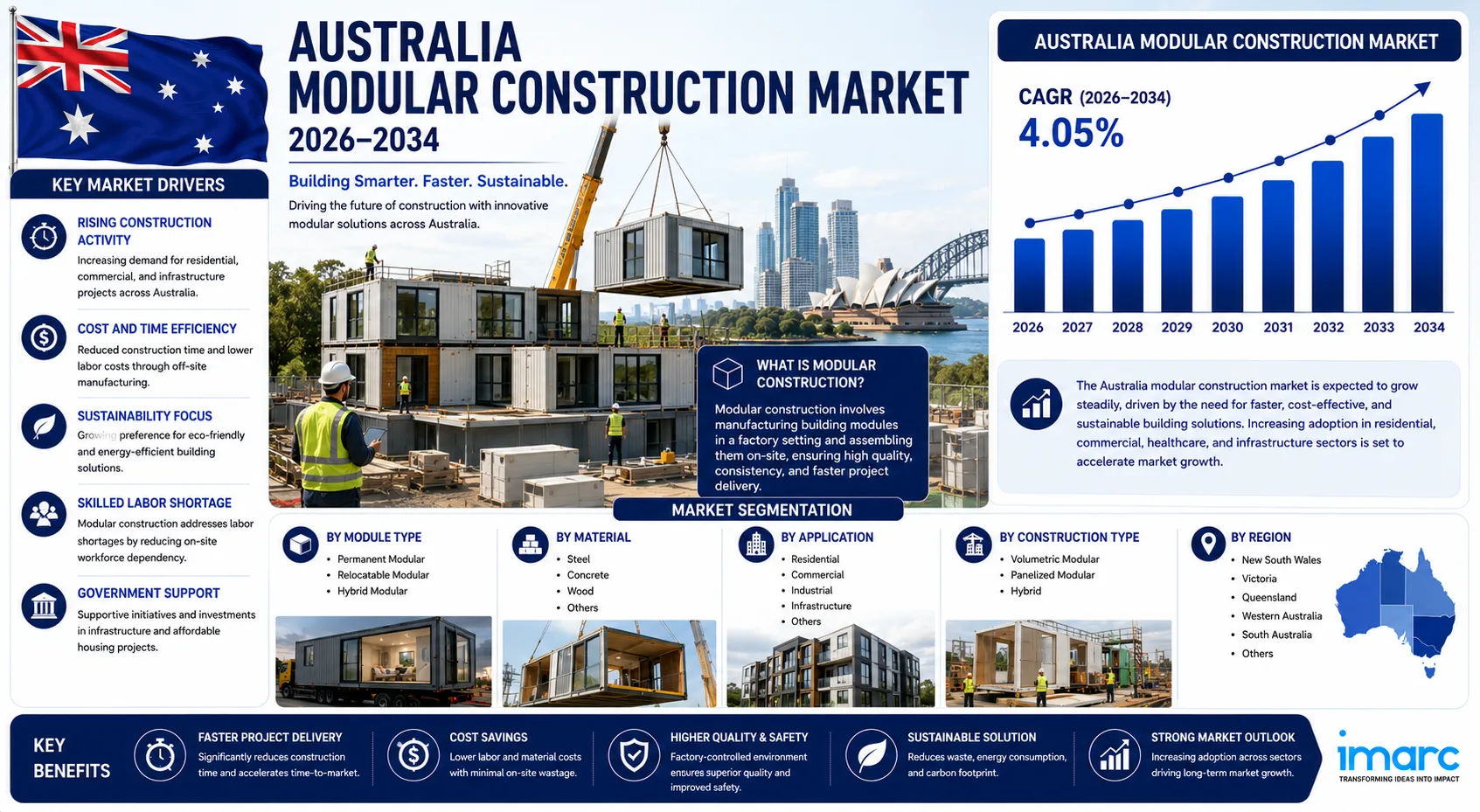
The Australia modular construction market size reached USD 11.8 Billion in 2025 and is projected to reach USD 17.1 Billion by 2034, growing at a compound annual growth rate (CAGR) of 4.05% from 2026 to 2034, from USD 12.4 Billion in 2026. The market is driven by the national housing shortage and the National Housing Accord, a large commercial and infrastructure pipeline, construction labor constraints, high urban land costs, institutional investment in build-to-rent and social housing, and defense-related infrastructure demand.
Australia Modular Construction Market Summary
- The Australia modular construction market covers permanent and relocatable buildings made from factory-built modules, across a range of module types, materials, and end uses.
- Modular construction is valued for faster build times, lower on-site labor needs, more predictable costs, and less waste.
- The ecosystem includes modular manufacturers, builders and developers, steel and building material suppliers, logistics providers, government agencies, institutional investors, and building owners.
- Major segments identified in the market include type (permanent 54.0%), module type (four-sided 29.0%), material (steel 42.0%), end use (commercial 32.0%), and region (ACT & NSW 36.0%), based on 2025.
- The National Housing Accord targets 1.2 million new homes from July 2024 to June 2029, which IMARC says traditional methods alone cannot meet.
- The federal government plans a ten-year infrastructure program of over AUD 120 billion, with schools, hospitals, and community projects increasingly using modular methods.
PORTER’S FIVE FORCES ANALYSIS
- Competitive Rivalry: Moderate. Specialist modular builders, large construction firms, and relocatable building providers compete on speed, cost, and quality. Business implication: Firms must differentiate through repeatable products, quality, and delivery reliability.
- Supplier Power (Materials and Transport): Moderate. Steel, concrete, and timber prices, plus logistics for oversized modules, affect cost and margins. Business implication: Manufacturers should secure materials and optimize transport planning.
- Buyer Power (Governments, Developers, and Investors): Moderate to High. Large government and institutional buyers can set terms and drive standardization. Business implication: Suppliers should offer scalable, repeatable products and long-term frameworks.
- Threat of Substitutes: Moderate. Traditional on-site construction remains the main alternative, especially where regulation and perception favor conventional methods. Business implication: Highlight speed, cost certainty, and quality advantages.
- Threat of New Entrants: Moderate. Factory capital and approval requirements are barriers, though demand and policy support attract entrants. Business implication: Incumbents should scale production and build track records.
Request a Sample Report for In-Depth Market Insights: https://www.imarcgroup.com/australia-modular-construction-market/requestsample
MARKET GROWTH DRIVERS
Housing Shortage and Policy SupportThe National Housing Accord’s 1.2 million-home target and government social and affordable housing procurement increase demand for faster building methods. The National Housing Supply and Affordability Council’s State of the Housing System report in May 2025 recommended faster adoption of modular and prefabricated methods.
Labor Constraints and Land CostsFactory-built modules need fewer site workers, which improves cost competitiveness amid labor shortages, while high urban land costs push developers toward faster builds that reduce holding costs.
Institutional Investment and InfrastructureBuild-to-rent and social housing investment favors repeatable modular products, while education, healthcare, and defense infrastructure, including AUKUS-linked remote bases and temporary accommodation, add demand.
AUSTRALIA MODULAR CONSTRUCTION MARKET SEGMENTATION
Type Insights:
- Permanent
- Relocatable
Module Type Insights:
- Four-Sided
- Open-Sided
- Partially Open-Sided
- Mixed Modules and Floor Cassettes
- Modules Supported by a Primary Structure
- Others
Material Insights:
- Steel
- Concrete
- Wood
- Plastic
- Others
End Use Insights:
- Commercial
- Residential
- Education
- Retail
- Hospitality
- Healthcare
- Others
Regional Insights:
- Australian Capital Territory & New South Wales
- Victoria & Tasmania
- Queensland
- Northern Territory & Southern Australia
- Western Australia
COMPETITIVE LANDSCAPE
The Australia modular construction market includes specialist modular builders, relocatable building providers, and large construction and development firms. Competition centers on production capacity, speed, quality, cost, and the ability to deliver at scale for government and institutional clients. Key challenges include high capital and transport costs, fragmented state-based regulation, perception gaps about quality and resale value, and logistics for oversized modules.
Key players mentioned in the report context include:- Hickory Group announced a partnership with Build Home in December 2025 to launch a 44,000 m² facade manufacturing precinct in China.
- Modscape is a specialist modular builder.
- Fleetwood Australia is a modular and relocatable building provider.
- Lendlease is a major developer and builder active in the market.
- Ausco Modular is a modular and relocatable accommodation provider.
- Quickbuilt, Moduline, and Portable Buildings Australia are also named as players.
REGIONAL ANALYSIS
- ACT & New South Wales: The leading region with 36.0% of the market in 2025, driven by Sydney’s housing demand, large development pipeline, and government projects.
- Victoria & Tasmania: A significant market with strong demand from housing, education, and commercial projects.
- Queensland: A growing market supported by population growth, housing demand, and remote and regional accommodation needs.
- Western Australia: A market with demand from resource-sector accommodation and regional construction.
- Northern Territory & Southern Australia: Smaller markets where remote accommodation, defense, and community infrastructure drive modular demand.
RECENT INDUSTRY DEVELOPMENTS
October 2026: South Australia commenced a A$3.3 million modular housing trial featuring five prefabricated homes designed for essential workers in regional communities. Built in South Australia and ranging from 115 to 135 square metres, the homes will be relocated to Quorn in the Flinders Ranges to accommodate workers such as teachers and healthcare professionals.
September 2026: The Australian Government committed A$39.3 million to advance prefabricated and modular construction under a national agreement running through June 2028. The initiative supports a standardised, publicly available building-components system to improve manufacturing efficiency, increase supplier participation and accelerate residential construction across states and territories.
August 2026: The National Reconstruction Fund committed A$120 million toward an advanced housing-manufacturing facility in Neerabup, Western Australia. Supported by a further A$100 million from Wesfarmers and a A$20 million state government grant, the facility is designed to produce more than 2,000 apartments annually once operational.
July 2026: New South Wales opened an industry expression-of-interest process to attract businesses capable of establishing or expanding factories for prefabricated components and large-scale modular housing. The state also allocated A$1.6 million to develop a dedicated regulatory and certification framework, aiming to streamline approvals and encourage investment in modern construction methods.
June 2026: Landcom’s Schofields development in Sydney showcased nine modular terrace homes assembled using sections manufactured off-site. The project demonstrates the potential of modern construction methods to improve productivity and reduce delivery times; the Productivity Commission estimates that modular and prefabricated construction can reduce overall costs by up to 20% and construction time by up to 50%.
Key Aspects Required for the Australia Modular Construction Market
- Market Performance: USD 11.8 Billion in 2025, USD 12.4 Billion in 2026, with a projected trajectory to USD 17.1 Billion by 2034.
- Market Outlook: A 4.05% CAGR through 2034 indicates steady growth driven by housing demand and policy support.
- Growth Drivers: Housing shortage and policy support; labor constraints and land costs; and institutional investment and infrastructure.
- Competitive Landscape: Specialist modular builders, relocatable providers, and large developers competing on capacity, speed, and quality.
- Value Chain Analysis: From material suppliers and module factories, through logistics and on-site assembly, to developers, governments, and owners.
- Industry Trends: Steel-based and four-sided modules; build-to-rent and social housing use; defense and remote accommodation; and standardization and design for manufacture.
- Strategic Recommendations: Scale factory capacity; standardize repeatable products; engage government housing programs; manage transport and regulatory complexity; and address quality and resale perceptions.
Note: If you need any specific information that is not currently covered within the scope of the report, we will provide the same as a part of customization.
Speak to an analyst: https://www.imarcgroup.com/request?type=report&id=24744&flag=C
Report Format, Delivery, and Customization Details
- Report Format Mode: PDF and Excel (Editable version in PPT/Word format available on special request)
- Report Delivery Mode: Online Delivery, Physical Delivery
- Report Delivery Time: report delivered over email within 24 to 48 hours. If requested by the client, a physical copy will be delivered within three to ten days.
- Report Confirmation Mode: Yes, via email
- Report Customization Mode: Yes, via Email / Call
- Report Table of Content: Yes
- Report List of Figures: Yes
- Report Methodology Mode: Yes
- Request For Sample Report: Yes