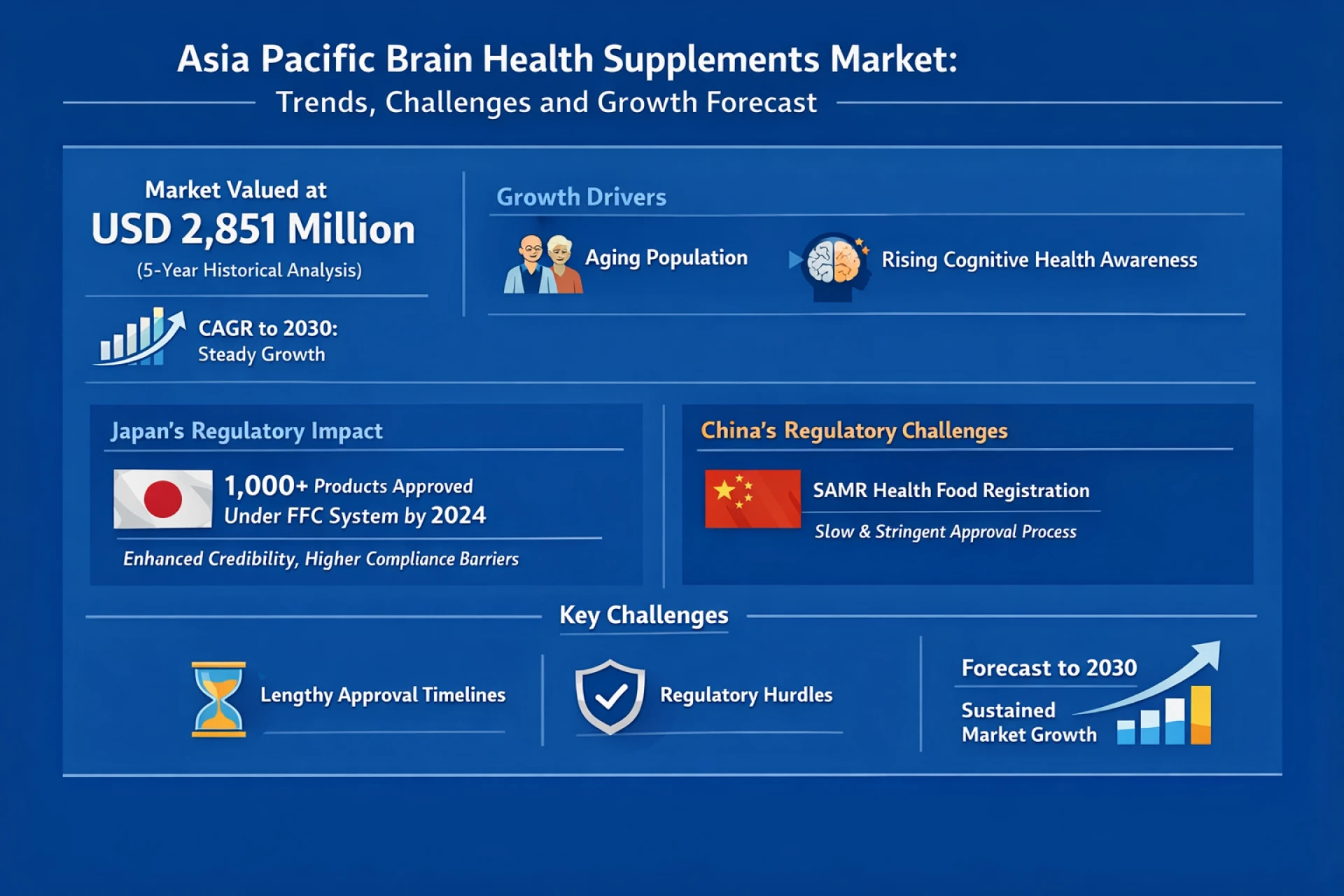
The Asia Pacific brain health supplements market, valued at USD 2,851 million based on a five-year historical analysis and growing at a steady CAGR through 2030, is navigating real structural constraints alongside compelling growth signals. Japan's FFC system approving over 1,000 products by 2024 creates regulatory credibility but also raises compliance barriers. China's SAMR health food registration requirements add approval timelines that slow product launches across the most important single market.
Asia Pacific Brain Health Supplements Sector Challenges Limiting Market Speed
Three categories carry the highest commercial weight within the Asia Pacific Brain Health Supplements Sector Challenges limiting market speed.
- Regulatory fragmentation across APAC: Japan's FFC system, China's SAMR registration, India's FSSAI framework, and Australia's TGA each operate distinct approval requirements, making multi-market supplement launches significantly more complex and expensive.
- Scientific substantiation requirements: as regulatory frameworks tighten, efficacy claims must be supported by clinical evidence that smaller operators cannot fund independently, creating a compliance barrier that favors multinational brands.
- Consumer trust and misinformation: the proliferation of unsubstantiated claims in online marketplaces erodes consumer trust and increases sales cycle length even for operators with legitimate clinical evidence.
"Regulatory fragmentation, clinical evidence barriers, misinformation. Each constraint affects a different operator type differently." Ken Research Analysis maps the full challenge landscape with country-level detail across each regulatory framework.
Asia Pacific Brain Health Supplements Industry Trends Reshaping Cognitive Health Demand
Nootropic supplement mainstreaming, clinical evidence demand, and personalized nutrition convergence are the three structural shifts defining the Asia Pacific Brain Health Supplements Industry Trends trajectory.
- Nootropic supplement mainstreaming: brain health supplements are moving from niche wellness markets into mainstream retail and e-commerce channels as consumer awareness grows among both aging populations and younger professional demographics.
- Clinical evidence and transparency demand: consumers are increasingly requiring documented clinical evidence for efficacy claims, shifting competitive advantage toward brands with published research and regulatory-approved health claims.
- Personalized nutrition convergence: DNA-based and microbiome-linked cognitive supplement recommendations are emerging as a premium positioning tier commanding higher price points and creating stronger consumer loyalty through individualized product design.
Q: Which brain health supplement trend is generating the fastest commercial growth?
Nootropic mainstreaming is generating the fastest commercial growth because it expands the addressable market from specialized wellness consumers to mainstream e-commerce buyers. As products like Omega-3, Bacopa, and Alpha-GPC enter general health and beauty retail channels online, the consumer acquisition funnel broadens significantly. The shift is most pronounced in China and India.
What Sustains Asia Pacific Brain Health Supplements Industry Growth?
Aging demographics in Japan and South Korea, rising disposable income in China and India, and Japan's FFC regulatory credibility framework are the three forces sustaining the Asia Pacific Brain Health Supplements Industry Growth through 2030. Each operates independently, stabilizing the growth rate across economic cycles.
Asia Pacific Brain Health Supplements Forecast: Premium vs Mass Market Bifurcation
The market forecast shows a clear bifurcation by consumer segment and geography.
- Premium clinical evidence segment: growing fastest in Japan and South Korea, driven by aging populations seeking clinically substantiated products through healthcare professional recommendations.
- Mass-market accessible segment: growing fastest in China and India, driven by younger consumers discovering cognitive supplements through social media and e-commerce at price points that fit broader consumer budgets.
Q: What does the Asia pacific brain health supplements industry forecast indicate through 2030?
Japan and South Korea's aging demographics sustaining memory and anti-aging supplement demand, China's rising middle class expanding accessible market depth, and e-commerce infrastructure deepening product accessibility are the three compounding variables anchoring the Asia Pacific Brain Health Supplements Industry Forecast through 2030. Natural molecules will maintain product share leadership. The fastest growth will come from the young professional performance supplement segment.
"Premium vs mass market, aging vs young professionals, Japan vs China. The forecast bifurcates cleanly." Ken Research Insights maps both trajectories with full country and segment granularity for operators planning product and market strategies now.
Conclusion
The Asia Pacific brain health supplements industry's growth is driven by aging demographics, e-commerce expansion, and regulatory credibility frameworks. Regulatory fragmentation and misinformation are the primary constraints on adoption speed. The forecast through 2030 shows bifurcation between premium clinical markets in Japan and South Korea and mass-market growth in China and India.