
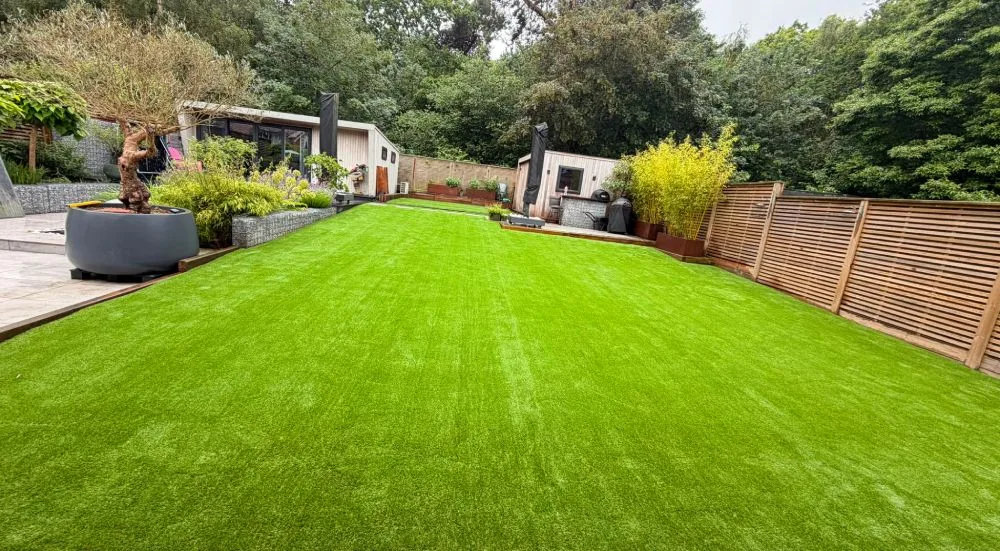
Merton is a borough defined by contrasts — the well-heeled streets around Wimbledon Village and the All England Club sit alongside the denser, more workaday residential areas of Mitcham and Morden. Gardens across SW19, SW20, and CR4 reflect this range, from the generous rear plots of Wimbledon's Victorian villas to the compact terrace gardens of Mitcham. What unites them is London Clay underfoot, intensive family use, and natural grass that consistently falls short of what homeowners want from their outdoor space. Artificial grass addresses all of it.
Ground Conditions Across Merton
London Clay and gravel outwash: Merton's geology is dominated by London Clay, with patches of river terrace gravel in the lower-lying ground near the River Wandle. The Wandle valley runs through the heart of the borough from Mitcham to Wimbledon, and gardens in the flood-risk zones near the river can have higher ground moisture than their soil type alone would suggest. For any garden within a few streets of the Wandle, drainage specification during the survey deserves specific attention.
Wimbledon's hillside character: The Wimbledon ridge creates a significant topographic feature in SW19. Gardens on or near the hillside — particularly in the Village and the streets south of the common — can have slopes that require additional groundwork to create a level installation surface. Drainage on sloped plots is also more complex and should be addressed during the survey rather than assumed to be self-managing.
Varied garden sizes across the borough: The contrast between Wimbledon and Mitcham extends to garden sizes. Victorian and Edwardian semis and detached properties in SW19 and SW20 can have gardens of 50–100m², while the denser terracing of CR4 typically yields compact plots of 20–35m². The right product specification and the economics of the installation differ substantially across these contexts.
Merton by Area
Wimbledon and South Wimbledon (SW19): The most prestigious part of the borough. Wimbledon Village and the streets around the All England Club have some of the most valuable residential gardens in South West London, and the expectation of finish quality is correspondingly high. Premium artificial grass with a convincingly natural appearance is the standard here. Further south and east in SW19, the residential character becomes more mixed, with Victorian terracing and inter-war housing presenting a mid-range market.
Raynes Park and West Wimbledon (SW20): A predominantly inter-war and Edwardian residential area with gardens typically ranging from 35–65m² for semi-detached properties. SW20 is an active mid-range market — family households with children and dogs who want a durable, low-maintenance surface that looks good. Naturalistic colouring is valued here, though less so than in the Wimbledon Village context.
Mitcham and Morden (CR4, SM4): The denser, more affordable southern parts of the borough. Gardens in Mitcham's Victorian and inter-war terrace streets are typically 18–30m² — compact, heavily used, and sitting on clay soil with the Wandle influence in the lower-lying areas. Mid-range and budget installations are most common here, with durability and drainage the primary selection criteria.
Installation in Merton: Key Considerations
Sub-base on clay: 75–100mm of compacted MOT Type 1 aggregate is appropriate throughout the borough. For gardens near the Wandle in Mitcham and south Wimbledon, 100mm with drainage assessment is the right specification. Sub-base depth must be confirmed during the on-site survey and stated explicitly in the written quote.
Sloped gardens in SW19: The Wimbledon hillside creates sloped gardens in a meaningful proportion of SW19 properties. Any visible gradient should be raised during the survey. Creating a level sub-base on a slope requires additional groundwork — terracing or a graduated base — and drainage channels at the lower boundary may be needed.
Access: Wimbledon and Raynes Park semi-detached properties frequently have side access, making installation logistics more straightforward than in the all-terrace streets of Mitcham. Confirm access arrangements before the survey and ask whether an access surcharge applies for your specific property type.
Premium finish expectations in SW19: In the Wimbledon Village context especially, the quality of the finished installation is scrutinised more closely than in most London markets. Edging, seam work, and the natural appearance of the selected product all matter more here. Ask for portfolio examples of completed Wimbledon installations before committing.
Product Guide for Merton
- SW19 premium — pile height 37–42mm, multi-tone naturalistic colouring, premium quality. Appearance matters above all else in the Wimbledon Village and hillside streets.
- SW20 mid-range — pile height 33–38mm, mid-range quality with dtex 11,000+, naturalistic multi-tone. Durable and good-looking for daily family use.
- CR4 compact gardens — pile height 28–33mm, mid-range quality, high drainage backing. Practical, durable, and neat in enclosed terrace spaces.
- High drainage backing across all specifications — 30+ litres per m² per minute on London Clay and near the Wandle.
Cost Guide for Merton
- Budget grade, installed: £40–£60 per m²
- Mid-range, installed: £60–£90 per m²
- Premium, installed: £90–£130+ per m²
A typical CR4 terrace garden of 20–30m² at mid-range comes out at approximately £1,300–£2,800 fully installed. A SW20 semi of 40–55m² at mid-range is £2,600–£5,000. A premium Wimbledon installation of 60–80m² is a more significant investment, proportional to the property context.
Choosing the Right Installer
Merton's range — from premium Wimbledon installations to practical Mitcham terrace projects — means the right installer needs both technical competence and an understanding of what different parts of the borough require. An experienced artificial grass company serving Merton working regularly across SW19, SW20, and CR4 will approach each context appropriately: specifying sub-base correctly for the specific soil and slope, assessing drainage near the Wandle, and delivering a finish quality matched to the homeowner's expectations.
Final Thoughts
Merton's diversity — from Wimbledon's premium gardens to Mitcham's practical terrace plots — makes it one of the most varied artificial grass markets in South West London. The common thread is London Clay, intensive use, and natural grass that cannot keep up. A well-specified artificial lawn resolves that permanently in every part of the borough, delivering a surface that performs reliably for fifteen years regardless of whether the garden is 25m² in Mitcham or 80m² in Wimbledon Village.