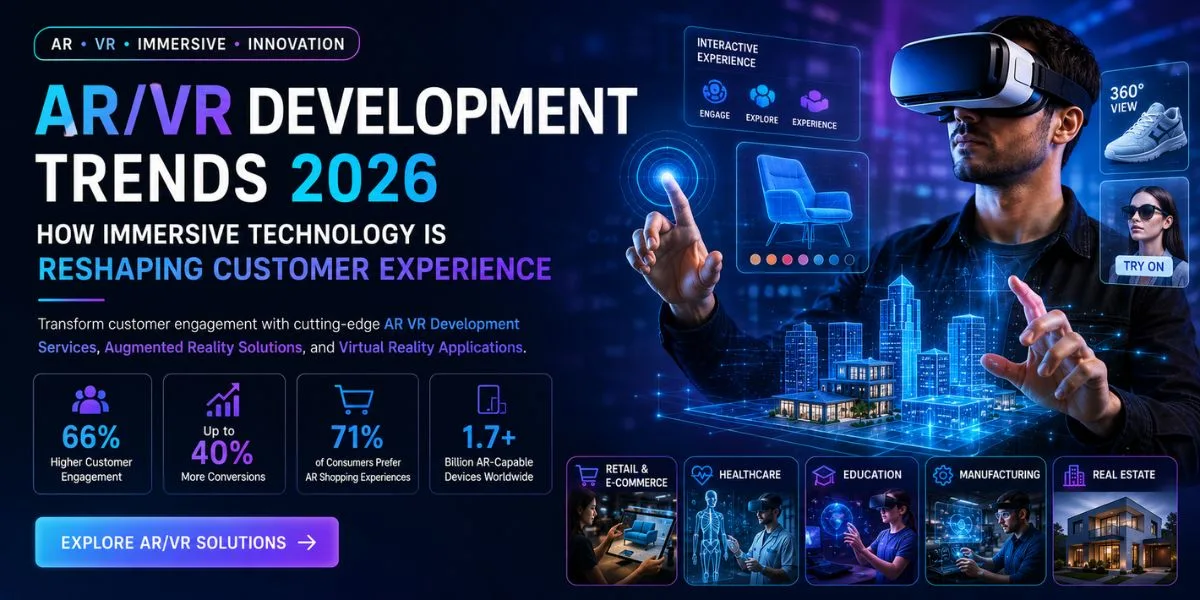
Businesses are under constant pressure to deliver better customer experiences, train employees faster, visualize products more effectively, and operate with greater efficiency. Traditional digital tools can solve many problems, but some business challenges require a more immersive approach.
That is where AR VR software solutions are becoming increasingly relevant.
Augmented Reality (AR) overlays digital information onto the physical environment, while Virtual Reality (VR) creates a fully immersive digital environment. Together, these technologies can help businesses rethink training, product visualization, customer engagement, collaboration, and operational workflows.
According to Mordor Intelligence, the global enterprise augmented reality market is estimated at $146.05 billion in 2026 and projected to reach $528.79 billion by 2031, representing a 29.35% CAGR.
Why Businesses Are Investing in AR and VR
The business case for immersive technology is moving beyond experimentation. Companies are increasingly looking for technology that can improve practical business processes rather than simply create impressive demonstrations.
Modern AR VR software solutions can connect immersive experiences with existing business systems, applications, product information, training platforms, and operational workflows.
Industry statistic: Remote assistance and collaboration represented 27.15% of the enterprise AR market in 2025, according to Mordor Intelligence.
This indicates how immersive technology can extend beyond entertainment into real workplace applications.
For example, a field technician could use AR instructions while working on equipment, while a distributed team could use VR environments for training, demonstrations, or collaborative product reviews.
1. Immersive Employee Training
Training is one of the most practical applications of VR.
Instead of learning only through presentations, manuals, or videos, employees can enter simulated environments and practice specific scenarios. This can be particularly useful for manufacturing, healthcare, logistics, construction, aviation, and other industries where hands-on experience matters.
Industry statistic: Training and simulation accounted for 33.5% of the enterprise metaverse market's application share in 2025, according to Grand View Research.
VR solutions can also make geographically distributed training easier to standardize because employees can access the same simulated environment regardless of location.
2. Better Product Visualization
Customers often struggle to understand how a product will look, fit, or function before purchasing it.
AR can address this problem by allowing users to visualize digital products or objects within their physical surroundings. Retailers, furniture companies, automotive businesses, real-estate organizations, and manufacturers can use this approach to create more interactive customer journeys.
Industry statistic: Software represented 47.3% of enterprise metaverse market revenue in 2025, highlighting the growing importance of software platforms within immersive technology ecosystems.
This is why businesses should think beyond hardware when evaluating immersive technology. The software experience, integrations, usability, and business workflow are equally important.
3. Remote Assistance and Collaboration
Traditional video calls provide communication, but AR can provide contextual information directly within a user's physical environment.
For example, an expert located in another city can guide a technician through equipment maintenance using digital annotations, visual instructions, or spatial information.
Companies exploring AR VR software solutions should therefore consider how immersive technology can connect employees, customers, and technical experts.
Industry statistic: Remote assistance and collaboration was the largest individual enterprise AR application category in Mordor Intelligence's 2025 analysis, with a 27.15% share.
4. Stronger Business Technology Solutions
AR and VR should not operate as isolated technology experiments. Their greatest potential comes when they become part of broader business technology solutions.
A successful implementation may connect immersive interfaces with:
- Customer relationship management systems
- Product databases
- IoT devices
- Analytics platforms
- Cloud infrastructure
- Training management systems
- Enterprise applications
This approach can turn immersive technology into a practical business tool rather than a standalone demonstration.
The World Economic Forum's technology research also highlights the convergence of spatial intelligence, immersive technologies, sensors, haptics, and AI-driven software platforms.
5. Preparing for the Next Stage of Digital Transformation
The AR/VR market continues to expand as businesses explore more sophisticated applications.
Fortune Business Insights estimates that the global augmented and virtual reality market could grow from $40.76 billion in 2026 to $441.51 billion by 2034, representing a projected CAGR of 34.69%.
However, adopting immersive technology should begin with a business problem rather than technology itself.
Companies should first identify where AR or VR could improve measurable outcomes such as training effectiveness, customer engagement, product understanding, operational efficiency, or collaboration.
From there, organizations can select the appropriate hardware, software architecture, user experience, integrations, and deployment model.
What Should Businesses Look for in an AR/VR Partner?
Choosing a technology partner involves more than finding developers who understand AR or VR.
Businesses should evaluate whether the provider understands software architecture, user experience, cloud integration, device compatibility, security, scalability, and the organization's actual business objectives.
A capable development partner can help transform an initial concept into a practical immersive application.
For companies exploring AR VR software solutions, Web Prism Dynamics provides AR/VR development capabilities designed around business use cases and digital experiences. Businesses can explore its AR/VR services to understand the types of solutions available.
The Future of Immersive Business Technology
AR and VR are increasingly becoming part of the broader digital transformation landscape. Their value is not simply in creating visually impressive experiences but in helping businesses solve specific problems differently.
From immersive training and product visualization to remote collaboration and connected workflows, VR solutions can create new ways for employees and customers to interact with digital information.
The companies that approach immersive technology strategically can focus on measurable business outcomes while building experiences that are scalable, useful, and aligned with long-term digital transformation goals.
As immersive computing continues to evolve alongside AI, IoT, cloud platforms, and spatial intelligence, AR and VR are likely to become increasingly connected with the everyday technology systems businesses already use.
Conclusion
AR VR technology are moving from experimental concepts toward practical business applications. Organizations can use them to improve training, visualization, collaboration, customer engagement, and oaarational workflows.
The key is to treat AR and VR not as isolated technologies, but as part of a broader technology strategy focused on solving real business challenges.