Most event AR fails in the first ten minutes. Not because the tech is bad, but because it sits behind a queue of eleven people waiting to borrow one headset.
If you're hiring an AR VR development company, that's the question to ask before anything else: how many guests can actually try this, and how fast?
Start with the phone in their pocket
Augmented reality is the generous half of the pair. Most attendees can experience it on their own smartphone or tablet, either through a small app or straight from a web browser using WebAR. No headset, no instructions, no staff member hovering with a cleaning cloth.
That's why AR travels so well across event types. An AR invite lands before the event even starts. Venue wayfinding helps first-timers find the right hall. A virtual try-on lets a visitor test a product at your stand without anything physical to unpack. Each one is small, useful and easy to explain in a sentence, which is the whole trick.
VR deserves its place too, just a more deliberate one. A headset gives one person a full, private world. Use it for a showpiece moment, a product walkthrough or a game, and plan the line like you would for a ride.
The photo booth that does the talking
If you want one AR product that works for almost any crowd, look at an augmented reality photo booth. Guests step up and the screen drops in a 3D superhero, a film star, a cartoon they grew up with or a beach they've been daydreaming about. Hand gestures move the props around. Two people in the same spot get two different photos.
The practical upside is bigger than it sounds. A brand can let attendees pose with its leaders or ambassadors, people who'd never otherwise be standing at a stall at 6 pm on a Saturday. Travel and hospitality companies use backdrops to give visitors a taste of a destination. Overlays carry your logo and the event theme, and guests collect a print or an emailed copy, so the souvenir does your advertising for months.
There's an AR filter option as well, built for Instagram, Facebook and Snapchat, for the guests who'd rather post than print. Use the same character in both places and the campaign feels like one idea instead of two.
Ask these before you sign
Does it run on guests' own devices? Can the content carry our branding? Who runs it on the day? And what happens when the venue Wi-Fi is awful? A good partner has an answer to the last one already.
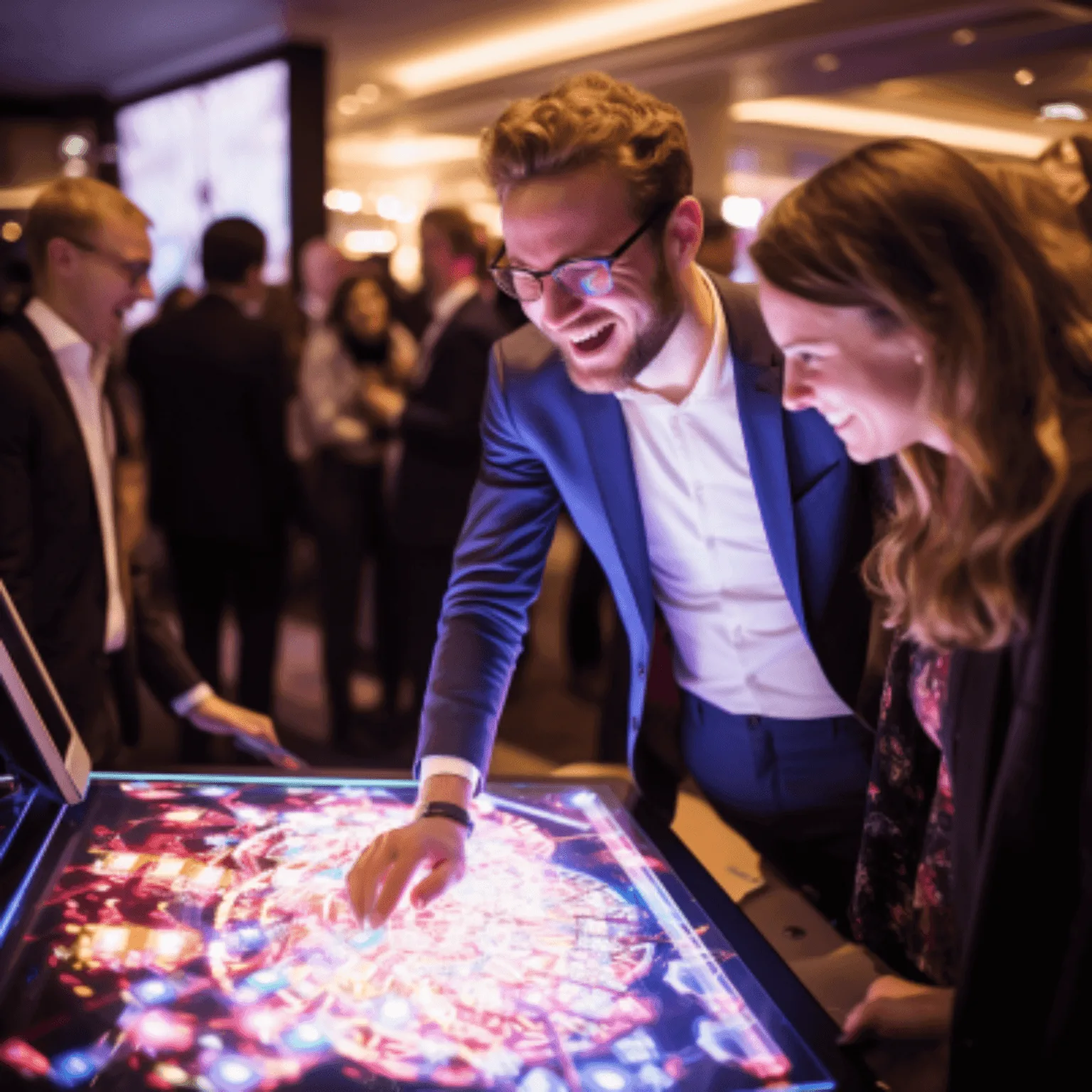
You can also push AR onto bigger screens. Our interactive display setups mix AR with touch, so a crowd can watch while one person plays.
Tell us what you want people to feel at the end. We'll work backward from there.