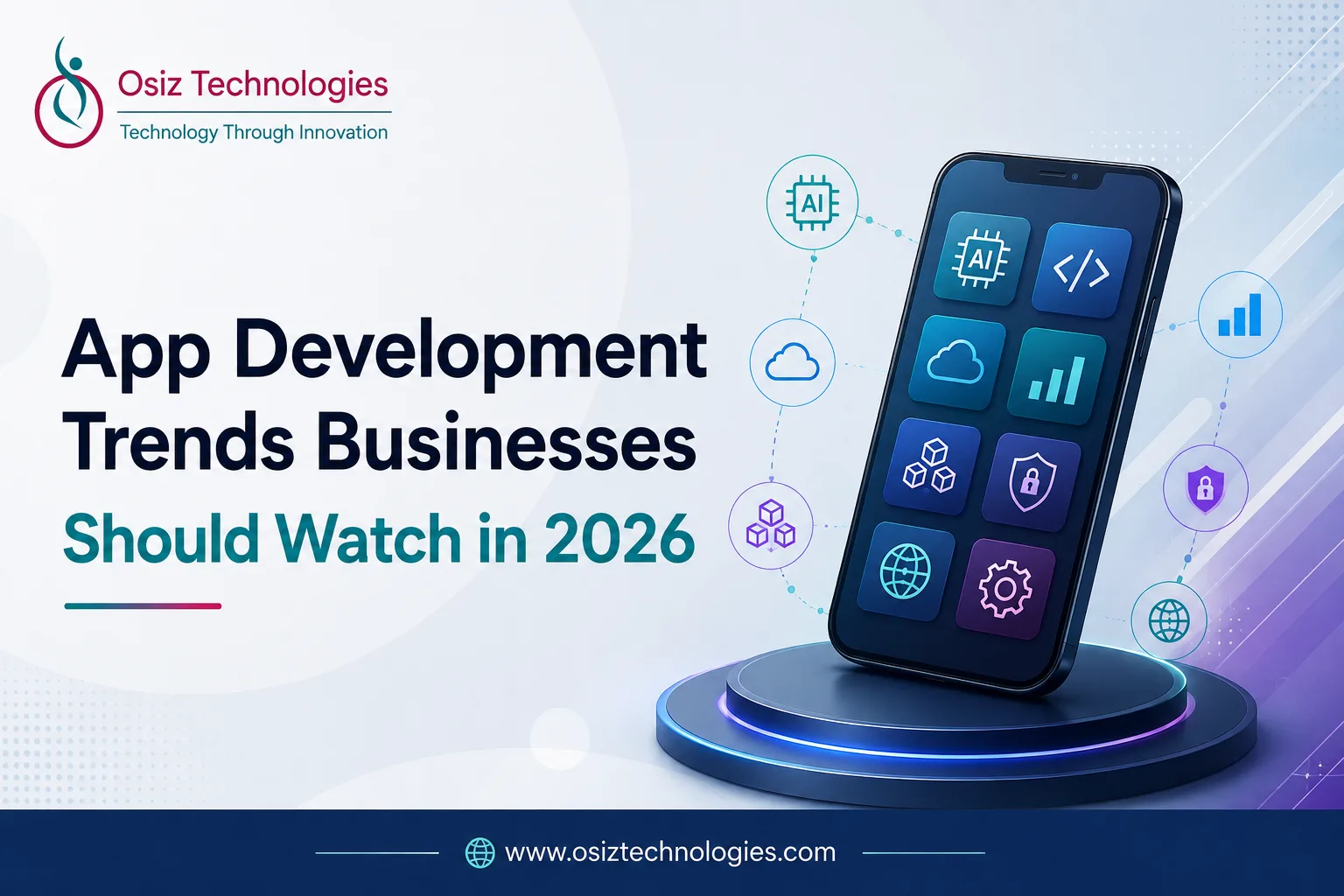
The app development landscape is evolving rapidly as businesses seek smarter, faster, more scalable, and personalized digital solutions. Applications are no longer limited to basic business functions. Today, businesses expect applications to automate processes, understand user behavior, connect with multiple systems, and deliver secure digital experiences.
From Artificial Intelligence and cross-platform development to cloud-native architecture, API-first development, edge computing, and immersive technologies, several innovations are shaping the future of app development in 2026.
So, what are the 8 latest app development trends businesses should watch?
1. AI-Powered App Development
Artificial Intelligence is becoming a major part of modern app development, helping businesses create smarter, more personalized, and efficient digital experiences. From intelligent recommendations and conversational assistants to predictive analytics, semantic search, content generation, and workflow automation, AI enables applications to understand user needs and perform tasks more intelligently.
Generative AI is further transforming the way users interact with applications by enabling natural-language communication, contextual responses, and intelligent assistance. As a result, an app development company can go beyond traditional chatbot integration by embedding AI into an application's core functionality to improve automation, personalization, decision-making, and overall user experience.
2. Cross-Platform App Development
Businesses increasingly want applications that can reach users across multiple platforms while maintaining consistent experiences. Technologies such as Flutter, React Native, and Kotlin Multiplatform allow developers to reuse significant portions of their codebase.
This approach can accelerate development, simplify maintenance, and help businesses launch applications more efficiently across different devices and platforms.
3. Cloud-Native App Development
Cloud-native architecture is becoming increasingly important as applications need to support growing users, workloads, and data. Technologies such as containers, microservices, serverless computing, and managed databases can help applications scale according to demand.
Cloud-native app development is particularly valuable for enterprise applications, SaaS platforms, and digital products that require flexible infrastructure and long-term scalability.
4. API-First and Connected Applications
Modern applications rarely operate independently. They often connect with payment gateways, CRM systems, ERP platforms, databases, analytics tools, and third-party services.
API-first development enables applications to communicate with these systems through reusable and scalable services. This approach can simplify integrations and make applications easier to expand as business requirements change.
5. Edge Computing and Real-Time Experiences
Users expect applications to respond quickly and provide seamless experiences. Edge computing enables certain data-processing tasks to take place closer to users or connected devices, helping reduce latency.
This can benefit real-time tracking, IoT applications, gaming, monitoring, collaboration platforms, and other applications where fast responses are important.
6. AR, VR, and Extended Reality
Immersive technologies are expanding the possibilities of app development beyond traditional interfaces. AR, VR, and XR can support product visualization, education, training, retail, real estate, manufacturing, and interactive experiences.
These technologies provide businesses with new ways to engage users and create differentiated digital experiences.
7. Low-Code and No-Code Development
Low-code and no-code platforms are gaining attention because they can help businesses create prototypes, dashboards, internal applications, and workflow automation solutions faster.
However, complex applications may still require professional development for advanced customization, integrations, security, scalability, and performance. Therefore, these platforms complement rather than completely replace custom app development.
8. Security-First App Development
Security is becoming a fundamental part of modern app development. Businesses are focusing on secure authentication, encryption, multi-factor authentication, protected APIs, vulnerability testing, and privacy-focused architecture.
Security should be considered throughout the development lifecycle, especially for applications handling financial, personal, or enterprise data.
Final Thoughts: The Future of App Development
The latest app development trends show a clear shift toward applications that are intelligent, connected, scalable, secure, and adaptable. AI is making applications smarter, cloud technologies are improving scalability, APIs are enabling seamless connectivity, and immersive technologies are creating new possibilities for user experiences.
However, businesses should not adopt every technology simply because it is trending. The right technology should be selected according to the application's purpose, target audience, business requirements, security needs, scalability expectations, and long-term goals.
A reliable app development company can help businesses turn these emerging technologies into practical digital solutions. Osiz Technologies provides a wide range of app development services, including mobile app development, custom app development, AI-powered app development, cloud app development, desktop app development, web app development, AR/VR app development, and enterprise application development.
By combining these services with modern technologies, scalable architecture, security, and user-focused development practices, Osiz helps businesses transform their ideas into innovative digital applications that are designed to support current requirements and future growth.