
Fiber broadband is expanding rapidly throughout Europe. In the UK and Germany especially, governments and telecom operators are racing to deliver faster, more reliable connectivity to homes and businesses.
While customers may only see the end result, the process of building a fibre network is far more challenging.
Behind every live connection is months of planning, engineering, and fieldwork carried out by teams working both on the ground and behind the scenes. This process is managed efficiently and at scale by companies like NETS International.
What really happens behind a fibre broadband deployment?
Careful network planning
Before a single cable is installed, telecom operators must first plan how the network will be designed.
This phase involves detailed surveys to figure out how to route fibre around existing infrastructure, roads, and buildings. We design scalable and efficient networks based on population density, existing utilities, and future needs.
In network planning, ducts and cables will be mapped out, permits will be obtained, and regulations will be complied with. NETS International supports operators with surveying, planning, and engineering expertise during this early phase.
Building the Physical Infrastructure
Upon finalisation of the network design, construction teams begin building the physical infrastructure.
It usually involves trenching, installing ducts, and sometimes utilising poles or underground pathways. Urban environments require careful coordination with local authorities to minimise disruption.
It’s often one of the most challenging phases of a fibre rollout. Unexpected obstacles, such as utility lines, weather conditions, or access restrictions, can stall progress.
The NETS International team has decades of telecom deployment experience and supports operators with civil works, duct installation, and project coordination.
Installing and Connecting the Fibre
After the infrastructure has been established, fibre optic cables will finally be able to be installed.
Depending on the network design, cables may be pulled through underground ducts or blown through micro-ducts using compressed air. For these cables to function as a continuous network, multiple fibres must be carefully connected together.
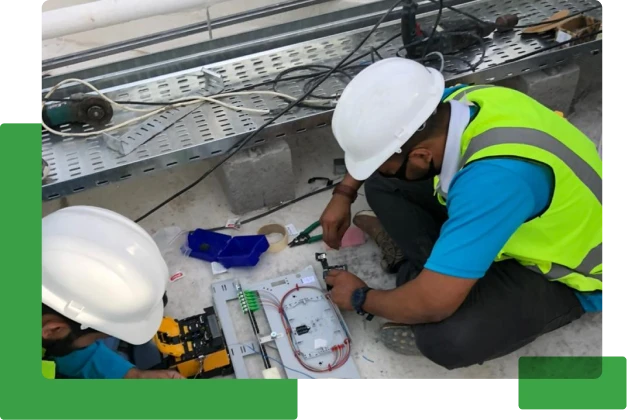
This is where fibre splicing comes in. Engineers use specialised equipment to fuse fibre strands together with extreme precision. This work requires highly skilled technicians since even the slightest misalignment can result in signal loss.
Our teams regularly perform fibre installation and splicing as part of large-scale deployment projects, ensuring that networks are built to the highest standards possible.
Putting the network to the test
It is imperative that the network undergoes rigorous testing before customers can be connected to it.
The engineers conduct optical signal tests in order to confirm that the data can travel through the fibre without being interfered with or degraded in any way. In addition to checking the physical infrastructure and network equipment, they also make sure that everything meets the performance standards.
After these checks are completed, the network is officially considered ready for operation as soon as it passes them.
It is essential for quality assurance to be carried out at this stage. A proactive approach to detecting and fixing issues early can help prevent service disruptions in the future.
Connecting Homes and Businesses
Installing at the property is the last stage of the process.
A fibre network terminal (ONT) converts the fibre signal into usable internet connectivity from the street network.
Connected routers are configured and tested to confirm customer speeds.
Managing thousands of installations each month can be challenging for telecom providers. It's here that deployment partners come in handy.
Supporting Fibre Rollouts in the UK
The UK is currently undergoing one of the largest fibre infrastructure expansions in Europe. Alternative network providers are building Fibre-to-the-Premises (FTTP) networks across cities and rural areas.
To keep up with this demand, operators rely on trusted engineering partners to help deliver network builds and customer installations at scale.
NETS International supports broadband providers through its UK operations.
You can learn more about their work here:
https://nets-international.com/uk/
With skilled engineering teams and project support, operators can accelerate fibre rollouts.
Driving the expansion of fibre optic networks in Germany
As part of its national digital transformation strategy, Germany is also investing heavily in next-generation broadband infrastructure.
Fiber network deployment in a region is a coordinated activity between telecom providers, local authorities, and engineering teams.
NETS International supports fibre-to-the-home projects in Germany by assisting in the deployment and management of fibber networks.
The company’s involvement in the region is in assisting infrastructure developers in stabilizing rollout operations for efficient delivery.
You can learn more about their German operations here:
https://nets-international.com/germany/
Future-proofing digital infrastructure
The digital economies of the future will need fibre broadband infrastructure. Internet connectivity is vital in a digital economy.
Every fibre connection requires a team of engineers, planners, and deployment specialists.
NETS International helps telecommunications companies expand broadband infrastructure across Europe.
Thousands of skilled professionals are working behind the scenes to build infrastructure for the digital age – or at least provide faster internet speeds