Artificial intelligence is the spark of modern life, powering everything from smart assistants to autonomous cars and real-time language translation. However, the data center—an underappreciated yet crucial component of infrastructure—is at the core of this AI phenomenon. These locations don't look anything like the server farms of the past in 2025. They have instead evolved into very advanced, high-tech "AI factories" that are specifically made to power intelligent apps and enormous models in real time.
In 2025, how will next-generation data centers look? How have they evolved, and why are they the key to the next wave of innovation?
Take a step inside and learn.
What Characterizes a Next-Generation AI Data Center in 2025?
The term data center no longer just represents a warehouse filled with servers. Rather, it now means high-density, AI-optimized processing environments. Such centers are designed to manage comput-intensive tasks, particularly the loads of large language models, computer vision, and other machine learning workloads.
Key features of an AI data center in 2025 are:
- GPU and TPU clusters for parallel processing
- Custom silicon chips for AI model training and inference
- Liquid and immersion cooling systems
- Hyper-fast interconnects for low-latency communication
- Autonomous monitoring and optimization systems driven by AI itself
In contrast to storage-focused cloud centers of the past, AI factories today are engineered ground up for the greatest computational throughput, rather than simply data preservation.
How Do AI Data Centers Vary from Traditional Ones?
Though both store and handle data, the architectural ethos of AI-focused data centers has been transformed. Traditionally, data centers were tuned for:
- File storage and retrieval
- Web hosting and databases
- Virtualization and redundancy
AI-centric data centers in 2025 are, in contrast, configured for:
- High-speed data computation
- Mass model training and fine-tuning
- Real-time AI inference operations
These AI factories use a lot more power, cooling, and bandwidth. For instance, training a cutting-edge model could take tens of thousands of interconnected GPUs running weeks at a time. Such a workload would be untenable within conventional facilities.
What Technologies Drive These Data Centers?
The backbone of AI data centers in 2025 consists of a combination of leading-edge hardware and software, including:
- NVIDIA H100 and AMD MI300X chips, specifically optimized for deep learning
- Google TPUs (Tensor Processing Units) to speed up neural networks
- High-bandwidth memory (HBM) and NVLink interconnects
- AI-native storage systems, which can feed gigantic datasets at the speed of lightning
- AI-driven workload managers that handle resource allocation and thermal management automatically
Moreover, software-defined infrastructure maintains flexibility and optimization at all levels, ranging from power consumption to chip usage.
How Are Data Centers Becoming More Sustainable?
As much as they consume energy, one of the highest priorities in 2025 is sustainability. Luckily, contemporary data centers are adapting to be even greener.
Some of the most important innovations are:
- 100% renewable energy utilization through solar, wind, and hydro power
- Innovative liquid cooling that consumes up to 90% less energy than air cooling
- Modular construction that minimizes waste and carbon footprint
- Artificial intelligence-driven energy monitoring systems optimize load balancing
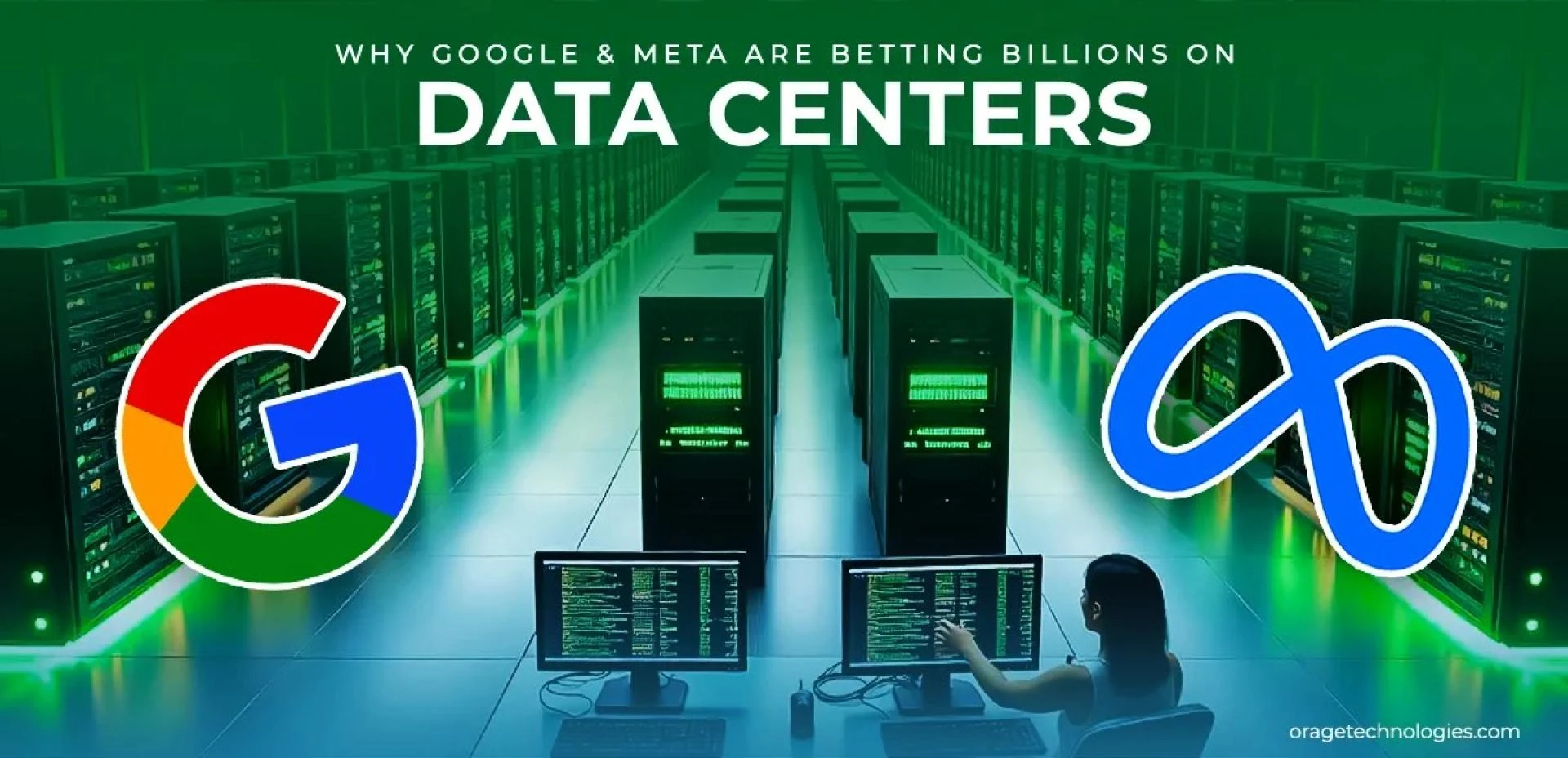
Tech behemoths Google and Meta are also pushing carbon-negative operations, not just cutting emissions, but also offsetting historical ones.
Where Are the World's Most Advanced AI Data Centers Located?
Strategic location is crucial in 2025. The world's most advanced data centers are being constructed in:
- Cool climates, including Scandinavia and the Pacific Northwest, to cut down cooling expenses
- Areas where low-cost renewable energy is available, such as Iceland or Quebec
- Tech clusters, including Northern Virginia, Singapore, and Frankfurt
These clusters tend to be near fiber optic backbones and low-latency network routes, thereby providing quick access to global users and services.
How Secure Are AI Data Centers in 2025?
As AI has increased, data centers have also become more important and exposed. Therefore, security is of the highest level in 2025.
The latest innovations are:
- Biometric and AI-driven surveillance tools
- Zero-trust architecture in physical and virtual worlds
- Real-time anomaly detection to detect intrusions before they develop
- Quantum-resistant encryption for high-security model training data
Security teams now collaborate with AI systems to detect, forecast, and prevent threats, sometimes even before they occur.
What Types of AI Models Do These Data Centers Accommodate?
Applications in these newer facilities are diverse. AI data centers in 2025 will accommodate everything from:
- Multilingual LLMs such as ChatGPT or Gemini
- Generative models for text, video, music, and code
- Medical diagnosis and drug discovery software
- Autonomous vehicle coordination systems
- Financial prediction and fraud detection algorithms
These models get continuously updated in real time, retrained on new data, and deployed across distributed networks—all from a central, AI-amp control room.
Who owns and runs these AI Factories?
It's not all about tech giants anymore. In 2025, a range of actors will play a part in owning and running next-gen data centers:
- Hyperscalers such as Google, Meta, Microsoft, and Amazon are heading development
- Chipmakers such as NVIDIA, AMD, and Intel provide AI-specific processors
- Specialized infrastructure companies construct modular, energy-efficient campuses
- Cloud AI companies rent compute power and provide "AI as a service" to businesses
The ecosystem has created a thriving AI infrastructure economy in which compute power is as valuable as data itself.
What Is the Future Outlook for AI Data Centers?
Looking ahead, we can expect several crucial trends to influence data center development:
- Edge AI processing will move mini data centers nearer to devices
- Self-optimizing power, cooling, and compute provisioning will become the norm in autonomous facilities
- Quantum accelerators could one day become collaborators, if not competitors, with GPUs to drive AI
- Global regulation will mandate ethical and environmental benchmarks
In short, these factories of AI will increase in size, wit, and conscience—extending the limits of what technology can do.
✅ Frequently Asked Questions (FAQ)
Q: Why is a contemporary AI data center different from a conventional one?
AI data centers are oriented toward compute power, rather than storage alone. They employ high-end chips and cooling systems to handle demanding AI workloads.
Q: Are AI data centers sustainable from an environmental perspective?
Some are designed with renewable power, efficient cooling, and modular design. Google and Meta are among the companies that strive for carbon-neutral or carbon-negative operations.
Q: Are smaller companies able to access these data centers?
Yes. Startups and SMBs can lease compute power from large vendors such as AWS, Azure, and Google Cloud through AI-as-a-service models.
Q: Where do most AI data centers exist?
They tend to be in cool climates, areas with cheap renewable power, and good network connectivity.
Q: Will AI automate the management of data centers?
In part, yes. AI is being used more and more to make the best use of resources, manage energy, and even forecast maintenance requirements.