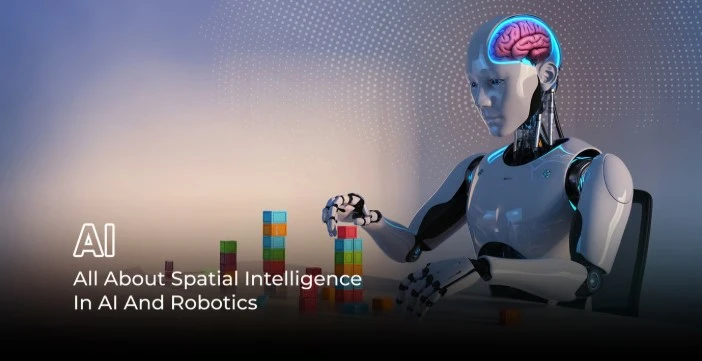
The 2004 sci-fi movie I, Robot imagined a 2035 Chicago where robots help humans with everyday and complex tasks, powered by advanced spatial intelligence. Today, this once-fictional concept is becoming reality through “Spatial AI.” Spatial intelligence allows AI-powered machines and robots to perceive, navigate, and interact with the physical world much like humans and animals do.
Spatial AI combines technologies like Simultaneous Localization and Mapping (SLAM), 3D mapping, computer vision, sensor fusion, and machine learning to help robots and autonomous systems understand their surroundings, recognize and track objects, and make real-time decisions. This technology powers a wide range of applications: autonomous vehicles navigate roads safely, robots assist in factories, warehouses, homes, and farms, and drones monitor the environment and support disaster response. Spatial AI also enhances healthcare through precise surgical robots and supports smart cities with better traffic management, safety, and planning.
Despite its promise, Spatial AI faces challenges like high computational demands, the need for real-time precision, privacy concerns from constant data collection, and integration hurdles with existing systems. Still, the future looks promising as advances in computing, sensors, and AI algorithms continue to push its boundaries. From immersive AR and VR to smarter healthcare and safer self-driving cars, Spatial AI is driving innovation and productivity. While we’re not at I, Robot levels yet, Spatial AI is steadily bringing us closer to intelligent, human-like machines that can navigate our world safely and effectively.