Market Overview and Growth Outlook
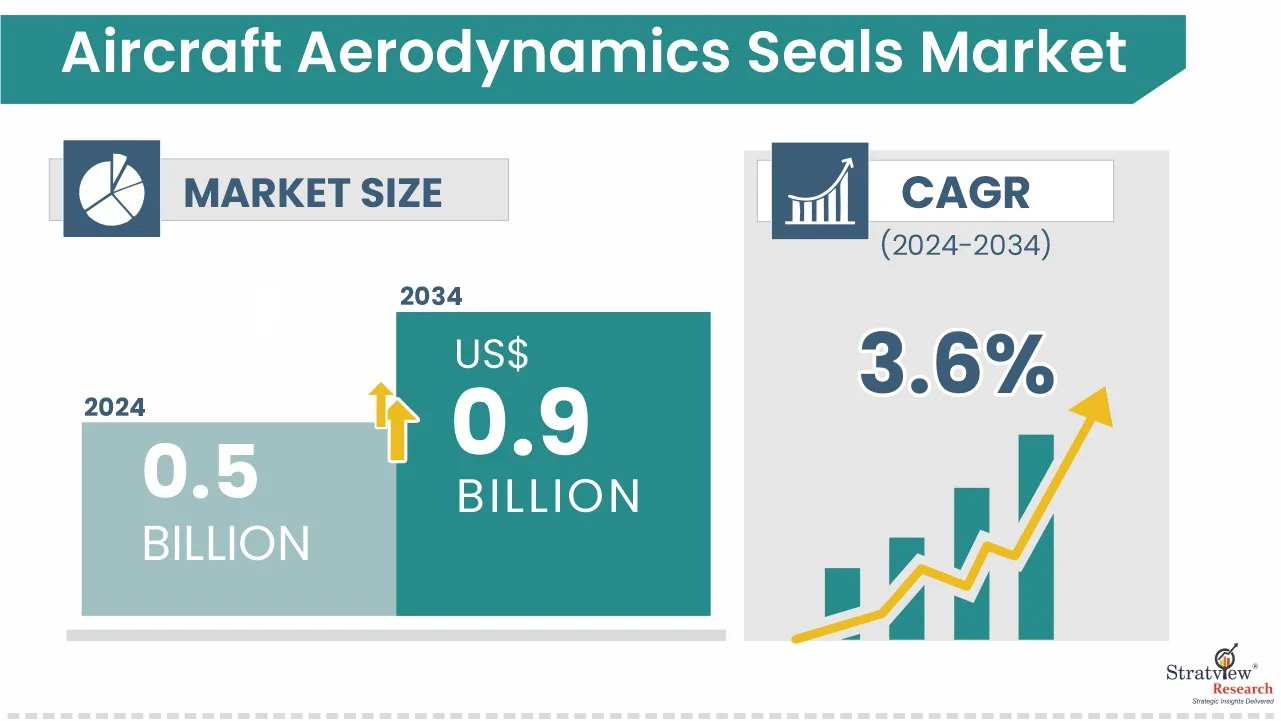
The Aircraft Aerodynamics Seals Market was valued at USD 0.5 billion in 2024 and is expected to reach USD 0.9 billion by 2034. The Aircraft Aerodynamics Seals Market is expected to grow at a CAGR of 3.6% during 2024-2034.
Aircraft aerodynamic seals help maintain stable airflow, structural performance, and efficiency across fixed aircraft components. Their ability to control leakage and withstand changing environmental conditions makes them essential to modern airframe design.
The direction of Aircraft Aerodynamics Seals Market growth is increasingly influenced by commercial-aircraft production, airframe sealing requirements, advanced elastomeric materials, static sealing applications, aftermarket activity, and aviation expansion across Asia-Pacific.
Material and design improvements are also raising seal durability and reliability while helping manufacturers reduce aircraft weight and maintenance requirements.
Request a free sample report:
https://www.stratviewresearch.com/Request-Sample/aircraft-aerodynamics-seals-market#form
Market Segmentation Analysis
By Aircraft Type, Commercial Aircraft, Regional Aircraft, Helicopters, Military Aircraft, and General Aviation constitute the market.
Commercial Aircraft are expected to maintain market leadership through 2034. Large OEM backlogs and continued aircraft production provide a strong demand base for seals installed in new platforms.
The commercial fleet also operates at high utilization rates, increasing exposure to temperature variation, pressure changes, vibration, and environmental conditions that place significant performance demands on seals.
By Application Type, the market includes Airframe, Landing Gear, Wheels & Brakes, and Other Applications.
Airframe is expected to remain dominant because aircraft fuselages, wings, nacelles, and empennage contain extensive sealing interfaces.
Seals in these structures help manage airflow, reduce drag, improve fuel efficiency, provide thermal insulation, support fire resistance, and limit vibration.
By Material Type, Elastomeric Seals, Thermoplastic Seals, and Metallic Seals form the market.
Elastomeric Seals are expected to remain the preferred material type because they offer flexibility, resilience, thermal resistance, low density, and reliable sealing performance.
Advanced fluorosilicone, EPDM, and fluorocarbon materials can withstand heat, ozone, fuels, hydraulic fluids, and changing atmospheric conditions.
By Motion Type, the market is segmented into Static Seals and Dynamic Seals. Static Seals are expected to retain market leadership through the forecast period.
Their dominance reflects extensive use between non-moving structural joints throughout aircraft airframes.
By End-User Type, the market includes OE and Aftermarket. OE remains the leading category because aerodynamic seals are required during initial aircraft assembly.
Large OEM production backlogs and long-term supplier agreements provide consistent demand visibility for seal manufacturers serving the original-equipment channel.
Regional Market Insights
North America is projected to remain the dominant regional market. It combines major commercial-aircraft manufacturing, military aviation programs, advanced sealing suppliers, and high investment in aerospace technology.
Boeing's substantial aircraft backlog supports long-term commercial demand, while US military modernization creates opportunities across fighter aircraft, cargo platforms, and unmanned systems.
Asia-Pacific is expected to be the fastest-growing region. Expansion in aviation activity and aerospace production provides an increasing addressable market for sealing technologies.
Europe remains a major aerospace market with established aircraft manufacturing and sealing-material capabilities.
Emerging Trends Shaping the Aircraft Aerodynamics Seals Market
Weight reduction is becoming increasingly central to aircraft design. Seal manufacturers are therefore developing lighter material solutions without sacrificing durability or sealing integrity.
Elastomer technology continues to improve as aircraft require greater resistance to temperature, pressure, fuel, hydraulic fluids, and environmental exposure.
Fire-resistant and high-temperature sealing materials are another important development area.
Improved leakage control is also gaining attention. New products increasingly target near-zero leakage, longer component life, and reduced maintenance.
Supplier consolidation continues as global aerospace companies expand sealing portfolios and aftermarket access through strategic acquisitions.
Key Growth Drivers of the Market
- Commercial aircraft production: Large delivery pipelines create sustained OE demand for aerodynamic seals.
- Fleet growth: Expanding global fleets increase both initial installation and replacement requirements.
- Lightweighting: Low-density sealing materials support aircraft fuel-efficiency and emissions objectives.
- Material advancements: New elastomeric formulations improve heat, fire, chemical, and environmental resistance.
- Aftermarket requirements: Growing aircraft utilization and maintenance activity create recurring seal-replacement demand.
Competitive Landscape
The Aircraft Aerodynamics Seals Market includes specialized companies with deep expertise in aerospace polymers, thermoplastics, metallic seals, engineering design, qualification, and manufacturing.
Market complexity and certification requirements limit the number of capable suppliers, increasing the value of long-standing relationships with aircraft OEMs and tier suppliers.
Strategic acquisitions have expanded global portfolios, particularly across aerospace sealing, proprietary components, and aftermarket channels.
Top Companies in the Market
- Hutchinson SA
- Trelleborg AB
- Parker Hannifin Corporation
- Freudenberg Group
- SKF Group
- Green Tweed & Co.
- EnPro Industries
- Saint-Gobain S.A.
Conclusion and Strategic Outlook
The Aircraft Aerodynamics Seals Market is projected to grow from USD 0.5 billion in 2024 to USD 0.9 billion by 2034 at a CAGR of 3.6%. Aircraft production, fleet expansion, lightweighting, maintenance activity, material technology, and stringent aerospace standards provide the principal foundations for market development.
Commercial Aircraft remain the leading aircraft type, Airframe dominates by application, Elastomeric Seals remain the preferred material, Static Seals lead by motion type, and OE retains end-user leadership. North America remains the largest region, while Asia-Pacific provides the fastest growth.
FAQs – Aircraft Aerodynamics Seals Market
1. What is the Aircraft Aerodynamics Seals Market forecast for 2034?
The Aircraft Aerodynamics Seals Market is projected to reach USD 0.9 billion by 2034 from USD 0.5 billion in 2024.
2. How fast is the Aircraft Aerodynamics Seals Market growing?
The Aircraft Aerodynamics Seals Market is expected to grow at a CAGR of 3.6% during 2024-2034.
3. What are the main Aircraft Aerodynamics Seals Market growth drivers?
Aircraft production, fleet expansion, lightweighting, advanced sealing materials, MRO activity, and stricter safety and environmental regulations are the main drivers.
4. Which region dominates the Aircraft Aerodynamics Seals Market?
North America is projected to remain the dominant region because of its established aerospace industry, commercial-aircraft production, defense programs, and advanced technology base. Asia-Pacific is expected to grow fastest.
5. What are the strongest opportunities in the Aircraft Aerodynamics Seals Market?
Elastomeric Seals, Airframe applications, Commercial Aircraft, OE supply, aftermarket replacement, lightweight materials, and Asia-Pacific represent the strongest source-supported opportunities through 2034.