

Orthodontic treatment has changed significantly in recent years, moving beyond traditional metal brackets and manual impressions. Artificial intelligence (AI) now plays a key role in how braces are designed, planned and fitted, delivering greater comfort, accuracy and predictability for patients. By analysing large amounts of data, AI helps predict tooth movement and personalise treatment plans with exceptional precision. Instead of relying only on visual assessments and experience-based estimates, orthodontists can now simulate outcomes before treatment begins. This technology-led approach allows for better planning, fewer adjustments and more reliable results, making orthodontic care more efficient and patient-focused than ever before.
What Is AI in Orthodontics?
Artificial intelligence refers to computer systems designed to analyse large amounts of data, identify patterns and make informed predictions. In orthodontics, AI processes digital scans, X-rays and photographs to assist with diagnosis and treatment planning. Traditional orthodontic planning relied heavily on physical impressions, visual assessments and professional judgement. While effective, these methods had limitations in precision and predictability. AI enhances this process by evaluating thousands of data points simultaneously, allowing orthodontists to simulate tooth movement, anticipate challenges and refine treatment plans. Rather than replacing professional expertise, AI acts as a powerful support tool, helping clinicians make better-informed decisions and deliver more personalised care.
How Braces Were Traditionally Designed
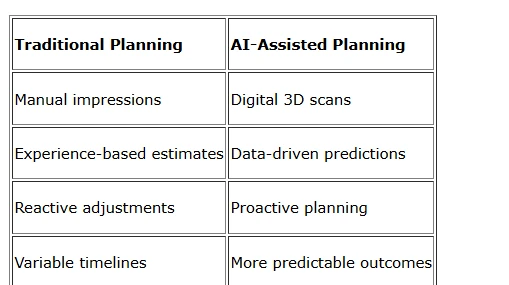
Before digital tools became widespread, braces were planned using physical moulds made from dental impressions. Orthodontists manually assessed tooth position, bite alignment and jaw relationships, then adjusted brackets and wires over time based on observed progress. While this approach achieved excellent results for many patients, it came with challenges:
- Impressions could be uncomfortable or inaccurate
- Treatment plans were less flexible
- Adjustments were often reactive rather than predictive
- Minor errors could extend treatment duration
These limitations paved the way for digital innovation and the integration of AI into orthodontic workflows.
How AI Is Changing Brace Design and Fitting
Digital Scanning and 3D Modelling
AI-powered intraoral scanners have replaced traditional impressions in many practices. These scanners capture highly detailed 3D images of the teeth and gums in minutes, eliminating discomfort and improving accuracy.AI then refines these scans, identifying tooth shapes, spacing and alignment issues with remarkable precision. The result is a digital model that forms the foundation of the entire treatment plan.
Predictive Treatment Planning
One of the most transformative aspects of AI is its ability to predict tooth movement. By analysing thousands of previous cases, AI software can simulate how teeth will move over time and forecast the final outcome.
This allows orthodontists to:
- Visualise treatment stages
- Identify potential complications early
- Optimise force levels for efficiency and comfort
Patients benefit from clearer expectations and more predictable timelines.
Customised Appliance Design
AI enables the creation of bespoke orthodontic appliances tailored to each patient’s anatomy. Brackets, wires and aligners can be designed with precise dimensions and positioning, improving comfort and effectiveness.During treatment, having access to an emergency dentist in Redditch can provide reassurance if unexpected discomfort or appliance issues arise, ensuring patient confidence remains high.
Benefits of AI-Designed Braces for Patients
AI-driven orthodontics offers several advantages that directly impact the patient experience.
Key benefits include:
- Greater accuracy in diagnosis and planning
- Improved comfort due to customised appliances
- Shorter treatment times in many cases
- Fewer emergency visits and adjustments
- More predictable results
With these improvements, orthodontic treatment becomes less disruptive and more aligned with modern lifestyles.

AI and Clear Aligner Technology
Clear aligners have benefited significantly from AI integration. Each aligner stage is planned digitally, with AI calculating the most efficient sequence of movements required to reach the desired outcome.
AI improves aligner treatment by:
- Reducing the need for refinements
- Improving tracking accuracy
- Enhancing fit and comfort
- Shortening overall treatment time
An orthodontist Redditch can use these tools to monitor progress closely and make data-backed adjustments when necessary, ensuring aligners perform as intended.
Remote Monitoring and AI-Driven Check-Ups
AI has also enabled remote monitoring, allowing orthodontists to assess progress without requiring frequent in-person visits. Patients can upload photographs through secure platforms, where AI analyses alignment changes and flags potential issues.
Benefits of AI-assisted monitoring include:
- Fewer clinic visits
- Early detection of problems
- Greater convenience for busy patients
- Improved compliance tracking
If urgent concerns are identified, patients can be advised to attend promptly, with support from an emergency dentist in Redditch available if immediate care is required.
How AI Supports Orthodontists
AI enhances, rather than replaces, professional expertise. Orthodontists remain responsible for diagnosis, decision-making and patient care, while AI provides additional insight and efficiency.
AI supports orthodontists by:
- Reducing administrative workload
- Improving treatment accuracy
- Allowing more time for patient interaction
- Supporting complex case analysis
An orthodontist Redditch can combine clinical judgement with AI insights to deliver highly personalised, high-quality care.
Is AI-Driven Orthodontics Safe and Reliable?
Safety and reliability are central to AI adoption in healthcare. AI systems used in orthodontics operate under strict clinical guidelines and regulatory standards. Importantly, AI recommendations are always reviewed by qualified professionals before implementation.Data security is also prioritised, with encrypted systems protecting patient information. Human oversight ensures that technology enhances care without compromising safety or ethical standards.

What the Future Holds for AI in Orthodontics
The future of AI in orthodontics is promising. Ongoing developments aim to further refine diagnostics, shorten treatment times and improve accessibility.
Potential advancements include:
- Smarter early detection of alignment issues
- Greater integration with facial and airway analysis
- More personalised treatment timelines
- Increased affordability through efficiency
As technology continues to evolve, patients can expect orthodontic care to become even more precise and patient-focused.
Conclusion
AI is transforming how braces are designed and fitted, bringing orthodontic care into a new era of precision, comfort and predictability. By combining advanced data analysis with professional expertise, AI-supported orthodontics delivers outcomes that are tailored, efficient and reliable. As innovation continues to shape dental care, patients can feel confident that modern orthodontic treatment offers both cutting-edge technology and human-centred care. Choosing advanced orthodontic solutions in Redditch ensures access to forward-thinking treatment designed for lasting results and improved patient experiences.