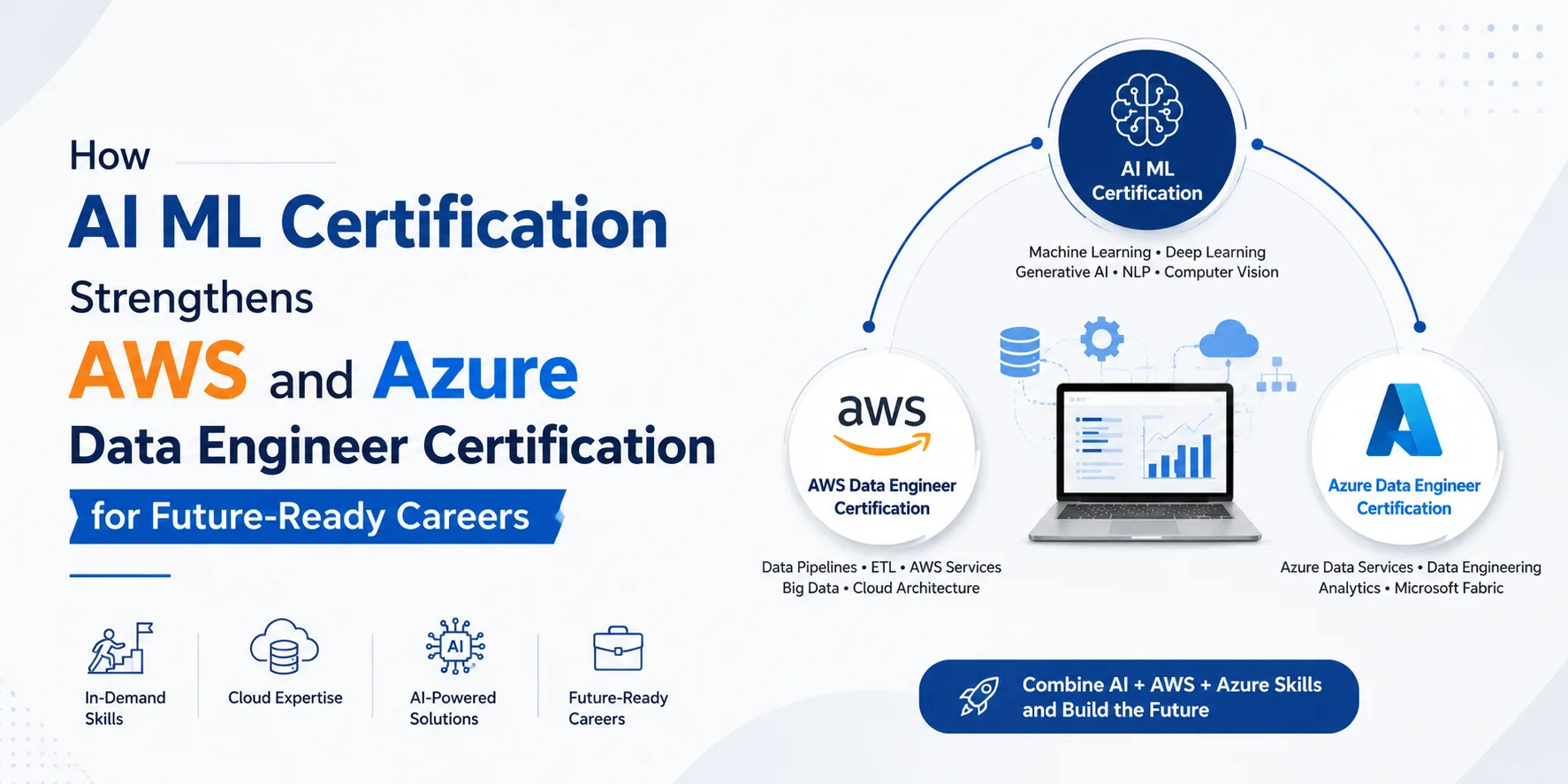
Artificial Intelligence (AI), Machine Learning (ML), and cloud computing are reshaping how businesses collect, process, and analyze data. As organizations increasingly rely on intelligent automation and cloud-native data platforms, professionals with expertise in both AI and data engineering have become some of the most sought-after technology specialists.
Today, earning an AI ML Certification, along with an AWS Data Engineer Certification and Azure Data Engineer Certification, provides a powerful combination of skills that prepares professionals for modern cloud and AI-driven careers. Instead of specializing in only one technology, organizations now prefer engineers who can build scalable data pipelines, manage cloud infrastructure, and support machine learning and Generative AI applications.
Whether you're beginning your cloud journey or looking to advance your career, combining these certifications can significantly improve your technical expertise, employability, and long-term career growth.
Why AI and Cloud Data Engineering Go Hand in Hand
Artificial Intelligence depends on high-quality data. Before AI models can generate predictions, automate workflows, or deliver business insights, they require clean, structured, and reliable datasets.
This responsibility falls on data engineers.
Modern data engineers build data pipelines that collect, transform, and deliver information from multiple sources to analytics platforms and AI models. Without robust data engineering, even the most advanced machine learning algorithms cannot produce accurate results.
As organizations adopt cloud platforms like AWS and Microsoft Azure for AI workloads, professionals who understand both cloud data engineering and AI technologies have become invaluable assets. Companies are actively seeking engineers who can develop scalable architectures capable of supporting analytics, machine learning, and Generative AI applications.
Why AI ML Certification Is Becoming Essential
An AI ML Certification equips learners with the knowledge required to build intelligent applications using modern artificial intelligence and machine learning technologies. Rather than focusing only on theoretical concepts, professional AI training emphasizes practical implementation through real-world projects.
Learners typically begin with Python programming before progressing to machine learning, deep learning, neural networks, Natural Language Processing (NLP), computer vision, and Generative AI. Modern programs also introduce TensorFlow, PyTorch, SQL, GPT models, DALL·E, Agentic AI concepts, and cloud-based AI deployment using AWS.
Hands-on projects allow learners to build intelligent applications while understanding how AI models are trained, optimized, evaluated, and deployed in production environments. Many programs also include interview preparation, resume support, and career guidance to help learners transition into AI-focused roles.
The Growing Demand for AWS Data Engineer Certification
Amazon Web Services remains the world's most widely adopted cloud platform, making AWS Data Engineer Certification one of the most valuable credentials for cloud professionals.
AWS data engineers design scalable architectures that collect, process, and store massive datasets across distributed cloud environments. Their responsibilities include building ETL pipelines, managing cloud storage, processing streaming data, monitoring workloads, and optimizing data infrastructure.
A professional AWS Data Engineering program typically covers AWS Glue, Amazon S3, Amazon Kinesis, PySpark, Snowflake, Kafka, distributed processing, cloud security, and workflow orchestration. Learners also prepare for the AWS Certified Data Engineer – Associate certification while gaining practical experience through enterprise-level projects.
These skills prepare professionals for cloud engineering roles across finance, healthcare, retail, manufacturing, logistics, and technology organizations.
Why Azure Data Engineer Certification Is Equally Valuable
Microsoft Azure has become one of the fastest-growing cloud platforms for enterprise organizations. Businesses adopting Microsoft technologies increasingly require professionals with expertise in Azure-based data engineering.
An Azure Data Engineer Certification validates your ability to design, implement, monitor, and optimize cloud data solutions using Microsoft Azure services.
Training generally includes Azure Data Factory, Azure Databricks, Azure Synapse Analytics, Azure Data Lake Storage, Microsoft Fabric, Apache Spark, Delta Lake, real-time analytics, data warehousing, and cloud security.
Through practical projects, learners build production-ready data pipelines, implement scalable cloud architectures, and develop enterprise analytics solutions that support AI and business intelligence initiatives.
For professionals working within Microsoft's ecosystem, Azure certification significantly strengthens technical credibility and career opportunities.
How AI ML Skills Improve Cloud Data Engineering
Modern cloud data engineering extends beyond simply moving data from one system to another.
Today's engineers are increasingly expected to support AI initiatives by preparing training datasets, integrating machine learning pipelines, automating workflows, and managing cloud infrastructure for intelligent applications.
Professionals with AI expertise can build smarter data pipelines that automatically detect anomalies, improve data quality, optimize resource utilization, and accelerate model deployment.
Understanding AI also helps engineers collaborate more effectively with data scientists, machine learning engineers, and analytics teams while contributing to complete end-to-end AI solutions.
This combination of AI and cloud expertise is becoming one of the strongest competitive advantages in today's technology job market.
Practical Skills You Gain Across All Three Certifications
Combining an AI ML Certification, AWS Data Engineer Certification, and Azure Data Engineer Certification provides a comprehensive technical foundation.
Learners develop expertise in Python programming, SQL, ETL development, distributed computing, cloud architecture, data lakes, data warehouses, machine learning, deep learning, workflow automation, streaming data, cloud monitoring, and AI application development.
Training also includes practical experience with AWS services, Azure services, Microsoft Fabric, Databricks, Snowflake, Apache Airflow, Kafka, TensorFlow, PyTorch, Spark, and Generative AI frameworks.
Working on multiple real-world projects allows learners to understand how these technologies integrate to solve complex business challenges while preparing them for enterprise-scale implementations.
Industries Hiring AI and Cloud Data Engineers
Organizations across virtually every industry are investing heavily in AI and cloud technologies.
Banks use AI for fraud detection supported by cloud-based data pipelines. Healthcare providers rely on machine learning for predictive diagnostics. Retail companies personalize customer experiences using recommendation systems powered by cloud analytics.
Manufacturing organizations implement predictive maintenance using IoT data, while logistics companies optimize operations through AI-driven forecasting.
Technology companies, SaaS providers, consulting firms, insurance companies, telecommunications organizations, and government agencies also continue expanding their AI and cloud capabilities, creating strong demand for professionals with multidisciplinary expertise.
Who Should Pursue These Certifications?
These certifications are suitable for professionals from diverse technical backgrounds.
Software developers can transition into cloud and AI engineering roles by expanding their knowledge of data platforms and machine learning.
Data analysts looking to move beyond reporting can build engineering skills that support large-scale analytics.
Database administrators can modernize their expertise by learning cloud-native data management.
Cloud engineers can strengthen their profiles by combining infrastructure knowledge with AI capabilities, while fresh graduates with programming fundamentals can build future-ready careers through structured learning paths.
Most professional training programs begin with foundational concepts before progressing toward advanced cloud and AI technologies, making them accessible to learners at different experience levels.
Why Hands-On Learning Matters More Than Certification Alone
While certifications validate technical knowledge, employers increasingly prioritize practical experience.
Real-world projects help learners understand how enterprise data pipelines operate, how cloud architectures are deployed, and how AI models integrate with production systems.
Building complete solutions-from data ingestion and transformation to cloud deployment and AI implementation-gives candidates the confidence to handle real business challenges.
Portfolio projects also provide valuable evidence of technical ability during interviews, making learners more competitive in today's rapidly evolving job market.
Choosing the Right Learning Path
Selecting the right training program is one of the most important career decisions you'll make.
Look for programs that combine certification preparation with extensive hands-on experience, instructor-led mentoring, industry case studies, cloud labs, interview preparation, resume support, and placement assistance.
An ideal curriculum should include Python, SQL, AWS, Azure, Microsoft Fabric, Databricks, Snowflake, Apache Airflow, Kafka, TensorFlow, PyTorch, Spark, Generative AI, machine learning, cloud deployment, and real-world capstone projects. Comprehensive programs that focus on practical implementation prepare learners not only to pass certification exams but also to perform confidently in professional environments.
Conclusion
The future of technology lies at the intersection of Artificial Intelligence, Machine Learning, and cloud data engineering. Organizations are no longer looking for professionals who specialize in just one technology-they need engineers who can build intelligent, scalable, and cloud-native data ecosystems.
By earning an AI ML Certification, AWS Data Engineer Certification, and Azure Data Engineer Certification, you develop a well-rounded skill set that combines AI expertise with modern cloud data engineering practices. This combination prepares you for high-demand roles in cloud computing, analytics, machine learning, and enterprise data engineering while opening doors to opportunities across multiple industries.
As businesses continue accelerating their digital transformation initiatives, professionals with expertise in AI, AWS, and Azure will remain among the most valuable and future-ready technology talent in the global job market.