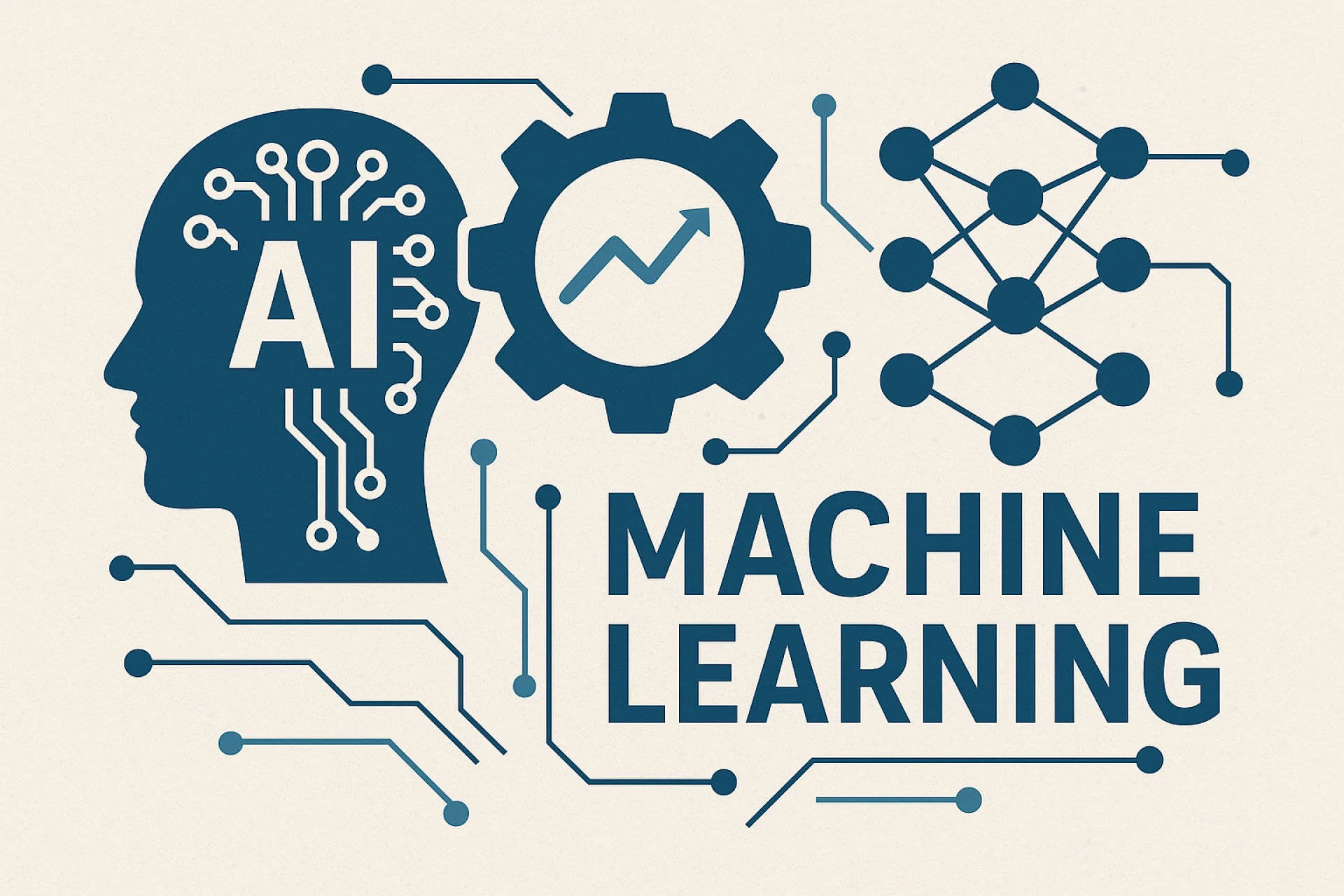
Artificial Intelligence (AI) and Machine Learning (ML) are no longer futuristic buzzwords-they are powerful technologies that shape our way of living, working, and innovating. By predicting diseases before enabling self-driving cars, AI and ML are replacing industries at an unprecedented speed. Businesses around the world are investing in a competitive lead in these techniques, improving decision-making and giving more personal solutions to customers.
At its core, AI refers to machines that can simulate human intelligence, while ML is a state of AI that enables the system to learn from data and improve over time without clear programming. An advanced branch of ML takes it one step forward by mimicking the human brain's neural network to handle complex tasks such as deep learning, image recognition, speech processing, and natural language understanding.
AI and ML are accelerating to be adoption as they solve real-world problems in many areas. In healthcare, they help doctors diagnose diseases more accurately; In finance, they detect fraud and optimize investment strategies; In logistics, they improve the route plan and supply chain efficiency; And in automotive, they power autonomous driving and advanced security systems.
However, applying AI/ML is not only about technology-it is also about strategy, data, and processes. Concepts such as MLOps (machine learning operations) have emerged to streamline model development, deployment, and monitoring, which ensure long-term success.
What is Artificial Intelligence?
Artificial Intelligence(AI) is the study of making machines or software that can carry out human-intelligent tasks such as understanding natural language, recognizing patterns, solving problems, and making decisions.
In simple terms, AI allows computers to "think" and behave in a human-like manner, but usually at faster and more accurate rates.
Types of AI
AI can be classified into various categories based on its abilities and functions:
Narrow AI (weak AI): designed to perform a single function, such as a voice assistant or spam filter.
General AI: Theoretical AI that can carry out any intellectual task just like a human is known as general AI (strong AI).
Super Intelligent AI: An idea for the future in which artificial intelligence completely outsmarts humans.
What is Machine Learning?
Machine Learning (ML) is a subset of AI centered on allowing systems to research from information without being explicitly programmed.
Instead of giving step-by-step instructions, we offer data, and the gadget reveals patterns and improves over the years.
Types of Machine Learning Algorithms
Supervised Learning: The model learns from categorised records, together with predicting housing prices based on historical records.
Unsupervised Learning: The version finds hidden styles, such as patron segmentation, in unlabeled records.
Reinforcement Learning: The system gains knowledge through trial and error, with moves resulting in rewards or penalties.
Deep Learning: What Is It?
Deep Learning is a subfield of machine learning that processes complex records, including text, audio, and images, the use of multi-layered neural networks. Applications like speech translation, facial recognition, and self-driving cars are powered by it.
AI vs. Machine Learning vs. Deep Learning
The extra preferred concept of machines mimicking human intelligence is referred to as synthetic intelligence (AI).
ML is an AI approach that emphasizes facts-pushed learning.
Deep Learning is an advanced form of machine learning that can correctly cope with huge, unstructured datasets.
Consider deep learning as a town, ML as a planet, and AI as the universe.
Why is AI/ML Important?
AI and ML are no longer a future idea - they are today's requirement. They enable companies to automate, make improved decisions, lower mistakes, and enhance customer experiences.
From healthcare to logistics, AI and ML are transforming businesses and building competitive advantages.
Utilize AI/ML Examples and Cases
Healthcare
- Predicting diseases before symptoms appear.
- Automating medical image analysis.
- Personalized treatment recommendations.
Financial Services
- Fraud detection in real-time.
- Automated investment advice (robo-advisors).
- Risk assessment for loans.
Automotive
- Self-driving technology.
- Predictive maintenance of vehicles.
- Driver assistance systems.
Logistics
- Optimizing delivery routes.
- Predicting inventory needs.
- Reducing fuel consumption through smart planning.
What is MLOps?
MLOps (Machine Learning Operations) is the practice of combining ML development with IT operations to streamline and scale AI/ML projects.
It ensures that machine learning models are deployed efficiently, monitored in real time, and continuously improved.
Accelerating Success with AI and ML Development Solutions
Organizations adopting AI/ML need more than just algorithms - they need strategic planning, the right tools, and expert implementation.
Partnering with experienced AI/ML development companies ensures faster deployment, higher accuracy, and cost efficiency.
AI/ML Development Process
A typical AI/ML development workflow involves:
Definition of problem: Identifying that you want to solve AI.
Data Collection and Preparation: Relevant, collecting high-quality data.
Model Selection: Choosing the correct ML algorithm or nerve network.
Training and Testing: feeding data into models and validation of results.
Personogen: integrating the model into real-world applications.
Maintenance and Monitoring: to guarantee continued performance and accuracy.
Start with AI/ML in your organization
Start Small: Identify the case of single high-effect use.
Make Information Investments: Relevant, clean data is the muse of suitable AI.
Assemble the ideal crew: Combine domain experts, engineers, and data scientists.
Select an Appropriate Tool: Choose the ML frameworks and AI platforms that satisfactorily meet your needs.
Monitor and Scale: Measure the results continuously in detail.
Conclusion
AI and ML are now not “pleasant-to-have” technology - they are the backbone of innovation in 2025. Whether it’s enhancing purchaser stories, optimizing operations, or predicting the future, the opportunities are countless. Organizations that embody AI/ML nowadays will lead tomorrow’s markets.