
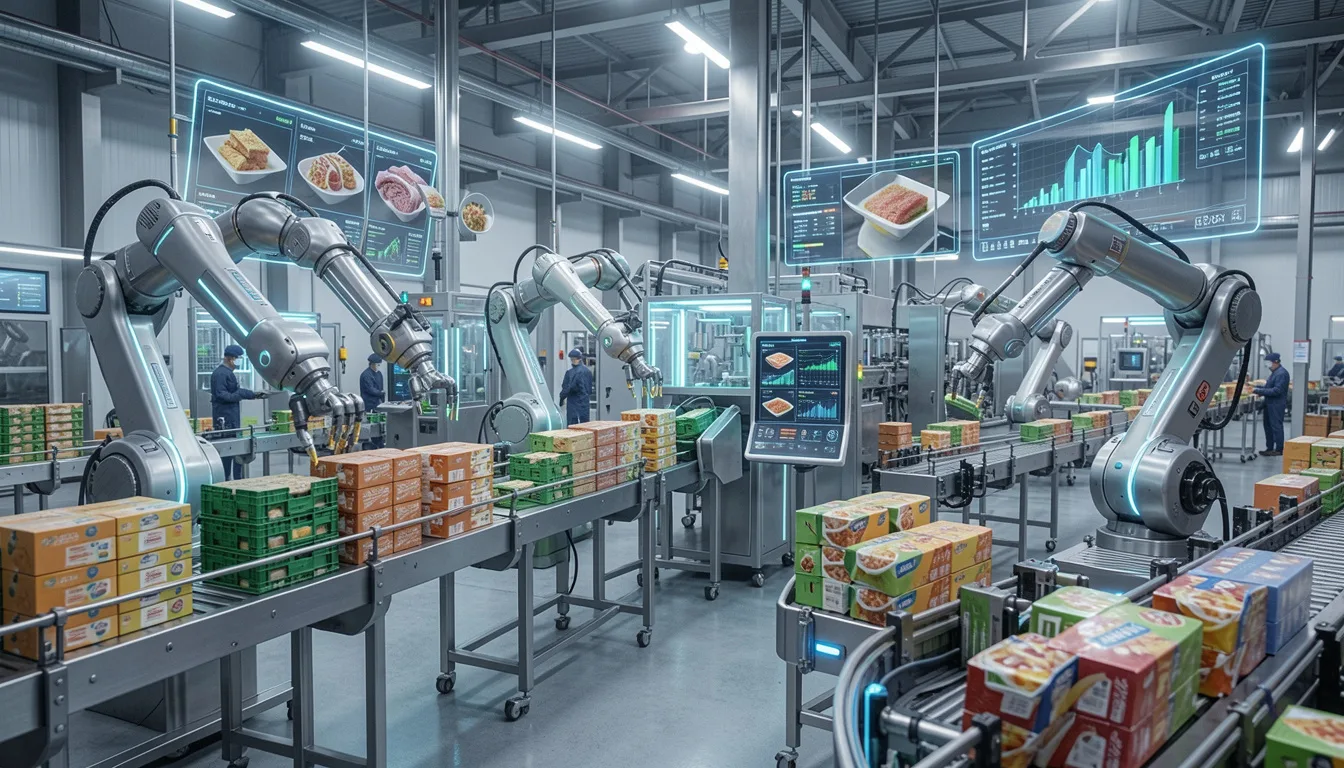
According to Dimension Market Research, The AI in Food Processing Market is rapidly transforming the global food industry by integrating artificial intelligence into production, quality control, packaging, supply chain management, and food safety systems. With increasing demand for efficient, safe, and scalable food production, AI technologies such as machine learning, computer vision, robotics, and predictive analytics are becoming essential tools for modern food manufacturers.
The Global AI in Food Processing Market is expected to reach a value of USD 12.7 billion by 2024 and is projected to grow significantly to USD 26.8 billion by 2033, expanding at a CAGR of 8.6% during the forecast period. This growth reflects the strong adoption of automation and intelligent systems across global food manufacturing facilities.
AI is improving operational efficiency by reducing human error, enhancing product consistency, and enabling real-time monitoring of production lines. From detecting contamination to optimizing ingredient usage and reducing food waste, AI is playing a crucial role in reshaping the food processing ecosystem.
The increasing demand for packaged and processed foods, driven by urbanization, busy lifestyles, and changing dietary habits, is further accelerating the adoption of AI-based solutions across the industry.
Download a Complimentary PDF Sample Report:
https://dimensionmarketresearch.com/request-sample/ai-in-food-processing-market/
Market Overview
The global food processing sector is undergoing a significant digital transformation, with AI emerging as a key driver of automation and efficiency. Food manufacturers are increasingly relying on intelligent systems to streamline operations, improve quality assurance, and enhance supply chain visibility.
AI-powered systems are widely used to analyze production data, detect anomalies in food quality, and optimize manufacturing processes. Computer vision technology plays a major role in identifying defects in packaging, sorting food items, and ensuring compliance with safety standards.
Additionally, predictive analytics helps companies forecast demand, reduce overproduction, and minimize inventory wastage. This not only improves profitability but also supports sustainability goals by reducing food loss across the supply chain.
Market Growth Drivers
Rising Demand for Processed and Packaged Foods
Urbanization and fast-paced lifestyles have significantly increased demand for convenient food products. This has created a strong need for efficient, large-scale, and automated food processing systems powered by AI.
Increasing Focus on Food Safety and Quality
AI enables real-time monitoring of production lines, ensuring early detection of contamination, defects, and inconsistencies, thereby improving food safety standards globally.
Automation in Manufacturing Processes
Food companies are adopting robotics and AI-based automation to enhance production speed, reduce labor dependency, and improve operational efficiency.
Growth of Predictive Analytics Adoption
AI-driven forecasting tools help manufacturers predict demand trends, manage inventory efficiently, and optimize supply chain operations.
Integration of IoT and Smart Sensors
The combination of IoT devices and AI systems enables real-time monitoring, predictive maintenance, and enhanced process control in food manufacturing plants.
Market Challenges
Despite strong growth, several challenges limit adoption. High implementation costs of AI infrastructure remain a major barrier, especially for small and medium food processors. A shortage of skilled professionals in AI and data analytics further slows adoption.
Cybersecurity concerns related to sensitive production data and integration issues with legacy manufacturing systems also pose challenges. Additionally, some traditional food manufacturers show resistance to adopting advanced digital technologies due to operational complexity and cost concerns.
Market Segmentation
By Component
Software
Hardware
Services
By Application
Quality control and inspection
Production optimization
Supply chain management
Predictive maintenance
Food safety monitoring
By Deployment Mode
Cloud-based
On-premises
By End User
Food manufacturers
Beverage companies
Packaging industries
Retail and distribution chains
Purchase the report for comprehensive details:
https://dimensionmarketresearch.com/checkout/ai-in-food-processing-market/
Regional Analysis
North America leads the global AI in food processing market, accounting for 37.5% of the total market share in 2024. The region benefits from advanced technological infrastructure, strong food manufacturing industries, and early adoption of AI-based automation systems.
The United States plays a major role in driving innovation, supported by leading technology companies and research institutions developing advanced AI solutions for the food sector. Europe follows closely with increasing adoption driven by strict food safety regulations and sustainability initiatives.
Asia Pacific is emerging as a high-growth region due to rising population, increasing demand for processed foods, and expanding food manufacturing capacity in countries such as China and India. Latin America and the Middle East & Africa are gradually adopting AI technologies as food industries modernize.
Key Trends in the AI in Food Processing Market
AI-powered computer vision systems are increasingly used for real-time quality inspection and defect detection. Robotics is transforming food manufacturing lines by automating repetitive tasks. Predictive analytics is improving demand forecasting and inventory management accuracy.
Smart packaging technologies and traceability systems are gaining popularity, enhancing transparency across the food supply chain. The integration of IoT and AI is enabling real-time monitoring, while sustainability-focused AI applications are helping reduce food waste and energy consumption.
Competitive Landscape
The AI in food processing market is highly competitive and innovation-driven. Companies are focusing on developing advanced automation systems, smart factory solutions, and cloud-based AI platforms.
Strategic partnerships between technology providers and food manufacturers are increasing, enabling faster deployment of AI solutions. Companies are also investing heavily in machine learning algorithms and computer vision technologies to enhance production efficiency and product quality.
The competitive landscape is expected to intensify as more players enter the market with specialized AI solutions tailored for the food industry.
Future Outlook
The future of the AI in food processing market is highly promising. By 2033, AI is expected to become a fundamental part of global food production systems, enabling fully automated and highly efficient manufacturing environments.
The integration of AI with robotics, IoT, blockchain, and advanced analytics will further enhance transparency, traceability, and efficiency across the food supply chain. Sustainability will remain a key focus, with AI helping reduce waste and optimize resource utilization.
As technology continues to evolve, AI will play a central role in ensuring food security, improving production scalability, and supporting global demand for high-quality food products.
FAQs
1. What is AI in the food processing industry?
AI in food processing refers to the use of artificial intelligence technologies to automate, optimize, and improve food manufacturing, quality control, and supply chain operations.
2. What is the market size of the Global AI in Food Processing Market?
The market is expected to reach USD 12.7 billion in 2024 and USD 26.8 billion by 2033.
3. What is the CAGR of this market?
The market is projected to grow at a CAGR of 8.6% during 2024–2033.
4. What are the key applications of AI in food processing?
Key applications include quality inspection, production optimization, predictive maintenance, food safety monitoring, and supply chain management.
5. Which region dominates the market?
North America leads the market with a 37.5% share in 2024, driven by strong technological infrastructure and advanced food manufacturing systems.
Summary of Key Insights
The global AI in food processing market is experiencing steady and transformative growth driven by automation, digitalization, and rising demand for processed foods. AI technologies such as computer vision, robotics, and predictive analytics are improving efficiency, safety, and sustainability across food manufacturing systems. North America leads the market, while Asia Pacific is emerging rapidly. The future of the industry will be shaped by smart, automated, and highly efficient food production ecosystems powered by artificial intelligence.