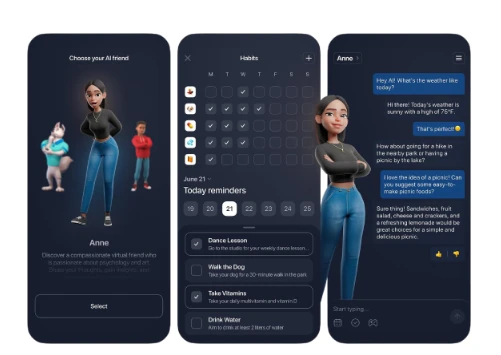
Artificial intelligence has grown much bigger than automation and analytics- nowadays AI is transforming human relations at a deeper level. In the vanguard of these changes is AI Companion App Development, a niche discipline that specializes in developing digital companions which can mimic real and meaningful interactions. These applications are no longer limited to basic chatbots, but are currently becoming platforms that replicate human-like personalities, emotions and relationships. The future of digital companionship is taking on a more immersive and personal direction with innovations such as the Candy AI Clone.
Understanding the Rise of Human-Like Interactions
The appeal of AI Companion App Development is that it can provide consistent, adaptive, and emotionally compelling experiences. Contrary to the traditional applications that possess a functional aspect to them, these AI-based platforms focus on connection and empathy. An example of such AI clones is the Candy AI Clone, which will be able to adjust to user preferences and habits and provide customized conversations that seem human rather than robotic.
This is the development of technology as not only a problem-solving tool, but also a relationship-building tool in the digital world. Users are demanding more interactions and AI companion apps are satisfying this desire through providing a feeling of presence and connection that goes beyond utility.
The Mobile App Life Cycle in AI Companionship
Greenfield AI companions are built upon the mobile app life cycle. Ideation and conceptualization through to design, testing and post-launch upgrades, each stage is important in determining the final user experience.
In its design, developers make conversational flows look natural. AI responses are fine-tuned in testing with feedback. Once deployed, the system is updated continuously to keep up with the needs of the user. This is a rigid loop of constantly updating, relevant, and entertaining platforms such as the Candy AI Clone.
AI Companion App Development and Professional Services.
The human-like AI companions are brought into reality by the means of mobile app development services. In these services, the latest technologies, like natural language processing, machine learning, and emotional recognition systems are incorporated to make AI companions more responsive.
A good example of how professional services can incorporate innovative technologies and design thinking to create apps that are more companion than tool is the Candy AI Clone. Companies are using these services to make a difference in an ever more competitive digital world, making sure that not only do their applications work, but they also have an emotional connection with customers.
MVP App Development as a Strategic Approach
Most companies that have ventured into the field of AI Companion App Development start with MVP app development. Creating an MVP will make sure that critical parts of the application such as conversational AI and adaptive response are tested in the real world and then scaled.
As an example, the Candy AI Clone may be launched as a bare product with bare conversation functionality. Once validated, more layers can be added like voice interactivity, avatars or cross platform integration. This incremental strategy minimizes risks without losing the life cycle as the product is developed based on the real user feedbacks.
Redefining the Dating and Companionship Ecosystem
The dating and companionship field is one of the most affected by the AI Companion App Development. The classic apps are based on human-to-human matches, and AI companions such as the Candy AI Clone are changing the game. They present an alternative in the form of a consistent, emotionally intelligent connection to future users who do not want to be exposed to the vagaries of human relations.
It is not replacing real relationships but a new type of digital companionship. The future of personal interaction with technology is being paved by AI apps, which incorporate the ability to respond as a human being would.
Innovations Driving Human-Like Experiences
Innovations in generative AI, voice synthesis, and emotional AI make it possible to create human-like interactions in AI companions. These technologies enable applications to imitate not only language, but also even tone, empathy and even contextual memory. The Candy AI Clone represents a rather realistic example of how all these innovations come together to make a nearly human-like companion.
To users, this translates into more natural, responsive and personalized interactions. In the case of businesses, it is a chance to design apps that transcend transactions to build relationships- a model that has the potential to transform how digital platforms are used.
Future Outlook: Beyond Companionship
Although companionship is at the forefront, AI Companion App Development extends beyond dating or other personal relationships. Whether it is mental health assistance, lifestyle coaching, or interactive entertainment, human-like experiences that these apps generate pave the way to various uses.
With models such as the Candy AI Clone ever-evolving, the boundary between digital tools and digital companions will continue to become unclear. Over the next few years, AI companions will be part of the metaverse, Web3 ecosystems, or virtual workplaces, where their role in real-life may be redefined.
Conclusion
The age of human-like automated interactions has started, and AI Companion App Development is the center of it all. By following established processes such as the mobile app life cycle, experience of mobile app development service, and approaches such as MVP app development, platforms such as the Candy AI Clone are defining new conventions in companionship technology.
These applications are not only utilities, but are beginning to adopt a form of companionship which acknowledges the emotional and social requirements of a digital first world. With continued technological growth, the path of AI companions will keep changing the way humans engage in connectedness in the digital era.