Imagine a classroom that senses when students are losing focus and adjusts the lesson pace automatically. This isn’t science fiction — it’s the power of AI and machine learning in neuroadaptive learning systems.
In today’s digital education era, neuroadaptive UI/UX design connects human cognition with artificial intelligence, enabling platforms that adapt in real time to learners’ mental states. Through EEG integration for learning, these systems read brainwave patterns and translate them into meaningful design responses — personalizing education down to each student’s neural rhythm.
This blog explores how AI and machine learning transform neuroadaptive design, turning data into adaptive intelligence that reshapes how humans interact, learn, and grow.
What Are Neuroadaptive Learning Systems?
Neuroadaptive learning systems combine neuroscience, UX design, and intelligent algorithms to adjust learning interfaces based on a user’s cognitive and emotional state. Unlike static e-learning platforms, they dynamically evolve using real-time brain and behavioral data.
At their core, they rely on three interconnected layers:
- EEG Integration for Learning – Captures electrical brain activity related to focus, stress, and engagement.
- AI-Driven Analysis – Processes EEG and interaction data to interpret learning states.
- Adaptive UX Response – Adjusts the interface, pacing, or visuals through cognitive UX design principles.
According to recent studies on neuroadaptive interfaces published in ResearchGate and UX Bulletin, combining EEG and AI models can significantly improve learner engagement and retention by 20–35%.
How Does AI Transform Neuroadaptive Design?
Artificial Intelligence acts as the brain behind the brain-aware interface. It interprets neural and behavioral signals, detects hidden learning patterns, and predicts when users are distracted or cognitively overloaded.
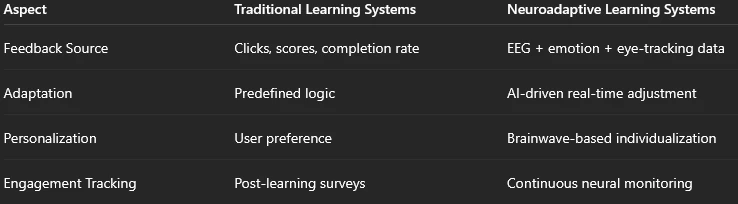
This transformation is powered by machine learning services, that train models on massive cognitive datasets. These models learn how the brain reacts to various stimuli — from visuals to sound — and refine the learning interface to suit each individual’s pace and focus.
How Machine Learning Powers Adaptive Intelligence
Machine learning enables neuroadaptive learning systems to become progressively smarter. By recognizing patterns in EEG data, attention levels, and learning performance, these systems can predict when to change difficulty levels, color contrasts, or even background music to enhance engagement.
Core ML Techniques in Cognitive UX Systems
- Supervised Learning – Trains models using labeled EEG data (e.g., “focused,” “fatigued,” “distracted”).
- Reinforcement Learning – Continuously improves by rewarding effective design adjustments.
- Deep Neural Networks – Detect complex patterns in brain signals that traditional analytics can’t capture.
These technologies enable a new class of adaptive user experiences that are emotionally responsive, cognitively efficient, and deeply personal.
When combined with AI business solutions, the data from cognitive sensors can inform not only design changes but also long-term learning analytics, helping educators understand how and when learners truly engage.
What Role Does EEG Play in Adaptive AI Models?
EEG integration for learning provides the raw biological data that fuels adaptive intelligence. Brainwave readings — such as alpha, beta, theta, and gamma frequencies — correspond to focus, relaxation, and cognitive load.
Example EEG Insights
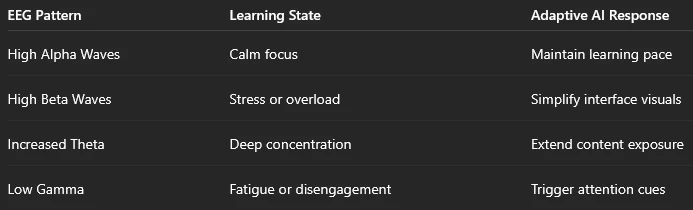
When AI-ML solutions analyze these signals in real time, the system automatically adapts the brain-computer interface UI — fine-tuning everything from task duration to content density.
This process enhances engagement and minimizes frustration, providing a learning experience tailored to each brain’s unique rhythm.
From Data to Design: Cognitive UX in Action
Cognitive UX design principles guide how neural insights are translated into meaningful user experiences. Instead of treating EEG data as raw metrics, designers use it to craft intuitive learning flows that align with human cognition.
Key Design Strategies
- Contextual Adaptation: Use machine learning to detect when users lose focus and shift content style accordingly.
- Dynamic Personalization: Modify UI colors, animations, or soundscapes in response to EEG-measured engagement.
- Real-Time Feedback: Provide subtle prompts or rewards when users achieve optimal concentration.
- Ethical Transparency: Always inform users how and why brain data is used.
These principles align closely with UI/UX design,methodologies that prioritize empathy, clarity, and data-informed iteration.
When integrated with predictive analytics technologies, cognitive UX frameworks can even forecast when learners are likely to disengage — allowing systems to intervene before attention drops.
Research Insights: The Science Behind the System
Recent academic work from arXiv (2025) and UX Bulletin highlights the critical synergy between AI, EEG, and user-centered design:
- Neuroadaptive systems using EEG integration for learning and AI models achieved 25–40% higher engagement compared to non-adaptive systems.
- Real-time EEG interpretation improved knowledge retention by up to 30%, especially in immersive AR/VR learning.
- Combining AI with eye-tracking and cognitive load monitoring provided more accurate personalization than behavior-only models.
The future of neuroadaptive UI/UX design lies in merging these technologies — EEG, AI, and NLP solutions — to interpret both neural and linguistic signals simultaneously, crafting richer multimodal learning experiences.
Real-World Applications of AI-Driven Neuroadaptive Systems
- EEG-Enhanced Virtual Classrooms: AI interprets cognitive states to adjust lesson pacing, ensuring learners remain neither bored nor overwhelmed.
- Gamified Learning Environments: Neuroadaptive learning systems use reinforcement learning to adapt challenges and rewards in real time, maintaining motivation.
- Corporate Training Dashboards: Employers use AI-ML solutions to assess workforce engagement and tailor modules for different cognitive profiles.
- Language Learning Tools: Integrated NLP solutions personalize vocabulary and grammar difficulty based on comprehension-related EEG patterns.
- Immersive Simulations (VR/AR): With brain-computer interface UI elements, trainees can navigate simulations hands-free while the system modulates intensity according to focus levels.
Ethical Considerations in AI-Based Cognitive Learning
While brain-aware learning offers enormous benefits, it introduces sensitive ethical questions.
- Data Privacy: EEG data is deeply personal — it must be anonymized and securely stored.
- User Consent: Learners must understand what’s being tracked and how it’s used.
- Algorithmic Bias: AI models must be tested across diverse brain patterns to prevent skewed personalization.
- Transparency: Every neuroadaptive system should communicate design logic openly.
Ethical cognitive UX design ensures that technology enhances human potential without exploiting neurological data.
The Future: A Symbiosis of AI, Mind, and Design
The integration of AI and machine learning in neuroadaptive learning systems marks a paradigm shift from static interfaces to living systems — ones that understand and evolve with the human mind.
As AI algorithms become more sophisticated and EEG sensors more wearable, we’ll move toward a seamless blend of adaptive user experience and cognitive science.
Supported by AI business solutions and predictive analytics technologies, future platforms will predict when, how, and why each learner performs best — turning education into a personalized symphony between brain and interface.
Conclusion
The fusion of AI, machine learning, and neuroadaptive learning systems is redefining the boundaries of digital education.
By leveraging EEG integration for learning and real-time cognitive modeling, these systems create emotionally intelligent and adaptive user experiences that respond directly to human thought patterns.
This evolution isn’t about replacing teachers or designers — it’s about empowering them with deeper insight into how people learn. The result is a future where neuroadaptive UI/UX design becomes the bridge between artificial intelligence and authentic human learning.
FAQs
1. What are Neuroadaptive Learning Systems?
They are AI-driven platforms that adapt educational content based on real-time brainwave and behavioral data.
2. How does EEG Integration enhance learning?
EEG integration for learning detects attention, stress, and engagement levels, allowing systems to optimize interface design and pacing.
3. How does AI improve personalization?
AI and machine learning services analyze brain and user data to deliver context-aware adaptations unique to each learner.
4. Is Brain-Computer Interface UI the future of learning?
Yes — as brain-computer interface UI technology matures, learners will interact using cognitive intent, creating hands-free, deeply immersive experiences.
5. Is Neuroadaptive Design ethical?
When guided by transparent and responsible data practices, cognitive UX design can enhance personalization while maintaining user trust and privacy.
Would you like me to now create the meta title, meta description, and keywo