Moving from Automation to Intelligent Orchestration
Traditional automation depends on predefined workflows and deterministic rules. While effective for structured processes, it becomes difficult to scale when workflows involve unstructured data, dynamic decisions, or multiple systems.
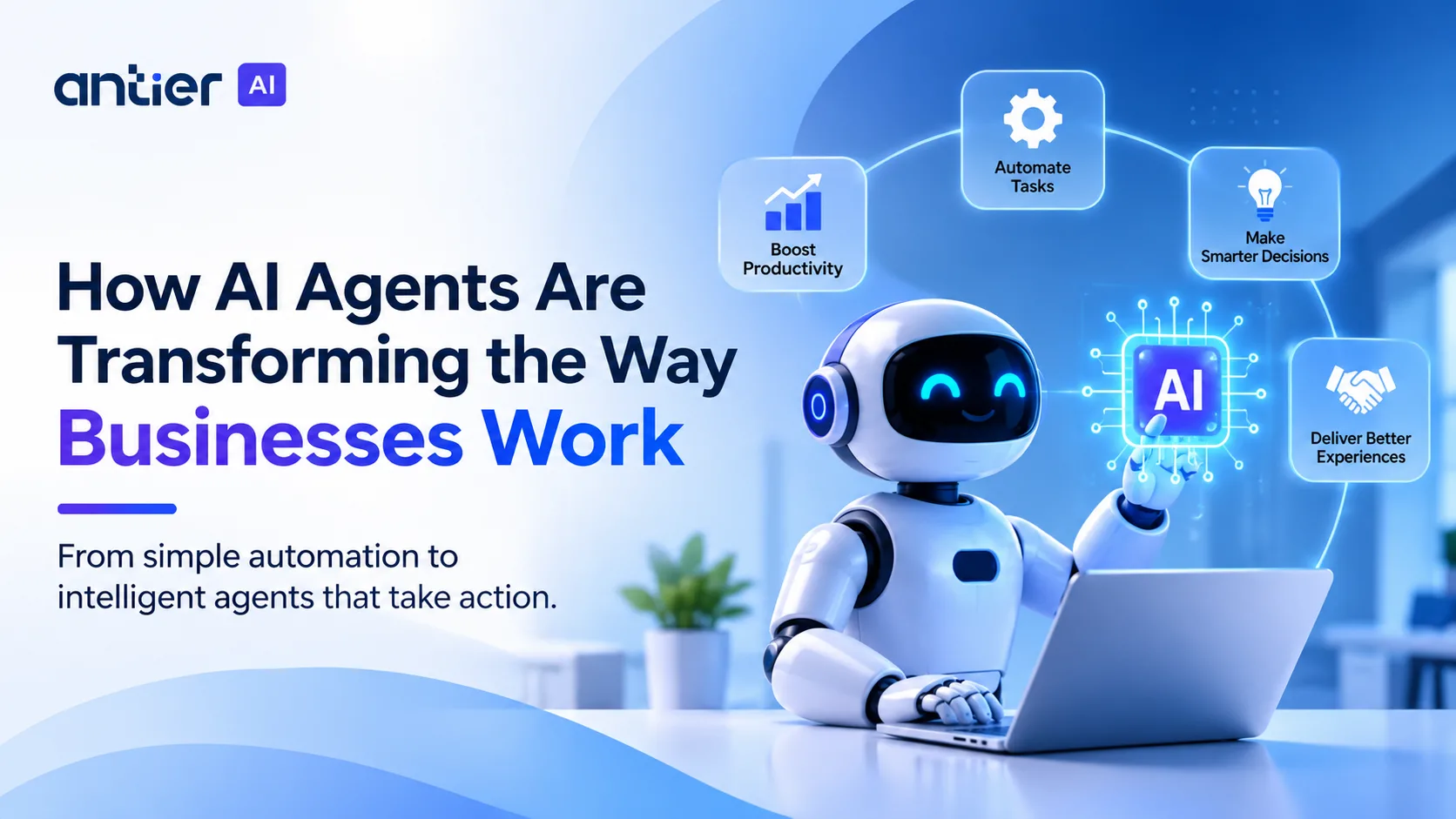
AI agents introduce a more adaptive execution model. They can interpret objectives, select tools, retrieve contextual information, execute actions, and evaluate outcomes. In enterprise environments, this capability can support complex processes across customer operations, IT service management, supply chains, finance, and internal knowledge systems.
The architectural challenge is determining where agent autonomy creates measurable value and where deterministic workflows remain the better choice.
Architecture Considerations for Enterprise AI Agents
Deploying AI agents at enterprise scale requires careful architectural planning across several layers:
- Model orchestration: Selecting and coordinating LLMs based on task complexity, latency, cost, and performance requirements.
- Enterprise data integration: Connecting agents with APIs, databases, internal knowledge repositories, and business applications.
- Context management: Implementing retrieval mechanisms, memory strategies, and context controls to maintain relevant information.
- Identity and access management: Enforcing permissions, authentication, data isolation, and least-privilege access.
- Observability and evaluation: Tracking execution traces, token consumption, response quality, errors, latency, and task completion rates.
A modular architecture allows enterprises to evolve models, tools, and workflows without rebuilding the entire application stack.
Governance, Security, and Reliability
Autonomous execution introduces operational risks that CTOs must address before production deployment. Agents may generate inaccurate outputs, misuse tools, expose sensitive information, or execute unintended actions.
Enterprise implementations should incorporate policy enforcement, human approval checkpoints, audit trails, sandboxed execution, and continuous evaluation. High-impact operations should use controlled permissions and explicit validation mechanisms.
Reliability should be measured through business-specific metrics such as successful task completion, exception rates, operational savings, response latency, and human intervention frequency.
Identifying the Right Enterprise Use Cases
The strongest initial use cases are workflows with measurable inefficiencies, accessible data, defined objectives, and manageable execution risks.
IT operations, enterprise knowledge retrieval, document-intensive processes, customer service orchestration, and internal workflow automation can offer practical starting points.
Organizations exploring implementation strategies can evaluate AI agent development capabilities from Antier AI to understand approaches for building integrated, scalable, and business-aligned agentic systems.
Building a Scalable Agentic AI Strategy
Enterprise AI agent adoption should be approached as an architectural and operational transformation rather than an isolated technology experiment.
CTOs should prioritize measurable business outcomes, establish governance frameworks, validate performance through controlled pilots, and develop reusable infrastructure for future deployments.
The long-term competitive advantage will come from integrating AI agents into enterprise systems strategically—combining autonomous capabilities with robust engineering, security, and human oversight.