
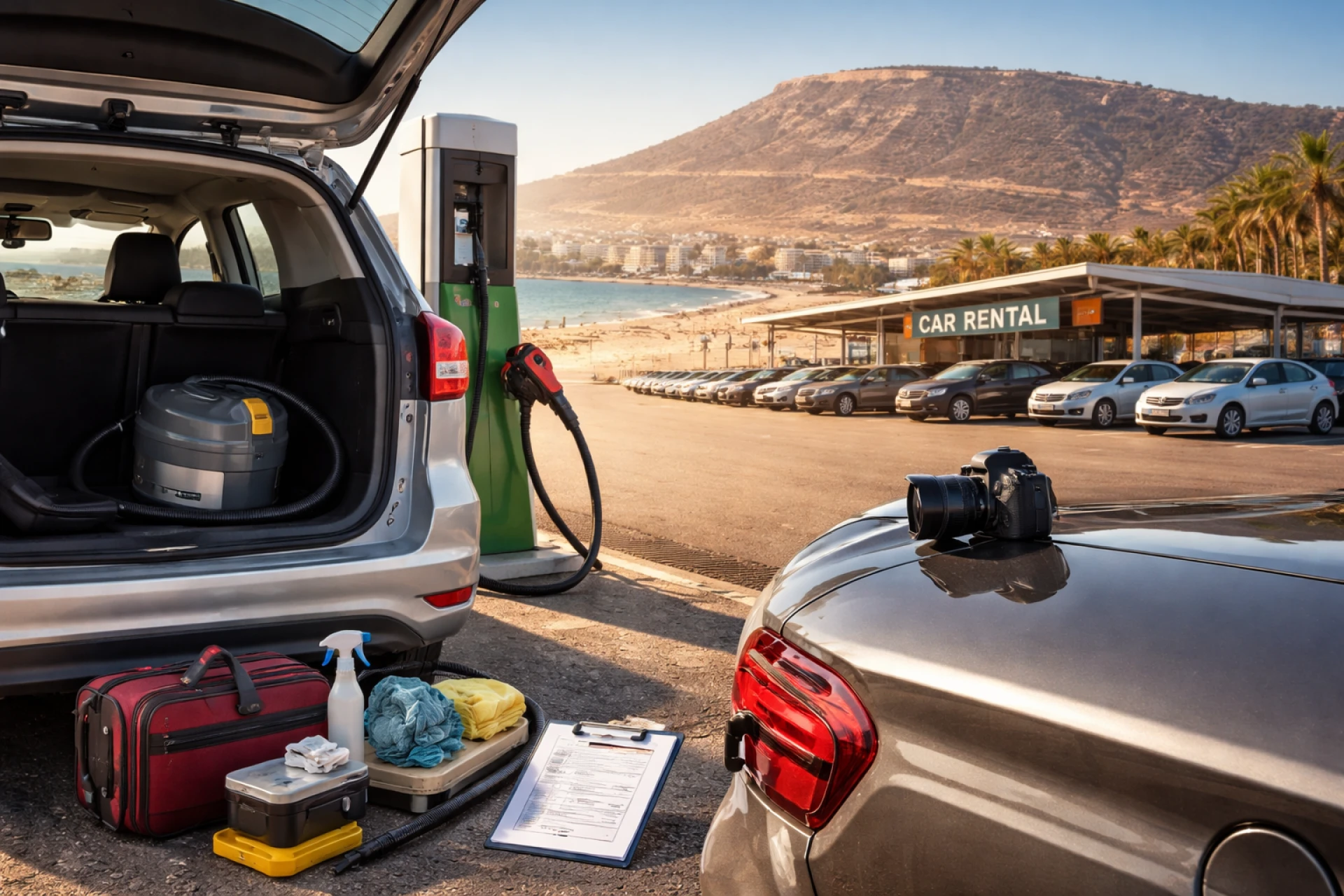
Return day is when a smooth Agadir car rental can either end perfectly, or turn into a stressful conversation about fuel level, late fees, or “new damage.” The good news is that most return problems are predictable, and you can avoid them with a simple routine that takes 15 minutes. This guide gives you a practical checklist for Agadir returns, whether you’re dropping the car in the city, at an agreed meeting point, or near the airport.
If you’re booking your rental and want clear local rules from the start, begin with MarHire and compare options inside the car rental category. Then use the steps below to return the car with proof and peace of mind.
Table of Contents
- The 15-minute return routine (quick plan)
- What to clean (and what actually triggers cleaning fees)
- Refueling correctly: full-to-full vs same-to-same
- The photo checklist that prevents disputes
- Timing buffers: how to avoid late charges
- Extra checks for luxury rentals
- The 5 most common return-day mistakes in Agadir
- FAQ
The 15-minute return routine (quick plan)
If you do nothing else, follow this order:
First, refuel according to your fuel policy, then park somewhere with decent light and space. Next, do a quick interior clean and remove all personal items. Then take your photos (2–3 minutes). Finally, hand over the keys and ask for a return confirmation message or note.
This routine works whether you rented a small city car or something premium. Many people assume only budget rentals have disputes, but higher-value cars can lead to more careful inspections. That’s why return-day proof matters even more if you booked through Agadir luxury car rental.
What to clean (and what actually triggers cleaning fees)
Most tourists don’t get charged because the car has a little sand on the mats. Charges usually happen when the car looks like it needs extra work before the next customer. In a coastal city like Agadir, the main culprits are beach sand, food smells, and sticky surfaces.
Start with the quick wins that change the inspection outcome:
Take out all trash, including water bottles, receipts, and snack wrappers. Shake the floor mats if they’re full of sand. Wipe any visible crumbs from seats and door pockets. If you ate in the car, remove all food packaging and do a quick check under seats because that’s where “mystery smells” come from.
If the car has heavy sand, don’t try to hide it, just do a basic cleanup so it looks cared for. A quick vacuum can be worth it if you’ve done multiple beach days. The goal is not perfection, it’s “normal use.” If you return a car that looks respected, the handover is usually faster and calmer.
Also check these easy-to-miss items: the trunk area, cup holders, and the space around the handbrake. Those spots are where inspectors often look for signs of careless use.
Refueling correctly: full-to-full vs same-to-same
Fuel policy is the number one return-day surprise. Many contracts apply a refueling service fee if you return below the required level, and that fee can be larger than the fuel difference itself.
If your rental is full-to-full, return the tank clearly full. Refuel close enough to drop-off that you won’t burn much fuel afterward, especially if you’ll drive in traffic. Keep a fuel receipt if you can, and take a photo of the gauge at drop-off. Avoid “almost full.” On some cars, the needle can sit just below full, and that tiny difference can trigger a charge.
If your rental is same-to-same, match the starting level. The trick is to avoid last-minute guessing. Take a photo of the gauge at pickup so you have a reference. On return day, top up earlier and drive a few minutes so the gauge updates. Some cars change slowly, and if you refuel and return immediately, it can look like you didn’t add fuel. Take a final gauge photo after the needle settles.
If you’re planning several day trips and want a policy that feels simplest, compare offers under Agadir car rental and prioritize clear fuel terms over the cheapest daily rate.
The photo checklist that prevents disputes
You don’t need dozens of photos. You need the right ones, in a consistent set. The aim is to prove the condition at return, including fuel level and mileage, plus the most common damage zones.
Start with wide exterior shots. Take a front and rear photo that shows the whole car. Then take one photo of each side. After that, take four corner shots: front-left, front-right, rear-left, and rear-right. Corners and bumpers are where most “new scratch” claims appear, so those angled shots are powerful.
Next, take details that matter. Photograph each wheel area, especially if you drove near curbs or parked in tight spaces. Take a clear windshield photo to show there’s no new crack or chip. Then take one dashboard photo that shows both the fuel gauge and the mileage. Finally, photograph the keys and any accessories together, especially if you were given something like a key fob pouch or parking card.
If you have 20 extra seconds, record a short video walkaround from a few steps back. It captures reflections and angles photos can miss.
Take your photos in decent light. If it’s dark, use a well-lit spot rather than forcing flash photos that blur.
Timing buffers: how to avoid late charges
Late fees happen when travelers treat the return time as “arrival time” instead of “handover complete” time. In Agadir, build a buffer so you can refuel, park, take photos, and meet the agent without rushing.
As a rule of thumb, aim to arrive at the return location 20–30 minutes before your contract end time. If you’re returning near the airport or in a busy area, give yourself 30–45 minutes. That buffer also helps if you need to find a fuel station or if traffic is heavier than expected.
If you’re running late, message early with a specific estimate. “Ten minutes” often turns into 25. Clear communication reduces conflict and can sometimes prevent extra fees.
Extra checks for luxury rentals
If you booked a higher-end vehicle, inspections can be more detailed and the contract may be stricter. That doesn’t mean you should be nervous, it just means you should be thorough.
Pay extra attention to rims and tires because they’re easy to scrape in tight parking. Photograph the front bumper carefully because low spoilers can pick up scrapes. Check the interior for marks on lighter seats and door panels, and remove anything that could leave a stain.
If you want to browse premium options and understand what’s included, use Agadir luxury car rental and confirm the damage and excess terms before pickup so return day feels predictable.
The 5 most common return-day mistakes in Agadir
The first mistake is refueling too far from drop-off and then driving through traffic. You burn fuel and return slightly under the level, which can trigger fees. Refuel near the end and drive minimally.
The second mistake is skipping the dashboard photo. Without a clear image of fuel and mileage at return, you lose your strongest proof.
The third mistake is not photographing corners and wheels. Those are the exact areas most often disputed.
The fourth mistake is returning late because you assumed there’s a grace period. Some rentals have one, some don’t. Your safest plan is to finish the handover before the contract time.
The fifth mistake is leaving without any return confirmation. Ask for a quick message confirming the car was returned and inspected. If your deposit is released later, that confirmation is useful if anything looks wrong.
FAQ
How clean does the car need to be when returning in Agadir?
It should look like normal use, not like it needs special cleaning. Remove trash, shake mats, and avoid food smells.
Do I need a fuel receipt?
It’s not always required, but it’s very helpful for full-to-full returns, especially if there’s a dispute.
What photos matter most?
Four corners, both sides, wheels, windshield, and a dashboard photo showing fuel and mileage.
How early should I arrive for return?
Aim for 20–30 minutes early in the city, and 30–45 minutes early if the return point is busy or you need to refuel first.
Will I get refunded for extra fuel?
Usually no. It’s better to match the policy than to overfill beyond what’s required.
What should I do if the agent isn’t available on time?
Take timestamped photos and a short video showing the car’s condition, fuel gauge, and location, then message the agency immediately.