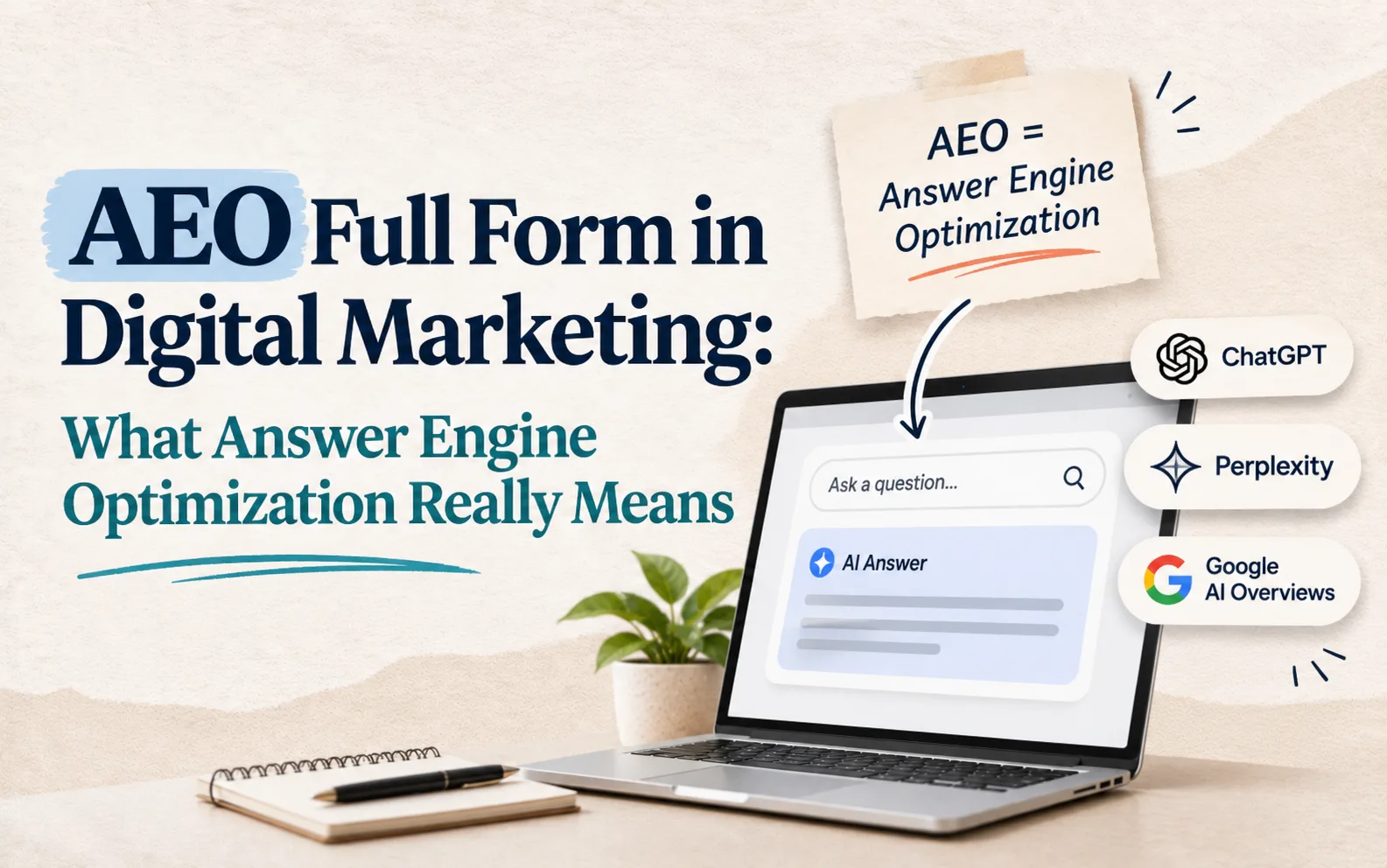
Type "AEO full form" into Google and you'll get two very different answers. In customs and international trade, AEO stands for Authorized Economic Operator, a status given to businesses that meet strict supply chain security standards. In digital marketing it means something else entirely, and it's the version that's reshaping how websites get found. This guide explains the AEO full form in digital marketing, how it differs from SEO and what a business can do about it today.
AEO full form: Answer Engine Optimization
In marketing, AEO stands for Answer Engine Optimization. It's the practice of structuring your content so that AI-driven tools can pull a clear answer from it and show that answer directly to the user. Those tools include Google's AI Overviews, featured snippets, voice assistants and chat-style assistants such as ChatGPT and Perplexity.
Traditional SEO asks, "How do I rank on page one?" AEO asks, "How do I become the source the answer is taken from?" The two goals overlap but they aren't identical.
Why AEO matters now
People are asking full questions instead of typing fragments. "Which dentist near me offers weekend appointments?" is a normal search today. Many of those queries now get a summary at the top of the results page, and users often read that summary without clicking anything.
When that happens, ranking third on the page may not bring you much traffic. Being cited inside the summary can. That is why more marketers treat AEO as an extra layer on top of SEO rather than a replacement for it.
AEO vs SEO: the practical difference
SEO is about authority, relevance and technical health, so search engines trust your page enough to rank it. AEO is about clarity and structure, so a machine can lift a precise answer from your page without guessing.
A page can rank well and still be hard for an AI system to quote, for example when the key answer is buried in the fourth paragraph under vague wording. The reverse is also true. A neatly structured page on a weak site rarely gets cited. You need both.
How to optimise content for answer engines
Lead with the answer. Under each heading, state the answer in the first one or two sentences, then expand. If the heading is "How long does SEO take?" the opening line should give the typical range.
Use real questions as headings. Look at "People also ask" boxes, customer emails and sales calls to find the exact wording people use.
Add an FAQ section. Short question-and-answer pairs match how assistants retrieve information. Keep each answer to two or three sentences.
Keep facts consistent. If your pricing, address or service list differs across pages, systems that compare sources have less reason to trust any of them.
Use structured data. FAQ, Organization and LocalBusiness schema help machines understand what your page is about.
Show who wrote it. Author names, credentials and dated updates make a page easier to trust.
What AEO means for local businesses
Local searches are a natural fit for answer engines because the questions are specific: opening hours, prices, service areas, how long something takes. A business that answers those questions clearly on its own site has a real chance of being quoted, even against bigger competitors.
An experienced SEO agency in Navi Mumbai will usually start with a content audit: which questions customers actually ask, which of them your site answers directly and which pages need rewriting so the answer is easy to extract. Local details such as neighbourhoods, landmarks and service areas make the content more useful to both readers and machines.
How to measure AEO
It's harder to track than rankings. Start by searching your target questions in Google, Perplexity and ChatGPT and noting whether your brand appears as a source. Repeat monthly. Watch branded search volume and direct traffic in Analytics, since people who see your name in an answer often search for you afterwards.
For a plain-language explainer you can share with your team, see Startup Rabbit's guide to the meaning of AEO and answer engine optimization.
The takeaway
The AEO full form in digital marketing is Answer Engine Optimization, and it rewards content that answers real questions quickly, clearly and consistently. You don't need to abandon SEO. Strengthen the fundamentals, then rewrite your most important pages so each question is answered in the first lines. That small change makes your content easier for people and machines to use.