A wired power connection makes battery life easy to ignore — until a scanning job moves outdoors or to a client site. Away from outlets, runtime, charging access, and freedom of movement decide whether a capture session finishes in one run or falls apart halfway. Talking to teams doing field inspections and shop-floor projects, the same pattern keeps showing up in three very different scenarios.
Is Battery Life More Than a Spec on Paper?
3D scanning is iterative work. Engineers circle the object, adjust angles, rescan missed regions, and manage data between passes. A scanner that dies mid-job stops the planned scan path in its tracks — and half-captured data usually means costly rework. Runtime, in other words, determines whether a session flows or fragments.
Scenario 1: What Does Outdoor Fieldwork Demand from a Battery?
Sculptures, building facades, heritage sites, and large equipment exteriors share two traits: they demand many scan positions, and there is rarely an outlet nearby. For projects scheduled as a single visit, longer battery life is what keeps the timeline intact when recharging simply isn't an option.
Scenario 2: Why Does Mobile On-Site Work Punish Every Pause?
Automotive components, molds, machine parts, and client samples are often scanned where they stand. The workflow means moving while scanning and repositioning constantly. Each charging stop interrupts capture — and that interruption ripples downstream into modeling, inspection, and reverse engineering schedules.
Scenario 3: Why Do Batch Scans Suffer Most from Interruptions?
Factories, labs, and digitization teams typically capture parts in a fixed sequence. A power loss mid-run breaks the rhythm, forces device reconnection, and complicates later data organization. In batch work, finishing the full round without interruption is usually worth more than shaving seconds off any single scan.
Can Hardware Design Absorb the Problem?
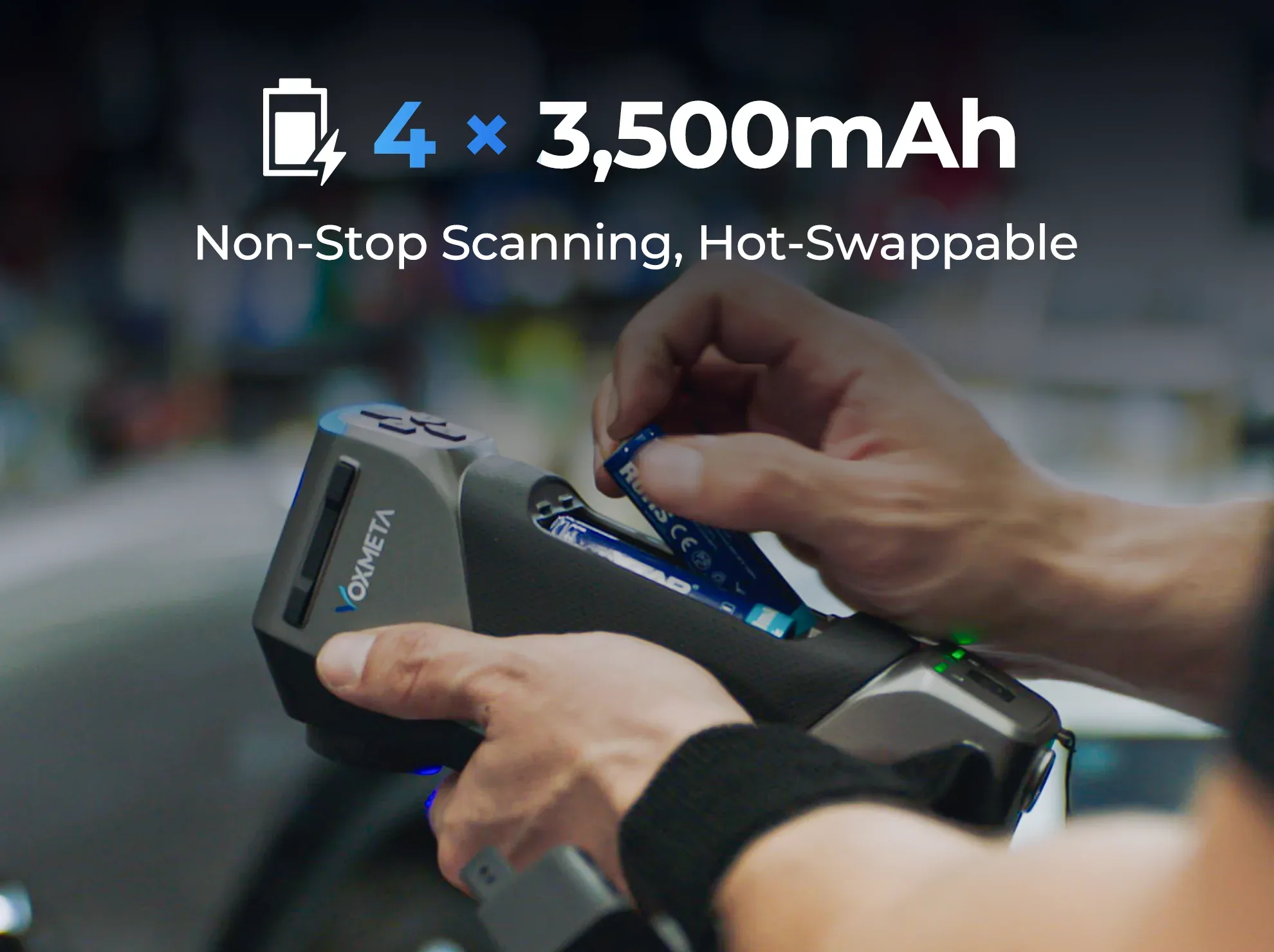
It can — and the most practical fix on the market right now is hot-swappable battery design. VoxMeta H1 PRO is one scanner built around exactly this problem: it runs on four 3500mAh packs with two active at a time, and when charge runs low, the depleted pair swaps for spares without powering down, so a session never stops for a battery. Whatever brand you end up with, the principle to check is the same: does the scanner support battery changes without shutting down, and how many full swaps does the kit allow?
Spec Footnote or Efficiency Feature?
As scan targets grow and sessions stretch longer, battery life stops being a spec-sheet footnote. For outdoor capture, mobile on-site jobs, and continuous batch runs, it behaves like an efficiency feature — and it deserves a place in your buying checklist next to accuracy and scan speed.