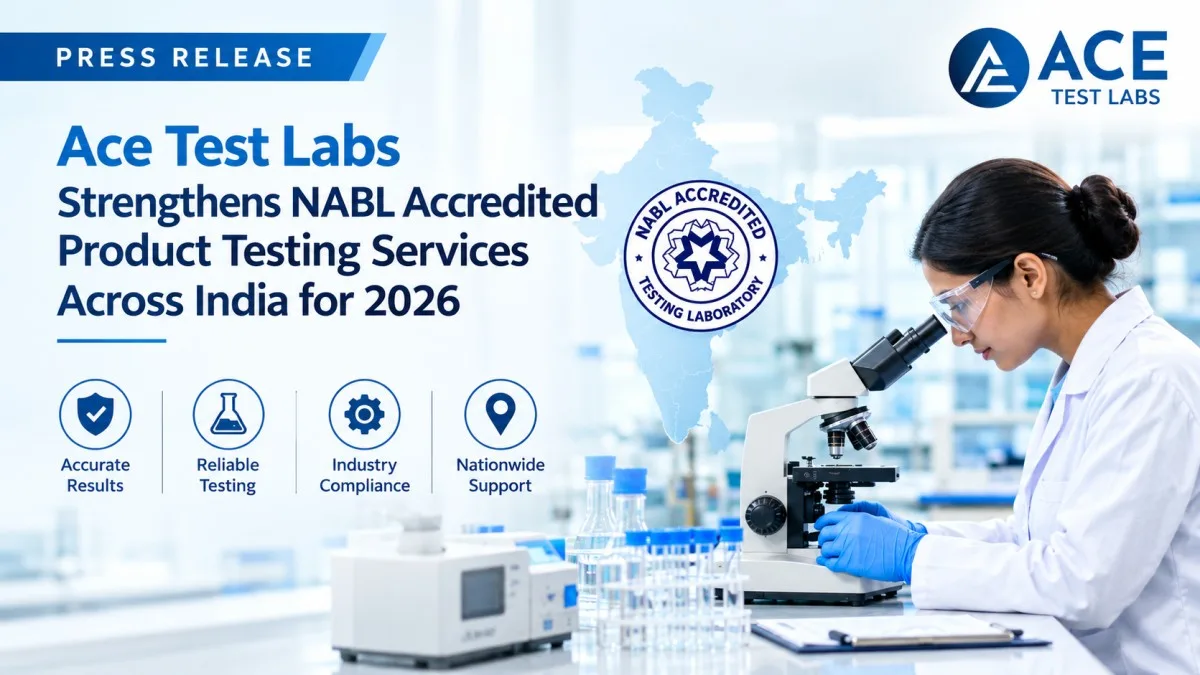
Sonipat, India - ACE Test Labs has expanded its testing capabilities heading into 2026, reinforcing its position as an independent testing laboratory in India for manufacturers, exporters and OEMs across a wide range of product categories. The laboratory operates under ISO/IEC 17025, holds BIS recognition, and is listed on the NEA Singapore website for energy efficiency testing, with relevant reports accepted by that authority. The expansion adds depth to an already broad scope covering household appliances, HVAC and refrigeration equipment, electronics, batteries, EV related products, lamps and luminaires, solar modules, water heaters and environmental testing. For manufacturers preparing products for domestic sale or export in 2026, that combination of accreditation, recognition and category coverage is the practical detail behind the announcement.
Why does expanded testing matter to manufacturers?
Product testing gives manufacturers documented evidence that a product performs as intended before it reaches distributors, retailers or export markets. For OEMs supplying multiple markets, working with one product testing services in India provider can help centralize relevant testing activities, internal quality checks and documentation, while the specific reports and requirements still depend on the product, standards and destination market. This matters most where a product line spans several categories - a company producing both small appliances and battery packs, for instance, needs verification that speaks to each set of applicable standards rather than a single generic pass or fail. Third-party testing does not replace certification or regulatory approval; it provides the underlying data those processes rely on.
What testing areas does ACE Test Labs cover?
The laboratory's scope spans household appliances, HVAC systems and refrigeration equipment, alongside electronics and IT products testing with reference to standards such as IS 13252 where applicable. Battery and EV-related testing sits within the same scope, supported through the battery testing lab in India service line, alongside lamps and luminaires, solar modules and water heaters.
Environmental testing, delivered through the environmental testing lab in India capability, covers conditions products are expected to withstand in transit, storage and use. Coverage across this many categories means a manufacturer working on more than one product type can consolidate its testing relationships rather than manage several separate ones.
Where does third-party testing add value for manufacturers?
- Product verification - confirming a product performs to its stated specifications before it ships.
- Safety assessment - checking a product against applicable safety requirements for its category.
- Performance data - producing measurable results manufacturers can reference internally or share with buyers.
- Compliance support - generating documentation relevant to applicable regulatory or market-entry requirements, without guaranteeing any specific approval outcome.
What NABL accreditation and BIS recognition actually confirm
NABL accreditation confirms that a laboratory's processes and technical competence have been assessed against ISO/IEC 17025, the international standard for testing and calibration laboratories. As a NABL accredited testing laboratory, ACE Test Labs' procedures are evaluated on that basis rather than on the laboratory's own claims about its capability. BIS recognition adds a further layer relevant to Indian market requirements. Neither accreditation nor recognition certifies every individual product tested at the facility; both establish that the laboratory itself meets a defined technical standard, which is a narrower guarantee than product certification. The distinction is worth stating plainly, because it is where accreditation is most often misread. Structured as an independent NABL test lab in India, not affiliated with the manufacturers whose products it tests, ACE Test Labs' role is to generate data, not to approve products.
Supporting manufacturers and exporters beyond India
ACE Test Labs supports manufacturers and exporters connected with India, the GCC, Singapore, Australia, Europe and other markets. Its listing on the NEA Singapore website for energy efficiency testing, and the acceptance of relevant reports by that authority, is directly relevant to businesses exporting energy-related products into Singapore. This does not mean every report issued by the laboratory is accepted in every market; acceptance depends on the specific product, the applicable standard, and the destination market's own requirements. For a BIS approved testing lab working across several export destinations at once, that distinction matters as much as the credential itself, since a report accepted in one market context is not automatically transferable to another.
The case for choosing ACE Test Labs
The laboratory's position is based on evidence recorded in documents rather than on the language of advocacy: NABL accreditation under ISO/IEC 17025, BIS recognition, independent third-party status, a broad multi-category testing scope, and a listing with NEA Singapore for energy efficiency testing. A manufacturer evaluating a partner for EV battery testing lab in India requirements, or for any of the other categories within scope, can weigh these factors directly rather than relying on general assurances about quality or reliability.
The 2026 expansion extends this scope further, giving manufacturers, exporters and OEMs a wider range of testing needs served under a single accreditation framework, with the underlying evidence available to support their own compliance and quality processes. As product categories and export requirements continue to shift, that combination of documented accreditation and broad category coverage is what a testing relationship is actually built on.
To review ACE Test Labs' accredited scope or request a testing schedule for 2026, visit www.acetestgroup.com or contact [email protected]