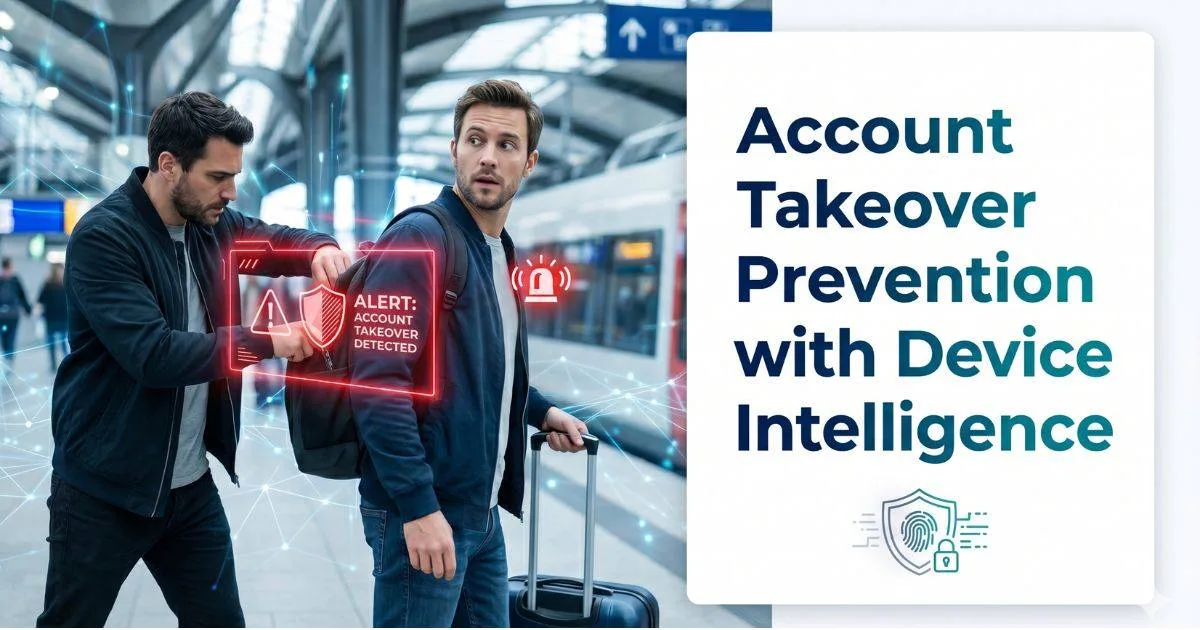
Account takeover fraud is a mainstream business problem. In 2025 alone, global ATO losses exceeded $12 billion, and the FBI reported more than $262 million in bank account takeover losses. For digital platform owners, that's not an abstract statistic. That's revenue lost, users churned, and brand trust eroded.
The harder truth? Most platforms are still relying on authentication methods that fraudsters have already figured out how to bypass. Passwords get stolen in bulk. MFA codes get intercepted via SIM swapping and phishing. Session cookies get harvested by infostealers and sold on dark markets. The problem is that credentials alone were never designed to prove who is on the other side of a login.
That's where device intelligence for account takeover prevention changes the equation entirely. Instead of asking "do you have the right password?", it asks a harder question to fake: "are you the same person, on the same device, behaving the same way you always have?" An attacker with stolen credentials simply cannot answer that question convincingly.
How Device Intelligence Prevents Account Takeovers
Device intelligence combines hardware signals, software attributes, network context, and behavioral patterns into a real-time risk profile for every session. Here's how each layer works to stop account takeover fraud before it causes damage.
1. Persistent Device Identification
The foundation of device intelligence is persistent device identification — the ability to recognise a returning device across sessions, browsers, and even after cache clears.
A device fingerprint is built from dozens of attributes: browser configuration, installed fonts, GPU rendering behaviour, screen resolution, timezone, language settings, and hardware-level characteristics. Individually, none of these are unique. Combined, they create a stable, highly accurate identity for the device.
What makes this powerful for ATO prevention is persistence. A fraudster who has stolen a victim's credentials is almost certainly not on the victim's usual device. The moment a login attempt comes from an unrecognised fingerprint on a high-value account action (a password reset, a wire transfer, a new payee addition) the system knows something is off, even before any rule fires. No friction for the real user. A hard wall for the attacker.
2. Real-Time Device Risk Scoring
Knowing the device is only half the picture. Device risk scoring turns that knowledge into an actionable decision (all in milliseconds).
Every session is evaluated against a composite risk score that factors in:
- Is this a known, trusted device for this account?
- Is the device fingerprint showing signs of tampering or spoofing?
- Is there a VPN, proxy, or Tor exit node masking the true location?
- Does the IP address match the device's usual geography?
- Has this device been flagged across other accounts or platforms?
Based on the score, the platform can make a proportionate response (allow, step up (trigger MFA), challenge, or block) without applying the same friction to every user. A returning user on a recognised device with a clean score sails through. A new device logging into a dormant account from an unusual location gets challenged. This is what makes device intelligence fraud detection fundamentally more precise than blanket rules.
3. Behavioral Analytics Fraud Detection
This is where device intelligence gets genuinely difficult to fake. Even if an attacker manages to spoof a device fingerprint, they cannot easily replicate how the legitimate user interacts with the platform.
Behavioral analytics fraud detection builds a continuous profile of user interaction patterns: typing rhythm and cadence, mouse movement paths, scroll behaviour, tap pressure on mobile, navigation sequences, and session pacing. These micro-behaviours are deeply personal and remarkably consistent for real users.
When behavioural signals sharply diverge from an account's historical baseline, the system flags it as a likely account takeover in progress. This is particularly powerful for detecting:
- Session hijacking, where an attacker takes over an already-authenticated session
- Post-login fraud, where the attacker waits quietly inside a compromised account before acting
- Bot-driven automation, where scripted tools interact with the platform at non-human speeds or patterns
The combined signal of a matching fingerprint but mismatched behaviour is one of the strongest indicators of an active account takeover.
4. Geo-Velocity and Anomaly Detection
Geography tells a story. Device intelligence continuously monitors the geolocation context of every session and flags patterns that are physically or logistically impossible.
Classic examples include:
- A user logging in from Mumbai, then from London 40 minutes later (an impossible travel scenario)
- A session originating from a residential IP in one city, followed immediately by one from a datacenter IP in another country
- A device whose timezone, language, and IP geography don't match (a common fingerprint of emulator-based fraud tools)
This layer is especially effective at catching large-scale, automated account takeover attacks where fraudsters route traffic through proxy networks or compromised devices in different regions. Even if individual login attempts look clean, the geo-velocity pattern across them exposes the attack.
5. Credential Stuffing and Bot Detection
Attackers using automated tools to test millions of stolen username/password combinations at scale is one of the most common vectors for account takeover fraud. It's largely invisible to traditional defences because each individual attempt uses valid credentials and looks like a legitimate login.
Device intelligence breaks this invisibility. Velocity checks on the device level flag when a single fingerprint (or a cluster of related fingerprints) attempts logins across multiple accounts in a short window. Behavioral analysis detects the non-human interaction patterns of automated scripts. Fingerprint consistency checks expose when bots use virtualised environments or attempt to cycle through synthetic device configurations.
The result: credential stuffing campaigns that would previously result in thousands of account takeovers get detected and stopped at the infrastructure level, before a single account is compromised.
Industries That Can't Afford to Ignore This
The sectors with the most to lose with account takeover fraud include:
- Banking and Fintech — unauthorised transfers, loan fraud, and payment diversion
- E-commerce and Retail — loyalty point theft, refund abuse, and fraudulent purchases
- Healthcare — patient portal takeovers leading to prescription fraud and PHI exposure
- Gaming and Digital Entertainment — in-game asset theft and account reselling
- SaaS and Enterprise Platforms — corporate account takeovers enabling data exfiltration
- Insurance and Lending — fraudulent claims and application abuse via compromised accounts
Frequently Asked Questions
How does device intelligence help prevent account takeovers?
Device intelligence identifies each user's device through a persistent fingerprint and monitors real-time behavioural signals. When a login comes from an unrecognised device or shows behavioural anomalies, the system flags or blocks it.
Why are passwords and MFA alone not enough to stop account takeover fraud?
Passwords are routinely stolen through phishing, data breaches, and infostealer malware. MFA can be bypassed via SIM swapping, real-time phishing proxies, and session cookie theft. Neither method verifies the actual device or user behaviour, only that someone possesses the right credential.
Can device intelligence detect credential stuffing attacks?
Yes. Device intelligence detects credential stuffing through velocity checks (one device attempting logins across many accounts), fingerprint clustering of bot-controlled devices, and non-human behavioural patterns from automated scripts, stopping attacks that traditional login monitoring misses entirely.
Which industries benefit most from device intelligence for account takeover prevention?
- Banking and fintech
- E-commerce
- Healthcare
- Gaming
- SaaS platforms
- Digital insurance platform