Most operational delays don’t happen overnight in the boardroom. They also don’t start in logistics planning or supplier negotiations. They start right at the door. Or at the lift.
Or at the loading bay where trucks have to wait five minutes longer than they should.
Typically, access points are not architectural details in modern facilities. They are the main performance drivers. When they function well, no one bats an eye. However, when they don’t, everything slows down.
As Peter Drucker said, “Efficiency is doing things right; effectiveness is doing the right things.”
Therefore, if your elevator, overhead doors, or dock shelters are poorly designed or specified, misaligned with workflow, or outdated, your site may be efficient on books but ineffective in reality.
What Exactly Is An “Access Point” In Operational Terms?
To be precise, an access point is any transition zone where movement changes direction or level. That includes vertical movement through an elevator, horizontal movement through overhead doors, and environmental transitions at loading docks secured by dock shelters.
In operations language, these are all friction zones. And friction zones determine speed of your operations.
How Can Elevators Create Delays?
An elevator is more than just a form of a vertical transport. It’s a timing system. When lift capacity doesn’t match the traffic volume, queues form. Similarly, when speed doesn’t match the peak demand, flow collapses. When maintenance schedules interrupt working hours, productivity dips silently. A freight elevator designed without load modelling becomes a daily bottleneck. A smartly specified elevator, however, does something super remarkable. It disappears into the rhythm of the site.
This goes to show the importance of a good design and how it won’t attract operational delays. An elevator that works well not only reduces congestion, but it also supports predictable timelines, and protects materials during transit. The question here isn’t whether you have one. The question is whether it matches your operational tempo.
Are Overhead Doors Slowing You Down?
Watch a warehouse during peak hour. Trucks idle. Forklifts pause. Drivers hesitate. Often, the delay is not the load. It’s the door. Yes, poorly automated overhead doors add seconds to every cycle without you even realizing it. Multiply those seconds across hundreds of movements per day, and you begin to see the rising hidden cost. Seal integrity matters. Speed matters. Opening height matters.
If doors are too narrow for modern machinery, operators adjust. If opening mechanisms lag, forklifts wait. If weather penetration increases, internal climate control systems work even harder, adding energy costs. This is the reason why in high-performing facilities, overhead doors are treated like infrastructure, not accessories. Because flow isn’t about movement, it’s about the uninterrupted movement.
What Role Do Dock Shelters Play in Operational Efficiency?
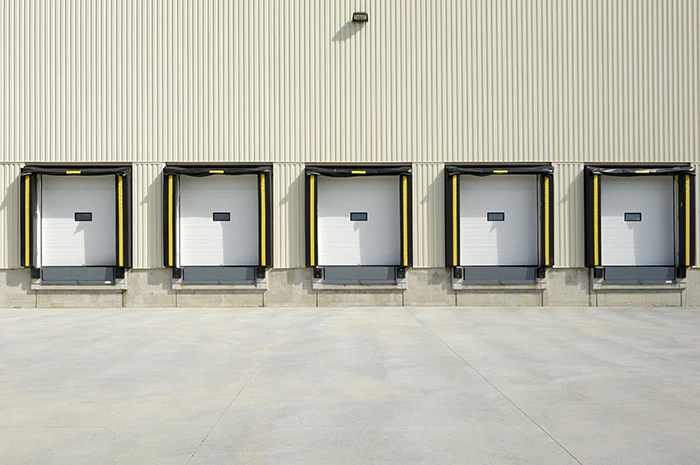
At first glance, dock shelters seem like simple protective components. But in reality, they’re the environmental control systems. When dock shelters are misaligned with vehicle types or poorly sealed, temperature loss occurs. Moisture enters. Contaminants compromise storage. This leads to product damage, energy waste, and safety risks. Therefore, it is equally essential to have a well-designed dock shelter that reduces climate fluctuation, speeds up loading transitions, and improves safety at the dock interface.
Conclusion
Operational excellence doesn’t begin out of nowhere with machines inside the building.
It begins at the points where movement normally starts and ends. Therefore, an optimized elevator, well-specified overhead doors, and engineered dock shelters are all needed to move operations without friction.