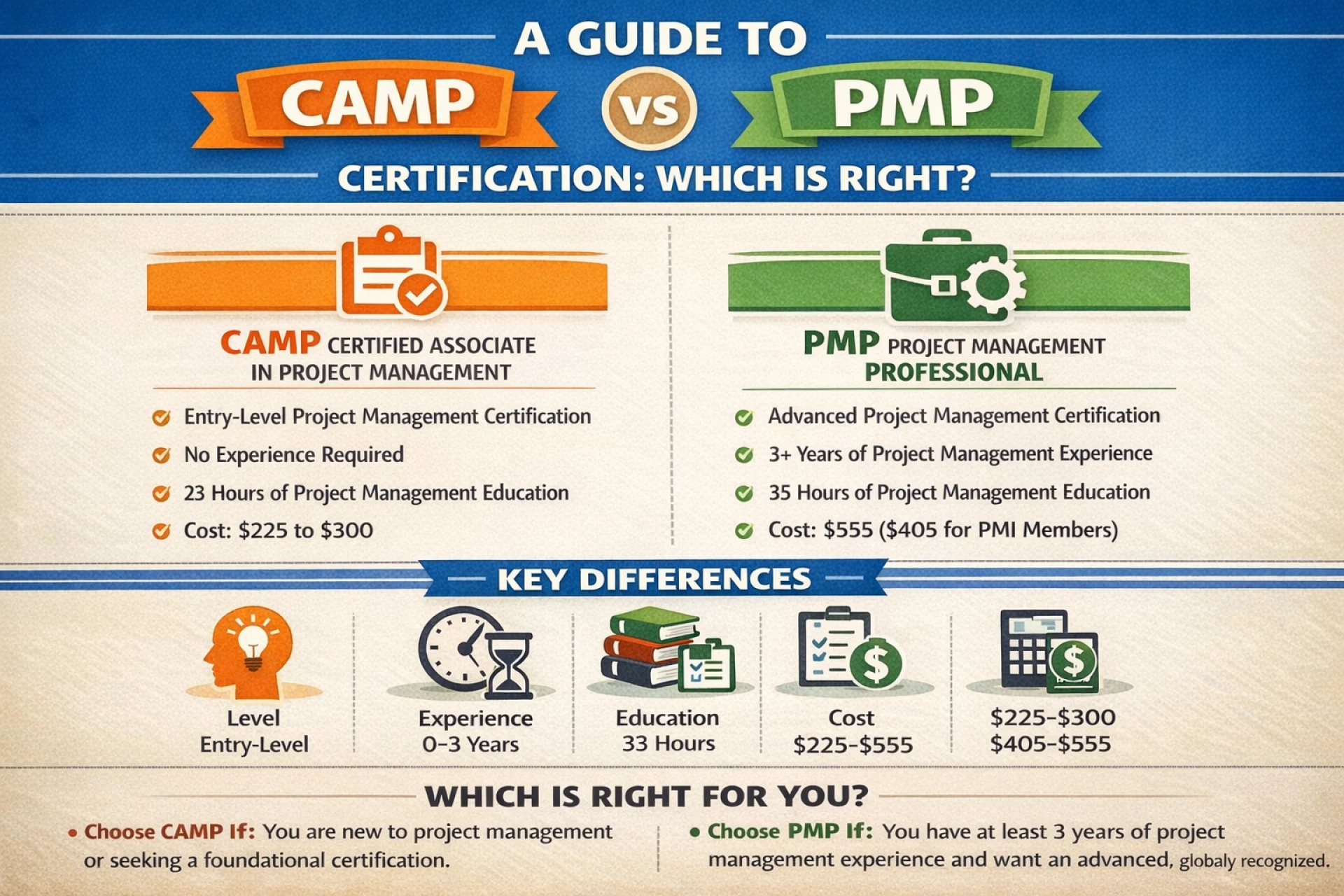
Deciding between the CAPM (Certified Associate in Project Management) and the PMP (Project Management Professional) is less about which is "better" and more about which one you are currently qualified to pass.
The Project Management Institute (PMI) designs these as two different stages of a career arc. One builds the foundation; the other validates the mastery.
The Eligibility Threshold
The most significant factor in your choice isn't your ambition—it's your resume. Before you study a single page of the PMBOK Guide, check these boxes:
CAPM Requirements
- Education: A high school diploma (or global equivalent).
- Project Experience: 0 hours.
- Training: 23 contact hours of formal project management education (which can be completed via an online course).
PMP Requirements
- Education: A 4-year degree (or high school diploma/associate degree).
- Project Experience: * With a degree: 36 months of unique, non-overlapping professional project management experience.
- Without a degree: 60 months of experience.
- Training: 35 contact hours of formal project management education.
Comparing the Exams
The experience of taking these two exams is vastly different.
- The CAPM is "Academic": It tests your ability to understand terms, processes, and the relationship between inputs, tools, and outputs. If the book says a project charter is created in the Initiation phase, that is the answer.
- The PMP is "Situational": It tests your judgment. A typical PMP question looks like this: "A stakeholder is unhappy with the frequency of updates. What should the Project Manager do first?" The answer isn't found in a glossary; it’s found in your ability to apply Agile, Predictive, and Hybrid methodologies to real-world friction.
Which One Should You Choose?
Go for the CAPM if:
- You are a recent graduate looking to stand out in a crowded entry-level job market.
- You are changing careers and need to prove you speak the language of PMO (Project Management Office).
- You want to work in project support roles like Project Coordinator or Junior Business Analyst.
Go for the PMP if:
- You have 3+ years of leading teams, even if your official job title wasn't "Project Manager."
- You want a significant salary bump. (The Earning Power report shows PMP holders earn a median salary roughly 33% higher than those without it).
- You are aiming for Senior PM, Program Manager, or Director roles.
Summary Table: At a Glance
Feature
CAPM
PMP
Model
Knowledge-based
Competency-based
Maintenance
Retest or earn PDUs every 3 years
Earn 60 PDUs every 3 years
Exam Fee
~$225 (Member) / ~$300 (Non-member)
~$405 (Member) / ~$555 (Non-member)
Global Recognition
High (for entry-level)
The Industry Gold Standard