Construction businesses rarely struggle because of poor workmanship. Most problems begin with unclear finances. When records are disorganized, decisions are based on guesswork instead of facts. This is why bookkeeping for construction industry is so important for contractors.
Construction work is constantly changing. Costs shift daily, labor hours vary, and payments come in stages. A basic system that only tracks income and expenses is not enough. Bookkeeping for construction industry must follow each project, each cost, and each payment from start to finish. Without this structure, growth often creates confusion instead of profit.
Many contractors feel busy but never see clear profits. Cash flow feels tight, even when projects are active. These issues usually build over time due to poor construction-specific bookkeeping. This guide explains how bookkeeping for construction industry works, why it is different, and how a specialized bookkeeper can bring long-term stability.
Why Bookkeeping for Construction Industry Is Different
Construction businesses operate very differently from standard service companies. Every project is unique, and financial activity changes constantly. That’s why bookkeeping for construction industry requires specialized knowledge.
Construction bookkeeping must handle:
- Job-based projects instead of fixed services
- Cost tracking by project, not just by month
- Progress billing and milestone payments
- Retainage that delays cash flow
- Change orders that affect revenue and costs
A general bookkeeper may record transactions correctly, but a professional trained in bookkeeping for construction industry understands how projects move financially.
Without specialized bookkeeping, contractors often face:
- Cash flow problems
- Incorrect billing
- Unclear job profits
- Tax and compliance risks
Job Costing: The Core of Construction Bookkeeping
One of the biggest differences in bookkeeping for construction industry is job costing. Instead of only tracking overall profit, contractors must track profit for each project.
Each job includes:
- Labor costs
- Materials
- Equipment usage
- Subcontractor expenses
- Overhead allocation
Proper job costing shows which projects are profitable and which are not. Without it, losses stay hidden and future bids become inaccurate.
Managing Multiple Projects and Payments
Most contractors manage several projects at once, each with different timelines and payment terms. Bookkeeping for construction industry must track:
- Overlapping jobs
- Progress invoices
- Partial payments
- Delayed collections
Accurate tracking ensures revenue is matched with the correct job costs. This reduces confusion and improves cash flow visibility.
Change Orders and Retainage Tracking
Change orders are common in construction and often missed financially. Bookkeeping for construction industry ensures:
- Approved change orders are recorded
- Additional costs are tracked
- Extra billing is not overlooked
Retainage also needs careful tracking. A professional bookkeeper monitors retained amounts, release schedules, and outstanding balances to protect cash flow.
Key Components of Bookkeeping for Construction Industry
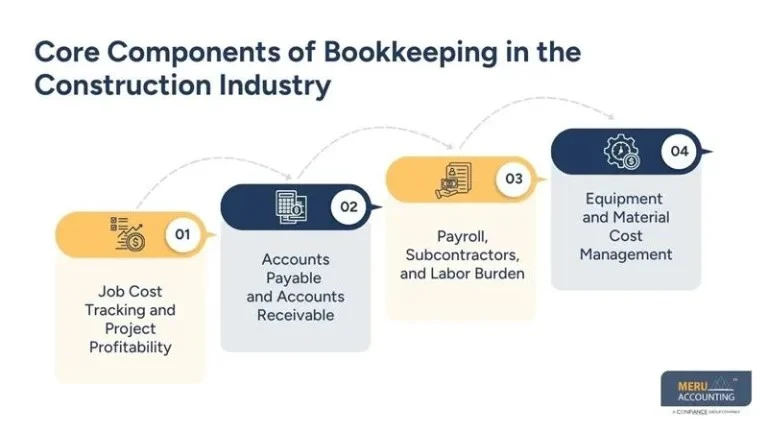
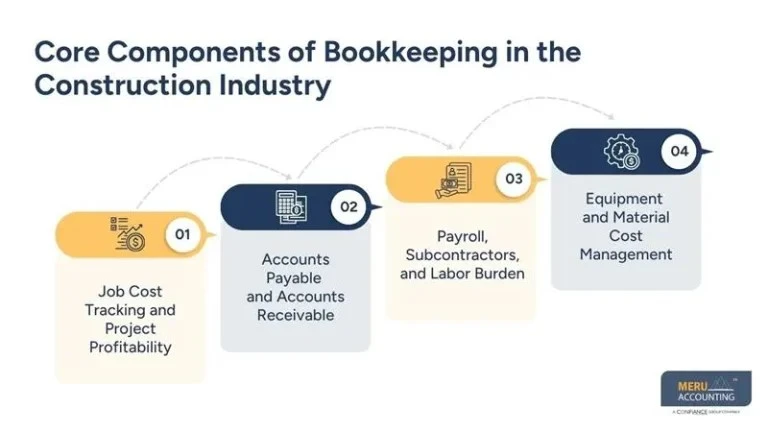
Effective construction bookkeeping includes:
- Job cost tracking and profit monitoring
- Accounts payable and receivable management
- Payroll, labor burden, and subcontractor payments
- Equipment and material cost tracking
Payroll and labor are major expenses. Proper allocation ensures true job profitability and compliance with labor rules.
Equipment and material costs must also be tracked accurately to avoid budget overruns and pricing surprises.
DIY vs Professional Construction Bookkeeping
Many contractors try to manage bookkeeping themselves. While this may work early on, it often leads to errors as the business grows.
DIY challenges include:
- Time pressure
- Higher risk of mistakes
- Missed deductions
- Compliance issues
Bookkeeping for construction industry requires experience and industry knowledge. Hiring a professional bookkeeper provides accurate job costing, reliable reporting, and peace of mind.
Bookkeeping for Construction Industry With Meru Accounting
Meru Accounting specializes in bookkeeping for construction industry. We understand the financial challenges contractors face and provide systems built specifically for construction businesses.
Our services include:
- Dedicated construction bookkeeping expertise
- Job costing and project profitability tracking
- Payroll and subcontractor management
- Change order and retainage tracking
- Contractor-focused financial reports
Whether you manage a few projects or many, our services scale with your business and bring clarity to your finances.
Key Takeaways
- Bookkeeping for construction industry is complex and project-based
- Job costing is essential for knowing real profits
- Cash flow depends on proper billing and retainage tracking
- Payroll and labor costs must be allocated correctly
- Professional bookkeeping reduces risk and saves time
- Meru Accounting provides construction-focused bookkeeping support