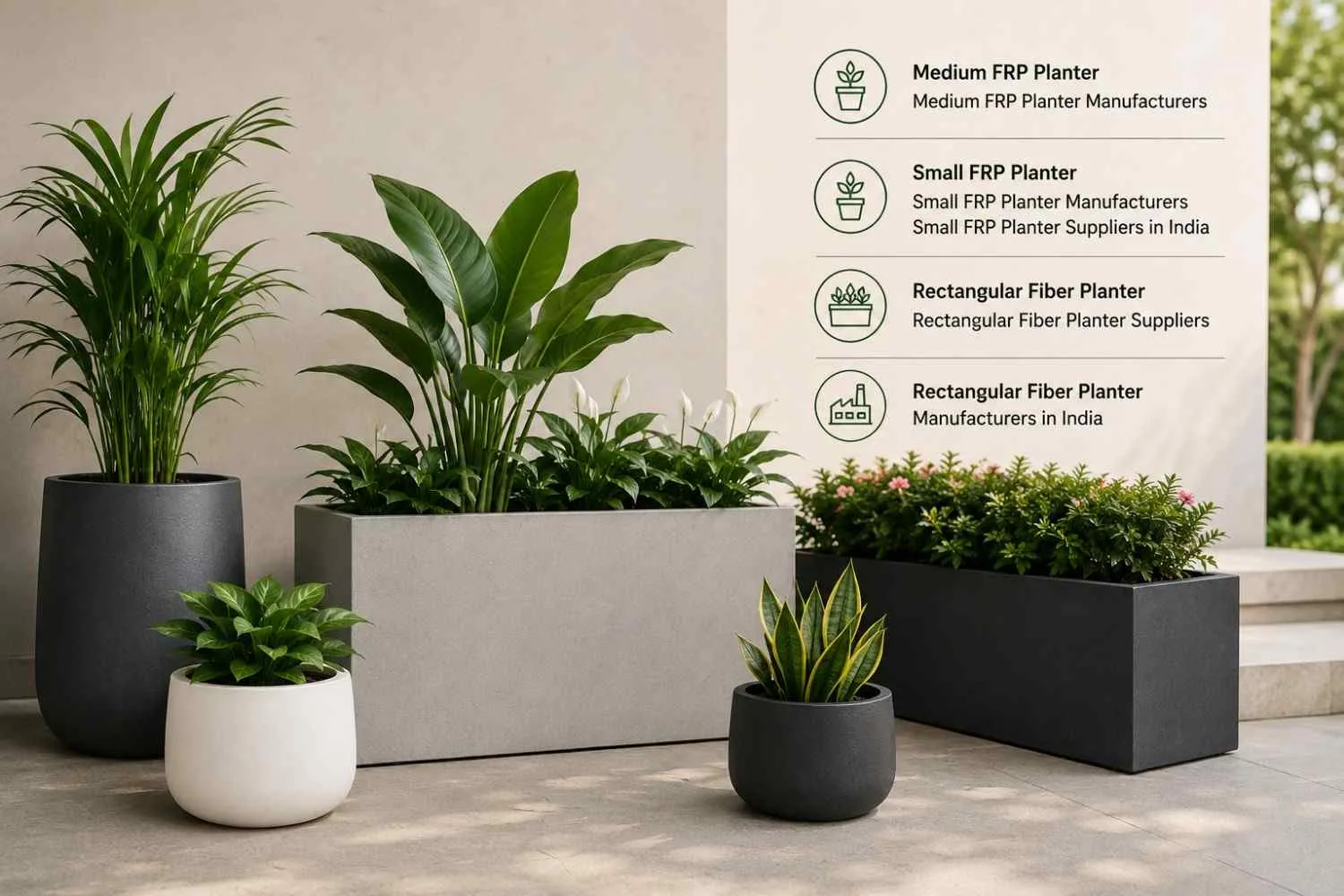
A delayed landscaping shipment can wreck an entire commercial handover schedule. Most buyers realise that only after the containers arrive with cracked edges, uneven finishes, or dimensions that don’t match the approved drawings. That’s exactly why sourcing the right Medium FRP Planter, Small FRP Planter, and Rectangular Fiber Planter matters far more than many procurement teams admit during the quotation stage.
And yet, a surprising number of buyers still choose suppliers based only on price per unit.
India’s commercial landscaping market crossed ₹12,000 crore in 2025 according to industry estimates, and FRP products continue gaining share because they reduce replacement frequency in hotels, malls, office parks, and residential projects. Lightweight structure, weather resistance, and lower freight breakage make FRP planters commercially practical. But supplier quality varies wildly. One batch lasts six years outdoors. Another fades within eight months.
That gap usually comes down to manufacturing discipline, not catalog photos.
The Specification Detail Most Buyers Ignore Until the Shipment Lands
Small FRP Planter Specifications That Actually Affect Durability
Most Small FRP Planter Manufacturers advertise size and colour options. Few discuss wall thickness consistency.
A planter with 3 mm thickness at the rim and 1.5 mm at the corners will eventually develop stress cracks during transport or outdoor exposure. That failure rarely shows up in factory photos. It appears after installation. Buyers then fight over responsibility while the project timeline burns.
Typical commercial-grade small FRP planters include:
- Thickness range: 3 mm to 5 mm
- UV-resistant gel coating
- Drainage provision
- Matte, textured, or glossy finish
- Weight range: 2.8 kg to 9.5 kg depending on size
- Common dimensions: 12", 18", 24", and 30"
Here’s what buyers overlook: drainage hole reinforcement. Poor reinforcement weakens the planter base over time, especially in rooftop landscaping projects where water retention becomes unavoidable.
Why Medium FRP Planter Orders Get Delayed More Often
Medium-sized planters sound simple until stacking and transport begin.
A standard Medium FRP Planter used for commercial landscapes often ranges between 24 and 42 inches in length. That size increases mould dependency. If a manufacturer lacks stable mould maintenance practices, shape variation starts appearing across batches.
Nobody tells you this during negotiations.
Factories running old mould systems often compensate with excessive putty work. The planter looks acceptable in photos, but edge symmetry fails during installation. Landscape contractors notice immediately.
Common specifications include:
- Length: 24–48 inches
- Load-bearing support for soil density
- UV-stabilised coating
- Indoor and outdoor compatibility
- Fiberglass reinforcement layers
- Weather resistance from -10°C to 55°C
India exported over $2.1 billion worth of fiberglass-based industrial products in FY 2025. Buyers increasingly demand dimensional consistency because overseas hospitality projects reject visible variation fast.
Rectangular Fiber Planter Production Is Harder Than It Looks
Straight-line finishing exposes manufacturing flaws quickly.
That’s why experienced Rectangular Fiber Planter Suppliers invest heavily in mould precision and sanding quality. A curved planter can visually hide minor imperfections. A rectangular design cannot.
Which means edge alignment, corner bonding, and paint curing quality matter more than decorative styling.
Commercial rectangular planters generally include:
- Powder-coated or textured finish
- Reinforced corner joints
- Anti-fade exterior coating
- Custom branding or colour matching
- Indoor lobby and outdoor façade compatibility
A supplier who avoids discussing resin composition usually has something to hide.
Five Supplier Checks Procurement Teams Should Never Skip
1. Ask for Batch Consistency Photos — Not Catalog Images
Good answer:
Recent production images from multiple shipment batches.
Bad answer:
“We customise every piece, so variation is normal.”
That statement becomes expensive once installation starts.
2. Verify Export Packaging Standards
Reliable Rectangular Fiber Planter Manufacturers in India use layered wrapping, foam edge protection, and pallet stability checks.
Bad answer:
“We normally manage transport issues case by case.”
That is not a logistics policy. That is a future argument.
3. Check UV Coating Specifications
Good suppliers specify coating type and outdoor suitability duration.
Bad answer:
“Outdoor use is generally fine.”
Generally fine is how projects get replacement complaints after one summer season in Ahmedabad or Gurgaon.
4. Evaluate Lead Time Honesty
A manufacturer producing 2,000 units monthly should not promise 15-day dispatch for a 5,000-unit customised order.
Most buyers underestimate how long curing and finishing actually take.
5. Confirm Replacement and Damage Policies in Writing
Professional Small FRP Planter Manufacturers document transit breakage procedures before dispatch.
Bad answer:
“Please share photos after delivery and we’ll review.”
That review often disappears after payment clearance.
How the Right FRP Planter Supplier Protects Buyer Margins
Reduced Freight Costs
FRP planters weigh substantially less than concrete alternatives. For interstate commercial deliveries, that difference changes freight budgeting fast. Some logistics firms report up to 28% lower transportation costs on comparable volumetric loads.
Lower Replacement Frequency
A properly manufactured Medium FRP Planter resists corrosion, moisture absorption, and fungal damage far better than untreated metal or low-grade polymer products.
Which means maintenance budgets remain predictable.
Faster Site Installation
Commercial landscaping teams prefer lighter units because handling becomes easier during phased construction schedules. Labour fatigue drops. Breakage rates drop too.
Better Visual Uniformity Across Large Projects
This matters more than many procurement managers expect.
A hotel entrance using 60 rectangular planters with inconsistent paint finish immediately looks poorly executed. Consistency affects perceived property value.
Easier Customisation for Brand Projects
Experienced Rectangular Fiber Planter Suppliers can match RAL shades, texture patterns, and dimensional requirements for hospitality chains, retail brands, and architects.
Outdoor Weather Resistance
India’s temperature swings are brutal on poor-quality resin mixes. High-grade FRP performs better in coastal humidity, northern winters, and western heat zones.
Cheap resin blends usually fail first at the corners.
Why India Remains a Major Sourcing Hub for FRP Planters
India’s fiberglass manufacturing ecosystem expanded rapidly after 2018 because raw material availability and fabrication expertise improved across industrial clusters like Gujarat, Haryana, Maharashtra, and Tamil Nadu.
That geographic spread matters.
Northern suppliers often dispatch faster to NCR, Punjab, and Rajasthan projects, while western manufacturers manage export container movement more efficiently through Mundra and Nhava Sheva ports.
Reliable Small FRP Planter Suppliers in India also benefit from lower tooling costs compared to European manufacturers. That allows better customisation flexibility without forcing buyers into massive MOQs.
And yet, buyers still make the mistake of choosing suppliers with no factory verification.
A polished website is not manufacturing proof.
Several procurement disputes in 2024 involved traders presenting third-party factory photos as their own production facilities. Buyers discovered the difference only after delivery delays began.
About Us
At Terre Pure, we work directly with wholesalers, project procurement teams, architects, and commercial landscaping buyers across India. We’ve seen projects fail over details most suppliers never mention during quotation discussions — mould wear, poor curing cycles, weak corner reinforcement, and rushed paint finishing before dispatch.
We started rejecting one particular resin blend in late 2022 after repeated outdoor fading complaints from high-UV installation zones in Rajasthan. Rather than disputing with buyers about exposure to conditions, we modified suppliers, changed curing schedules, and improved inspection standards.
That shaped our approach to production approval and dispatch inspection.
For buyers evaluating long-term sourcing partnerships, our product range includes commercial Small FRP Planter, Medium FRP Planter, and custom rectangular fiberglass planter solutions built for both indoor and exterior applications.
If you’re sourcing for hospitality projects, retail developments, corporate campuses, or distributor inventory, send us the following before requesting pricing:
- Required dimensions
- Quantity
- Finish preference
- Delivery location
- Expected dispatch timeline
- Reference drawings or photos
At Terre Pure, we usually respond within one business day for standard enquiries. MOQ depends on size and finish requirements, though most commercial customised orders begin from 25–50 units. And yes, we’ll tell you honestly if your delivery timeline is unrealistic before taking the order.
Conclusion
Choosing the right Medium FRP Planter, Small FRP Planter, or Rectangular Fiber Planter supplier is less about catalog variety and more about manufacturing discipline. Buyers who verify coating quality, mould precision, and packaging systems usually avoid the costly disputes that appear after dispatch. India is partnering with nations around the world to consolidate its position as the primary provider of FRP. Operational transparency is the only difference between a reliable partner and a dangerous one. The next few years will likely reward manufacturers who prioritise consistency over aggressive quotation pricing.
Here is another blog you might be interested in
Why Large FRP Planter Suppliers Are Essential for Commercial Landscaping Projects
FAQs
What is the average lifespan of a Rectangular Fiber Planter?
Commercial-grade FRP planters generally last 5–8 years outdoors with proper coating quality. Coastal installations may require additional UV protection depending on exposure levels.
Why are Rectangular Fiber Planter Suppliers preferred for commercial landscaping?
Designs with rectangles can efficiently serve as entrances, partitions, edge finishes for terraces, and lobby layouts. Skilled suppliers of Rectangular Fiber Planters can, therefore, manage dimensions that are more custom to architectural design projects.
Do Small FRP Planter Suppliers in India offer low MOQ orders?
Some do, especially for standard mould sizes. Custom colours and textures usually increase MOQ requirements because setup and finishing costs rise sharply on small production runs.
What causes cracking in Medium FRP Planter products?
Usually poor resin balance or inconsistent thickness. Transportation handling also matters. A badly packed planter can crack even if the manufacturing quality was acceptable.
Are Rectangular Fiber Planter Manufacturers in India competitive globally?
Yes. Indian manufacturers remain cost-competitive because tooling and labour costs are lower than many western markets. Still, buyers should evaluate process control carefully instead of assuming every supplier operates at export quality.