
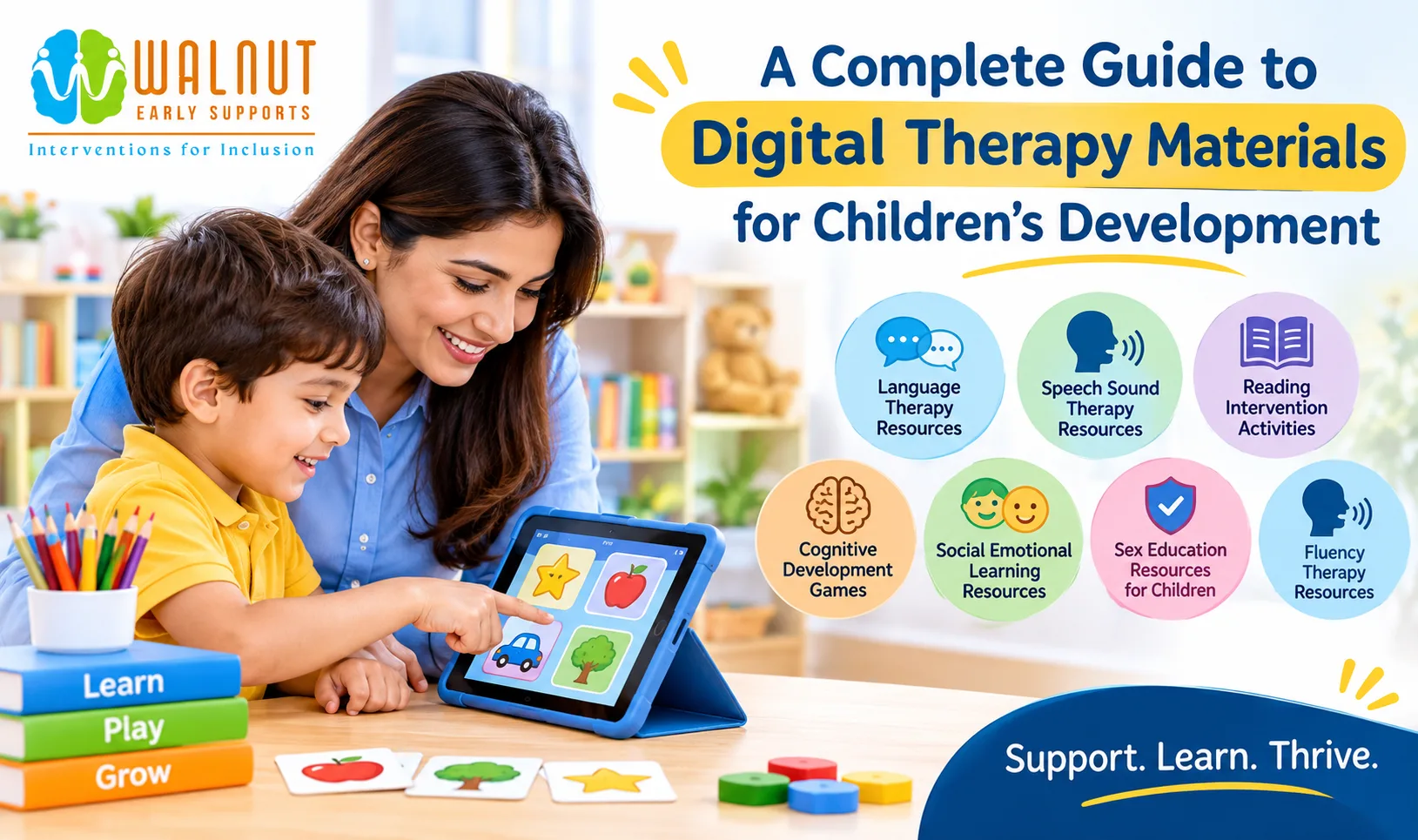
Children develop different skills at different stages of life. While some children learn communication and language skills easily, others may need additional support with speech, reading, attention, memory, social interaction, or emotional understanding. Providing suitable learning opportunities can help children strengthen these abilities and become more independent in everyday activities.
Digital therapy materials have become a valuable resource for supporting children's development through interactive games, visual activities, and structured exercises. These resources allow speech-language pathologists (SLPs), educators, therapists, and parents to work on specific developmental goals while making learning more engaging.
In this guide, we explore different types of digital therapy materials, their benefits, and how they can support children's overall development.
1. What Are Digital Therapy Materials?
Digital therapy materials are online learning resources designed to support children's developmental and therapeutic needs. They include interactive games, picture-based exercises, quizzes, visual activities, and structured learning tasks.
These resources can be used to practise various skills, including communication, pronunciation, reading, cognitive abilities, emotional understanding, and fluency.
Unlike traditional printed activities, digital resources often provide interactive experiences that encourage children to participate actively. They can also be used across different settings, including therapy clinics, schools, teletherapy sessions, and home environments.
2. Language Therapy Resources for Communication Development
Language development helps children understand information, express their thoughts, follow instructions, and communicate with others.
Language therapy resources provide structured activities to improve receptive and expressive language skills.
Common activities include:
- Picture identification to develop vocabulary.
- Word association games to improve word understanding.
- Sentence-building exercises to support expressive language.
- Listening activities to improve comprehension.
- Storytelling exercises to encourage communication.
These activities can help children develop vocabulary, understand sentence structures, and communicate their needs more effectively.
3. Speech Sound Therapy Resources for Better Pronunciation
Some children experience difficulties producing particular speech sounds correctly. These difficulties may affect speech clarity and make communication challenging.
Speech sound therapy resources help children practise articulation and phonological skills through structured exercises.
Examples include:
- Identifying and recognizing speech sounds.
- Practising target sounds in initial, medial, and final word positions.
- Repeating words using picture prompts.
- Practising target sounds in sentences.
- Participating in interactive articulation games.
Activities should be selected according to the child's speech difficulties and individual therapy goals. Regular guided practice can support the development of clearer speech.
4. Reading Intervention Activities for Literacy Skills
Reading is an important part of academic and language development. Children may need additional support with recognizing sounds, blending letters, spelling words, and understanding written information.
Reading intervention activities provide opportunities to practise foundational literacy skills through engaging exercises.
Some useful activities include:
- Rhyming games to recognize similar-sounding words.
- Sound blending and segmentation exercises.
- Letter and word recognition activities.
- Spelling and vocabulary games.
- Reading comprehension exercises.
- Sentence sequencing activities.
These activities can strengthen phonological awareness, decoding, spelling, and comprehension skills while making reading practice more interactive.
5. Cognitive Development Games for Thinking and Reasoning
Cognitive development involves the mental abilities children use to think, remember, understand, and solve problems.
Cognitive development games provide opportunities to practise different thinking skills through interactive challenges.
Examples include:
- Memory games to improve recall.
- Matching activities to develop visual recognition.
- Sequencing exercises to understand patterns and order.
- Puzzles to encourage problem-solving.
- Attention activities to practise concentration.
- Logical reasoning games to develop decision-making.
These activities can also support executive functioning, mathematical reasoning, and visual-spatial skills. Choosing suitable challenges according to a child's developmental level helps make practice more effective.
6. Social Emotional Learning Resources for Social Development
Social and emotional skills help children recognize their feelings, understand others, build relationships, and respond appropriately to different situations.
Social emotional learning resources introduce these concepts through interactive activities, visual stories, and real-life examples.
Children can practise:
- Identifying and naming different emotions.
- Recognizing facial expressions.
- Understanding social situations.
- Learning to share and take turns.
- Developing appropriate social responses.
- Understanding empathy and personal boundaries.
Social stories and emotion-based games can help children develop emotional awareness, self-regulation, and positive interaction skills.
7. Sex Education Resources for Body Awareness and Safety
Age-appropriate sex education is an important part of children's development and personal safety. Children need to understand their bodies, privacy, boundaries, and safe relationships.
Sex education resources for children can introduce these topics through simple explanations, illustrations, and structured activities.
Important learning areas include:
- Understanding body parts and body awareness.
- Learning about private body parts.
- Recognizing safe touch and unsafe touch.
- Understanding personal boundaries and consent.
- Learning about privacy and appropriate behaviour.
- Understanding puberty and body changes at an appropriate age.
These resources should use clear, respectful, age-appropriate language and consider each child's communication and learning abilities.
8. Fluency Therapy Resources for Speech Development
Fluency refers to the smooth and natural flow of speech. Some children experience stuttering or cluttering, which may affect their speaking rhythm, timing, and communication.
Fluency therapy resources provide structured opportunities to practise speech under the guidance of a qualified speech-language pathologist.
These may include:
- Structured speaking exercises.
- Reading and repetition activities.
- Speech pacing exercises.
- Metronome-based practice.
- Delayed Auditory Feedback (DAF) tools.
The selection of fluency activities should depend on the child's individual communication needs and professional assessment.
9. Benefits of Using Digital Therapy Materials
Digital resources can offer several advantages when incorporated into an appropriate therapy or learning programme.
Interactive learning: Pictures, animations, and game-based exercises can encourage active participation.
Individualized practice: Activities can be selected according to a child's age, abilities, and developmental goals.
Flexible access: Online resources can be used in clinics, schools, teletherapy sessions, and at home.
Consistent reinforcement: Parents and educators can reinforce skills introduced during therapy sessions.
Multiple learning areas: A digital resource library can provide activities for language, speech sounds, reading, cognition, emotional development, body safety, and fluency.
However, digital activities should complement professional guidance, meaningful communication, and real-life learning experiences rather than replace them.
10. How to Choose the Right Digital Therapy Materials
Selecting suitable resources requires an understanding of the child's developmental abilities and learning requirements.
Consider the following factors:
- Age and developmental level: Choose activities appropriate for the child's abilities rather than age alone.
- Individual learning goals: Identify the skills that need additional support.
- Activity difficulty: Begin with manageable tasks and gradually increase complexity.
- Interactive features: Look for clear visuals, simple instructions, and engaging exercises.
- Skill coverage: Select resources that address relevant developmental areas.
- Progress monitoring: Observe the child's participation and adjust activities when necessary.
Parents and therapists should work together to ensure that activities remain suitable as children develop new skills.
Conclusion
Digital therapy materials provide valuable opportunities to support children's speech, language, literacy, cognitive, social, emotional, and communication development. From articulation exercises and reading games to memory challenges, social stories, body-safety activities, and fluency practice, different resources can address different developmental needs.
The most important step is selecting activities according to each child's abilities, interests, and learning goals. With appropriate guidance, consistent practice, and engaging learning experiences, digital therapy resources can become a useful part of children's developmental journeys.