Artificial Intelligence is becoming an important part of India's digital transformation. Businesses, educational institutions, startups, and technology companies are exploring AI-powered solutions to improve productivity, automate repetitive tasks, and deliver better services. Among the emerging technologies, Generative AI is gaining attention because it can create text, images, code, summaries, and other forms of digital content.
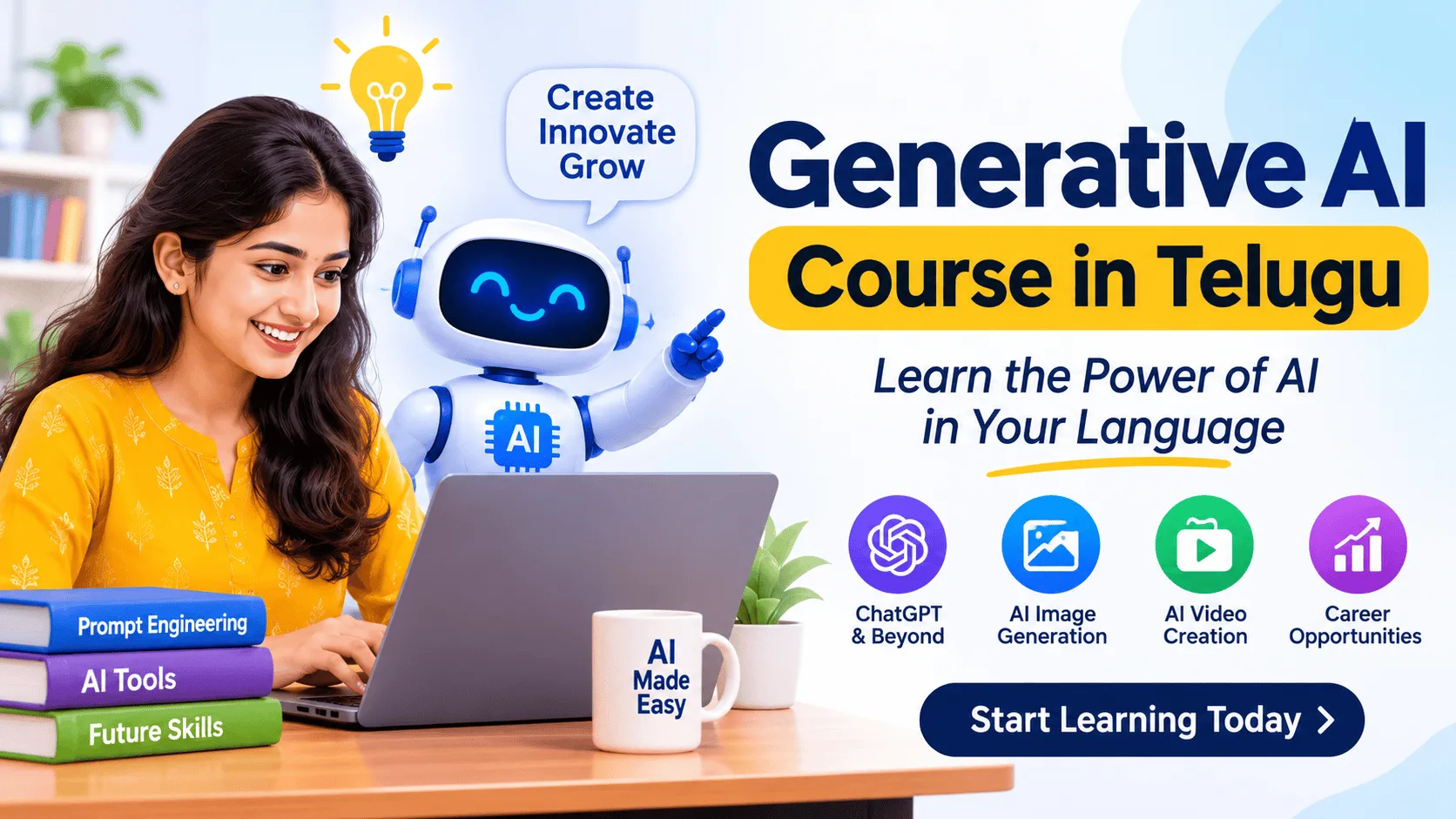
As organisations continue experimenting with this technology, learning Generative AI can help students and working professionals prepare for changing career requirements. A Generative AI Course in Telugu can provide beginners with a structured introduction to AI concepts, practical tools, and industry applications.
What Is the Future Scope of Generative AI in India?
India has a growing technology ecosystem, a large digital services sector, and increasing interest in AI adoption. Generative AI can support several business activities, including software development, customer communication, content creation, education, research, and data management.
Its future growth will depend on factors such as business investment, infrastructure, skilled professionals, data availability, regulations, and the ability to implement reliable AI solutions.
1. Growing Opportunities in the IT Industry
The Indian IT industry is exploring Generative AI for software development, code assistance, documentation, testing support, and application modernisation.
Developers can use AI assistants to understand unfamiliar code, generate initial code suggestions, and prepare technical documentation. However, developers must verify generated code for security, performance, and correctness.
Professionals who understand programming along with AI integration may find opportunities in AI-powered application development.
2. Expansion of AI-Powered Startups
India's startup ecosystem provides opportunities to build products around specific business problems. Entrepreneurs and developers can explore solutions such as AI-based learning assistants, document-processing platforms, customer-support chatbots, and business automation tools.
For example, a startup could develop an AI assistant that answers questions using a company's approved product documents. Such solutions need proper data protection, testing, and human oversight.
3. Transformation of Education and Learning
Generative AI can make learning more interactive by providing explanations, practice questions, summaries, and personalised study support.
Students can use AI assistants to understand difficult subjects, practise interview questions, and explore programming concepts. Teachers can use AI to prepare draft lesson materials and learning activities.
Learning platforms may also explore regional-language AI solutions to make technical education more accessible.
4. Opportunities in Digital Marketing
Digital marketing teams can use Generative AI for content planning, campaign ideas, advertisement drafts, email writing, and customer communication.
AI tools can support keyword research workflows, content outlines, and creative brainstorming. However, marketers still need SEO knowledge, audience understanding, fact-checking, and editorial skills to produce valuable content.
5. AI Adoption in Banking and Healthcare
Financial organisations can explore Generative AI for document summaries, internal knowledge assistants, customer-service support, and report preparation.
Healthcare organisations may use it to support administrative documentation, research summaries, and information retrieval. Sensitive decisions must remain under qualified professional supervision, with appropriate privacy and safety controls.
6. Future Career Opportunities
As AI adoption develops, different job roles may become relevant across industries. Examples include:
- Generative AI Developer: Builds applications using language models and AI APIs.
- AI Application Developer: Integrates AI capabilities into software products.
- Prompt Engineer: Designs and evaluates instructions for AI systems.
- AI Automation Specialist: Develops workflows that combine AI with business tools.
- Machine Learning Engineer: Develops and maintains machine learning systems.
- AI Product Specialist: Helps teams identify requirements and evaluate AI-powered products.
Job availability and responsibilities will vary by employer. Candidates should build skills that match actual job descriptions rather than depending on job titles alone.
Skills Required to Prepare for the Future
Learners interested in this field should gradually develop the following skills:
- Artificial Intelligence and Machine Learning fundamentals.
- Python programming and basic problem-solving.
- Prompt engineering and responsible AI usage.
- Large Language Models and their applications.
- APIs and AI application integration.
- Retrieval-Augmented Generation (RAG).
- Cloud platforms, databases, and deployment basics.
- Testing, data privacy, and AI evaluation.
A practical Generative AI Course in Telugu should combine theoretical concepts with assignments and real-world projects.
How Beginners Can Prepare
Start by understanding basic AI concepts and experimenting with conversational AI tools. Next, learn Python fundamentals and explore how language models work. Build small projects such as a chatbot, document summariser, or AI-powered study assistant.
Maintain a portfolio that explains the problem, technologies used, development process, and project results. Continuous learning is important because AI tools and development frameworks change frequently.
Frequently Asked Questions
1. Does Generative AI have a future in India?
Generative AI has potential across India's IT, education, finance, marketing, healthcare, and startup sectors. Its adoption will depend on business needs and successful implementation.
2. Can freshers build a career in Generative AI?
Yes. Freshers can prepare for suitable entry-level opportunities by learning fundamentals, practising with AI tools, and developing relevant projects.
3. Is Python necessary for Generative AI?
Python is useful for technical AI development and application building. Some tool-based and business-focused roles may require less programming.
4. Which industries may benefit from Generative AI?
IT, banking, healthcare, education, manufacturing, marketing, and customer service are among the industries exploring its applications.
5. How can I start learning Generative AI in Telugu?
Choose a structured learning programme, understand AI fundamentals, practise prompt writing, learn programming basics, and build practical projects.
Conclusion
The future scope of Generative AI in India includes opportunities in technology, education, business automation, marketing, and other industries. However, career growth will depend on practical knowledge, problem-solving ability, and continuous learning. By choosing a suitable Generative AI Course in Telugu and developing industry-focused projects, beginners can prepare themselves to participate in the evolving AI ecosystem.