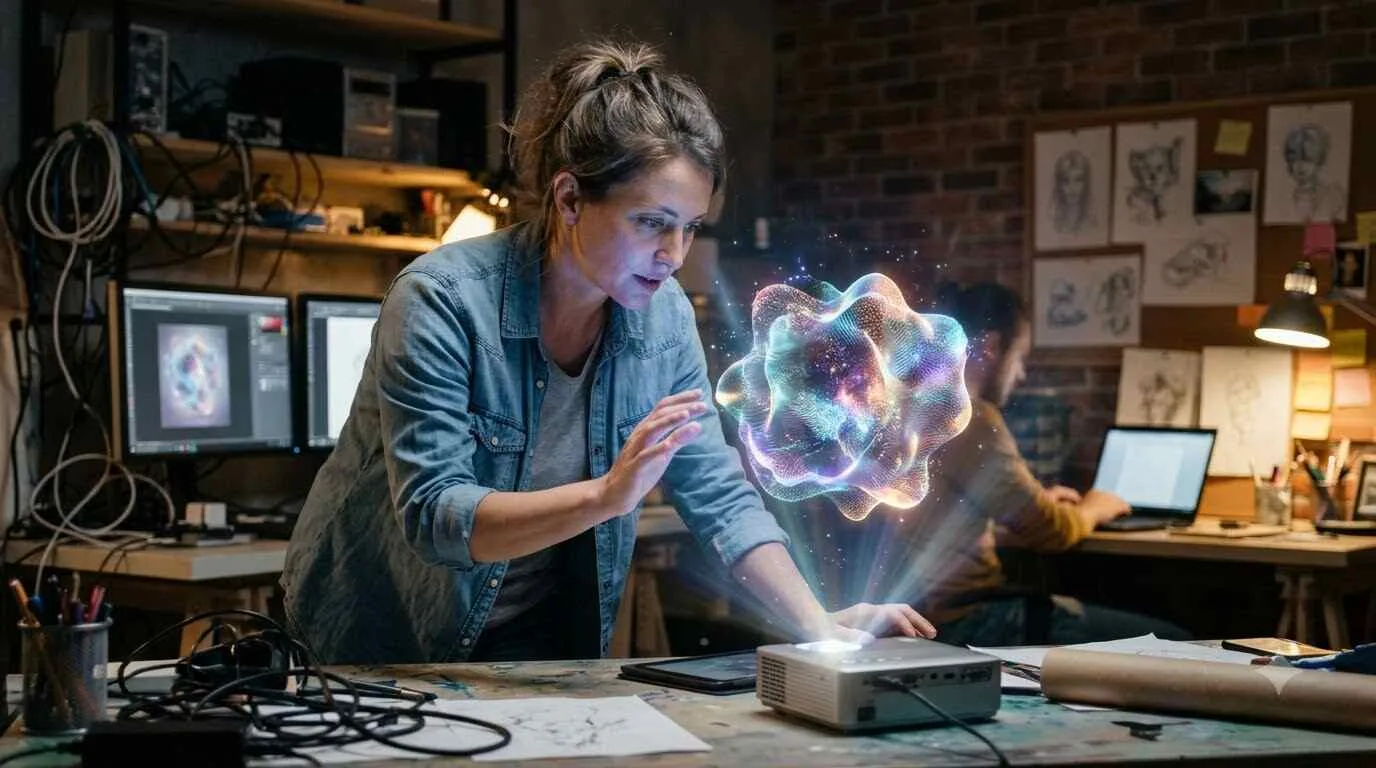
A hologram projector can help a brand explain a product, stop passers-by or stage a launch, provided the technology fits the job. This article sets out nine practical benefits and the checks that decide whether each one holds up. First, a note on terms, because most commercial "hologram" products are not true holograms.
- LED fan displays: spinning LED blades that rely on persistence of vision. They suit windows and counters.
- Pepper's Ghost: a reflection on angled glass or foil. It suits controlled, darker venues.
- Transparent displays: screens that place digital content over real products.
- Light-field displays: multiple simultaneous views let groups see depth without glasses.
- Volumetric displays: image points formed in space. A 2018 Nature paper showed the principle at laboratory scale only.
- Digital holography: a distinct field where reviews still list heavy computation among the main hurdles.
1. Capture Attention in Competitive Environments
Depth and movement can set a display apart in a crowded shop front, showroom or exhibition hall. Placement and viewing distance matter as much as the hardware, because the effect weakens at poor angles. Position the display where people naturally pause, and test sightlines at standing and seated eye levels.
According to supplier HYPERVSN, HUGO used a three-unit LED fan wall in its Milan store window to show a life-size digital twin of an influencer. Attention still depends on relevant content. A holographic display does not automatically outperform a well-made conventional screen.
2. Make Complex Products Easier to Understand
Rotation, cut-aways and exploded views can show how a product is built, which flat photography struggles to do. This suits consumer electronics, automotive components, industrial equipment and medical devices.
Citizen Watch used a transparent OLED display case in a New York department store to reveal the inner workings of real watches, according to LG's case study. Script any demonstration around the questions buyers actually ask.
3. Create More Immersive Brand Experiences
An immersive experience asks the visitor to take part. A decorative display only asks them to look. Spatial displays can anchor a launch, a flagship store or a trade-show stand when they connect to lighting, sound and a clear story.
Without that connection, the technology becomes a backdrop and visitors treat it like one. Ask what the visitor does, learns or decides differently afterwards. If the answer is nothing, it is decoration.
4. Support Product Storytelling
Three-dimensional sequences can walk viewers from raw material to finished product, or reveal a mechanism that is normally hidden. This helps when the subject is technical or abstract.
Build short loops around one idea each, so a passing viewer can follow the story at any point. Pair the visuals with short, plain captions so the message survives without sound.
5. Present Products in New Ways
Large, fragile, premium and customisable products are hard to show in person. A transparent display can layer information over a real item, as in the Citizen Watch case. A 3D model can show variants without stocking each one.
These displays supplement physical inspection. They do not replace it.
6. Create Distinctive Event and Exhibition Presentations
Pepper's Ghost has staged illusions since the 1860s. Modern versions appeared at Coachella in 2012 and at Melbourne's National Sports Museum in 2008, as Cosmos magazine reports.
Results depend on content, audience flow and lighting, because the illusion needs a dark backdrop and clear sightlines. Measure light, ceiling height and throw distance before requesting quotes, as this guide to hologram projector room requirements explains.
7. Communicate Consistent Brand Visuals Across Locations
Some systems include cloud content management. HYPERVSN's CMS, for example, lets operators manage devices and content remotely. That supports templates, scheduling and campaign updates from one place, with room for local adaptation within brand guidelines.
Not every display offers this, so ask before you buy.
8. Help Brands Demonstrate Innovation
A new display format can support an innovation story, but only when it serves the customer. HYPERVSN reports that Nike installed LED fan walls at its House of Innovation in Paris to augment the store experience.
Buying a hologram projector does not make a company innovative. A clear customer problem and thoughtful content do. Ask what the display lets customers do that an ordinary screen could not.
9. Create Opportunities for Interactive Customer Experiences
Interactivity comes in levels: passive displays, touch or gesture displays, sensor-enabled installations and fully integrated systems linked to apps or product data. HUGO's Milan window added a gesture camera, so passers-by could swipe through outfits without touching the glass.
Not every hologram projector supports gesture control. Confirm hardware and software support first. Start with the simplest level that meets your goal, because each step adds cost, maintenance and testing.
Before You Invest: A Practical Checklist
The value of any display depends on the objective, the execution, the audience and the fit of the technology. Before buying, check:
- Audience and campaign objective.
- Display technology and viewing angles.
- Ambient lighting and installation space.
- Content production needs.
- Hardware and software compatibility.
- Installation, maintenance and total cost of ownership.
- Accessibility and audience movement, including seated viewers.
Start with one clear objective, pilot in the real location and judge the result against that objective. Treat supplier claims about sales or engagement as claims to verify, not benchmarks.