
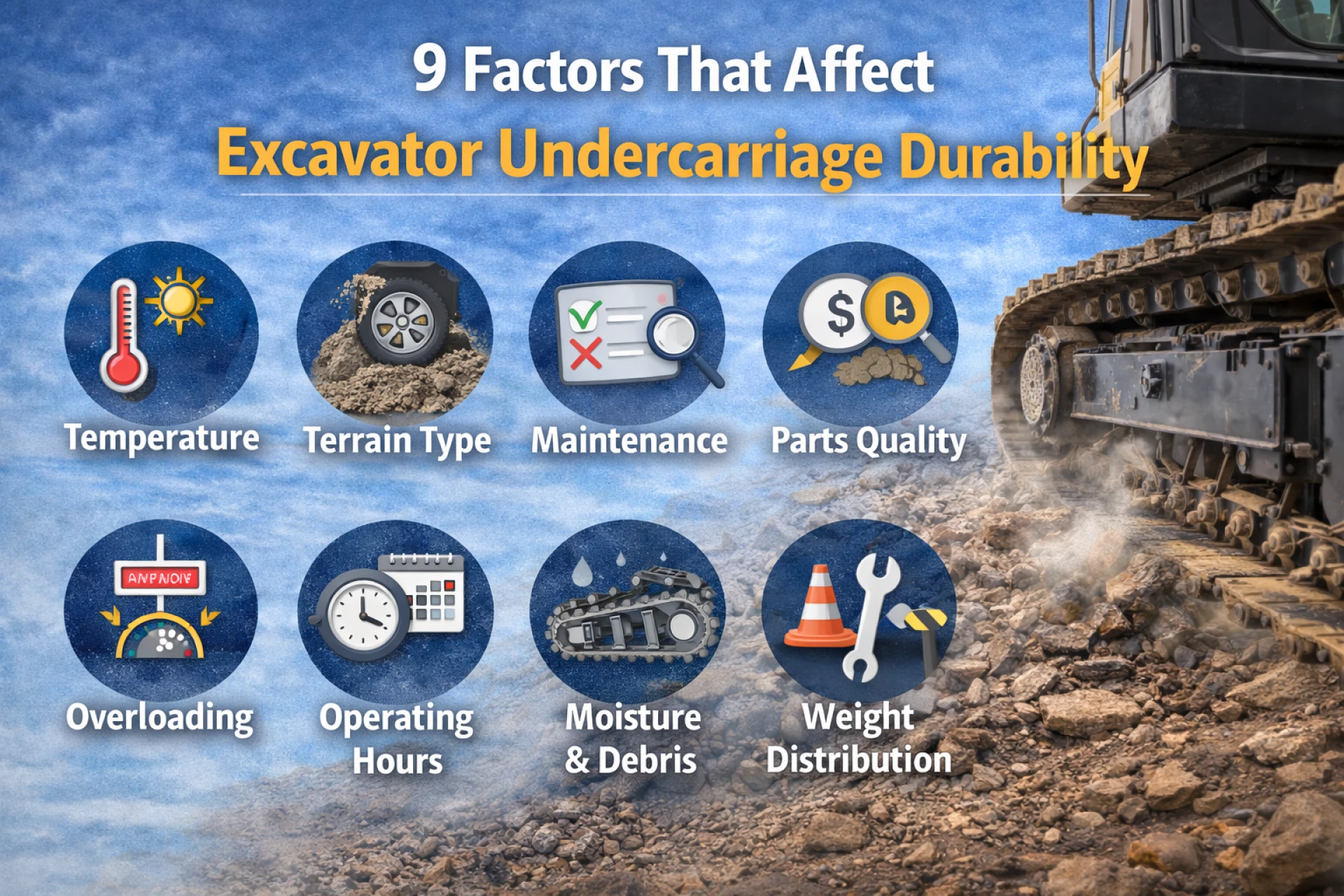
Every expense involved in operating an excavator falls into one category, which is the highest cost for fleet managers. This single system often accounts for nearly 50% of the machine's lifetime maintenance expenses. Because these parts operate in constant contact with the ground, they endure the most punishing conditions on a job site. The service life of your excavator undercarriage parts will improve when you understand the operational parameters that control your maintenance practices.
Top 9 Aspects Impacting the Durability of Excavator Undercarriage
Here are the aspects to consider-
1. Ground Conditions and Terrain Abrasiveness
The environment in which you work determines how quickly your components will wear. The jagged rock, shale, and sand surfaces create friction that acts like sandpaper against the metal components. The abrasive materials cause your excavator's undercarriage components to wear more quickly than they would in soft clay or topsoil. The movement of sand causes it to enter the joints of equipment. This results in internal bushing damage from grinding.
Chemical factors also play a massive role in durability. Standing water or acidic soil compositions can lead to rapid corrosion. If moisture appears on the steel, it weakens the surface and can eventually compromise the seals that protect the internal lubrication.
2. Managing Excavator Undercarriage Parts Through Work Intensity
Each hour your machine is in motion adds to the system's baseline wear. However, not all hours are equal. You must distinguish between stationary digging and heavy "tramming" or travelling. If you frequently move the excavator over long distances, you generate significant heat within the rollers and links. This heat softens the metal slightly and speeds up the friction-based degradation of the pins.
High-duty cycles involving constant movement under load place immense stress on the drive motor and the track groups. You can reduce this intensity by planning your site layout to minimise the distance the machine needs to travel.
3. Managing the Track Tension
A common mistake in the field is improper track tension. Suppose you tighten the tracks too much. You may create unnecessary loads on the bushings as well as pins. Tight tracks also force the engine to work harder. This may waste fuel while straining the entire drive assembly.
On the other hand, loose tracks present their own set of problems. If your tracks sag too much, you risk de-tracking. That may result in significant damage to the idlers & frames. Loose tracks often lead to uneven wear on sprocket teeth as the bushings do not seat correctly in the tooth gaps.
4. Operator Habits and Manoeuvring Techniques
The person at the controls has a direct impact on the steel's lifespan. High-speed pivoting or counter-rotation on a single spot puts immense lateral pressure on the track links. This sideways force can bend components or cause the track to pop off the rollers. You should encourage operators to make wide, gradual turns whenever the site space allows.
Another issue is preferential turning. Many operators have a habit of always turning in one direction. This leads to lopsided wear, with the left or right assembly wearing out significantly faster than the other. You can prevent this by consciously alternating your turning patterns. Small changes in how you handle the machine help prevent uneven stress distribution across the undercarriage.
5. Shoe Width Selection Relative to Environment
Selecting the right shoe width is a technical requirement that many overlook. You might think wider shoes are always better for stability, but they cause issues on hard ground. If you use wide shoes on rocky surfaces, the outer edges of the shoes lack support.
Proper sizing is about matching the shoe width to the specific ground pressure requirements of your site. Wide shoes are intended for soft, marshy ground where flotation is needed. On firm ground, you should use the narrowest shoe possible that still provides the necessary traction.
6. Regularity of Undercarriage Cleaning
Debris is a silent enemy of durability. When you allow mud, rocks, or frozen material to build up in the rollers, it creates a "packing" effect. This debris can become so compacted that it prevents the rollers from turning at all. When a roller stops turning, the track slides over it, wearing a "flat spot" into the roller. Once a flat spot forms, the part is effectively ruined and must be replaced.
There is also the hidden cost of weight. Carrying hundreds of kilograms of dried mud increases the load on the drive motors and increases friction throughout the assembly. You should make it a rule to clean the undercarriage at the end of every shift. Removing debris while it is still wet is much easier than trying to chip away hardened clay the next morning.
7. Directional Travel Preferences
The direction you travel matters more than you might realise. Excavators operate for their intended purpose, which requires them to move forward. The reverse operation results in increased friction between the bushings and sprocket teeth due to the way the machine components are designed. If you frequently reverse over long distances, you will notice the sprockets wearing down to sharp points much faster.
8. Component Quality & Metallurgy
Your undercarriage's durability is limited by the quality of the steel used in manufacturing. High-quality elements undergo a specific heat-treatment process that hardens the steel deep below the surface. Seal integrity is another vital factor. The seals must keep lubricants in and contaminants out of the internal pin-and-bushing area.
9. Inspection alongside Parts Matching
Neglecting a small problem often leads to a massive failure. A single seized roller can destroy an entire track link in a matter of days. You should perform proactive inspections to catch these issues before they spread. Checking for oil leaks around the rollers or looking for uneven wear patterns on the sprockets can save thousands of pounds.
Symmetry is also important when replacing parts. If you only replace one side of a high-wear area, you create an alignment issue. The machine will naturally pull to one side, causing the new parts to wear at an accelerated rate to match the old ones.
Maintenance is not just about fixing what is broken; it is about preventing the wear that leads to the break in the first place.
FAQs
How often should I check the tension on my excavator undercarriage parts?
You should check your track tension every day before you begin work. Ground conditions change frequently, and a setting that worked in wet mud might be too tight once the ground dries out or if you move to a rocky area.
Can I mix and match different brands of undercarriage components?
It is technically possible. However, you should avoid mixing brands in the same track group. Different manufacturers use different metallurgy and tolerances. Mixing them can lead to uneven wear and might cause the entire assembly to fail prematurely.
Which is the easiest way to tell if my rollers are failing?
Check for "flat spots" on the surface of the roller. If you see a flat area, it means the roller has stopped turning & the track is sliding over it. You should also look for oil leaks around the hub, which indicates a blown seal.