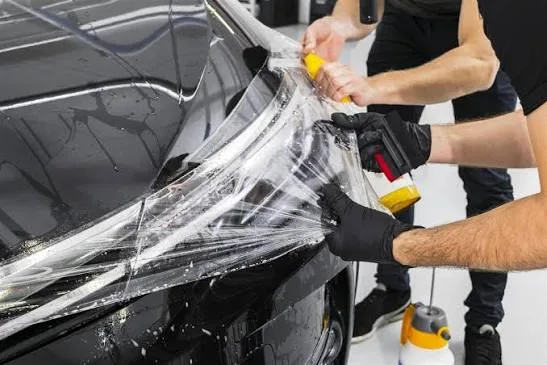
Daily driving is becoming a real test of endurance: fine stone chips, harsh weather conditions, branches, and inconsiderate parking by neighbors. Professional protection (polyurethane film, nanoceramic, liquid glass) is therefore no longer a luxury, but a sensible necessity. Here are eight of the most important reasons why you should equip your car with a modern protective coating.
1. Reliable protection against damage and chipping
Nothing is more annoying for drivers than a stone chip flying from the car in front directly onto the hood. Without proper car paint protection, this almost certainly means that the paint will chip all the way to the ground or even down to the metal. A polyurethane paint protection film offers invisible protection and absorbs the impact energy. The film withstands stone chips even at high speeds and protects the most vulnerable areas: bumper, hood, fenders, headlights, and side mirrors.
2. Vehicle value retention
Every car is an asset that depreciates over time. However, the condition of the bodywork is one of the key factors in determining its value on the used car market. A car with integrated paint protection film, without holograms, minor scratches, or repainted areas, can be sold significantly faster and for a much higher price. Protecting the paint from day one is an investment that is guaranteed to pay off when you resell.
3. Water-repellent effect and time savings when washing
After treatment with professional coatings, the surface acquires highly water-repellent properties. Water collects in perfectly round droplets and beads up at a shallow angle, carrying dirt with it. Your car stays significantly cleaner for longer, even in the rain. Washing also becomes easier and faster since dirt doesn't become embedded in the paint pores, eliminating the need for harsh alkaline shampoos.
4. Uncompromising chemical protection
The roads are full of aggressive chemicals, especially in winter when municipalities liberally apply salt and de-icing salt. In summer, paintwork suffers from bird droppings, insect remains, and tree sap (like from linden or pine trees). These organic substances contain strong acids that can literally "bake" unprotected paintwork within a few days, leaving irreparable dull spots. Ceramic coatings form a dense barrier at the molecular level, thus preventing chemical reactions with the original paint.
5. Self-healing properties
High-quality polyurethane film possesses a unique property: the ability of the top coat to self-heal. Should minor scratches occur after off-road driving or improper washing, no polishing is necessary. Simply park the car in the summer sun or treat the affected area with hot water – the polymer bonds in the film structure expand, and the scratches disappear without a trace.
6. UV protection and color preservation
The sun has the same damaging effect on car paint as it does on human skin. Under the constant influence of UV radiation, paint sealant fades, loses its vibrancy, and can become cloudy over time. This process is particularly noticeable on red, black, and dark blue cars. Nanoceramics contain special UV blockers that reflect the sun's rays. As a result, your car's color remains as intense as the day it was purchased, even after 5–7 years.
7. Long-term economic advantage
At first glance, professional vehicle detailing services may seem expensive. However, the final cost proves otherwise. Annual, intensive polishing (which irrevocably removes micrometers of paint each time), regular application of expensive waxes, frequent car washes, and the inevitable repainting of bumpers due to peeling paint result in significantly higher costs within 3-4 years. A one-time investment in high-quality protection saves you money and unnecessary stress in the long run.
8. Aesthetic perfection and mirror shine
No factory paint finish achieves such a deep, glass-like shine as a professionally applied nanoceramic or composite sealant. The chemical composition penetrates the micropores of the paint and smooths the surface, creating a wet-look or lollipop effect. The car's color is saturated to the maximum and gains depth and contrast.