
Why Fabric Quality Inspection Matters in Garment Manufacturing
In the apparel industry, quality begins long before a garment reaches the sewing floor. The foundation of every high-quality garment lies in the fabric itself. Even the most advanced production facilities can struggle to deliver consistent quality if defects are not identified before cutting and sewing begin.

Fabric typically represents 60–70% of the total garment manufacturing cost. As a result, fabric-related issues can significantly impact profitability, production efficiency, customer satisfaction, and brand reputation. A single defective fabric roll can create a chain reaction of production delays, excessive rework, material waste, and shipment rejections.
To minimize these risks, apparel manufacturers rely on standardized inspection methods such as the 7 Point System. Combined with a modern Garment Quality Management System, this approach helps factories maintain quality consistency, improve traceability, and reduce manufacturing risks.
What Is the 7 Point System in the Garment Industry?
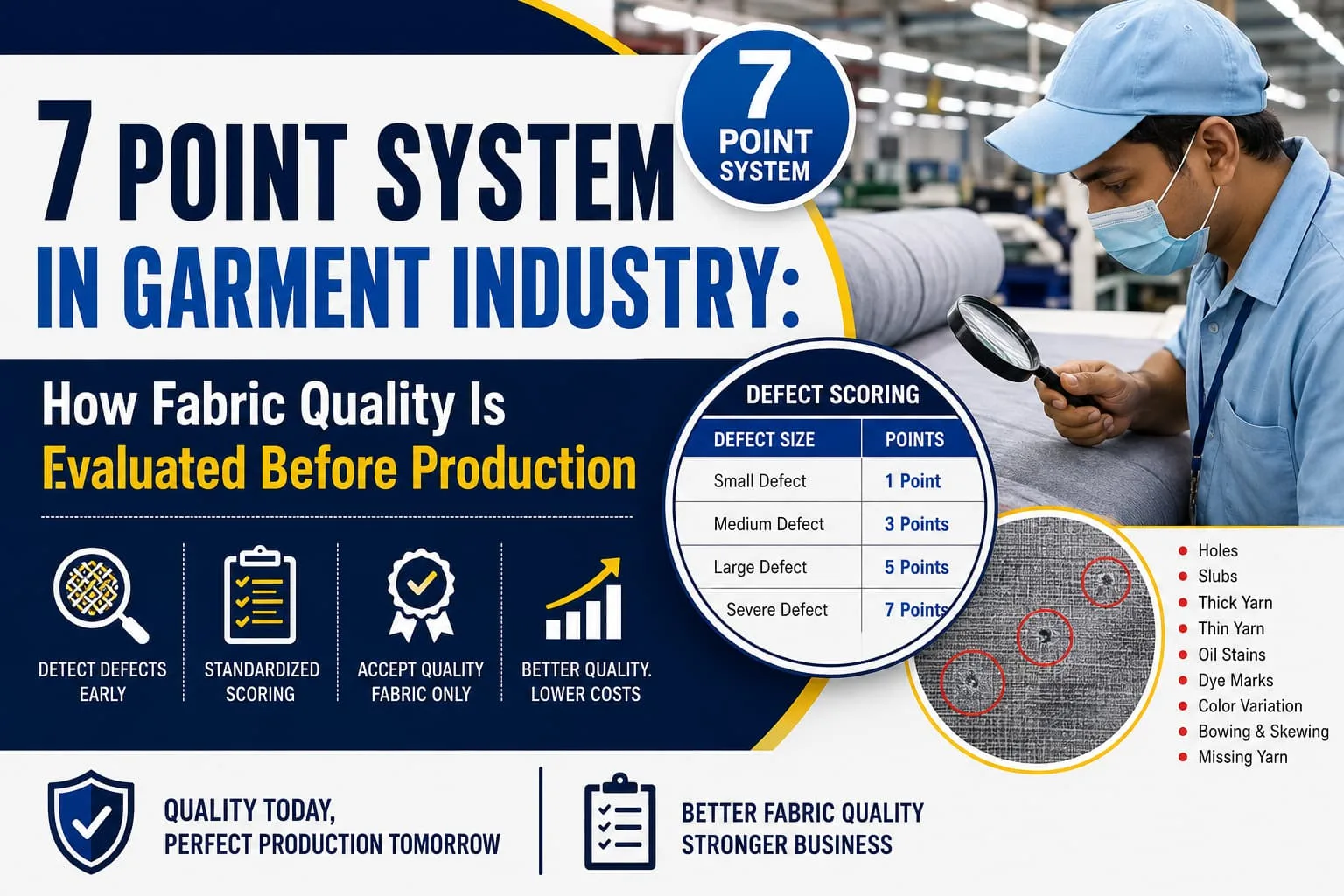
The 7 Point System is a fabric inspection method used to evaluate fabric quality before production. Inspectors identify defects, assign points based on severity, and determine whether a fabric roll meets quality requirements for garment manufacturing.
Today, leading apparel factories are integrating this inspection process into digital quality platforms, including Garment Production Management Systems, Garment Shop Floor Software, and Apparel MES Software, to improve visibility and decision-making.
Understanding the 7 Point System in Garment Industry
What Is the 7 Point Fabric Inspection System?
The 7 Point System is one of the most widely used fabric inspection standards in apparel manufacturing. It provides a structured and measurable method for evaluating fabric quality before production starts.
The objective of this system is simple: identify defects early enough to prevent them from affecting cutting, sewing, finishing, and shipment operations.
Unlike subjective visual inspections, the 7 Point System establishes clear scoring rules, making fabric acceptance and rejection decisions more consistent.
Many apparel manufacturers document this process through a Garment Quality Management System Project, ensuring that inspection procedures remain standardized across factories and production units.
Organizations often develop internal training materials, including a Garment Quality Management System Project PDF, Garment Quality Management System PPT, and Quality Management System in Garment Industry PDF, to train quality teams and maintain compliance standards.
Why Fabric Inspection Happens Before Cutting
Fabric inspection is strategically performed before cutting because defects become far more expensive to correct once production begins.
If defective fabric reaches the cutting department, manufacturers may experience:
- Incorrect garment panels
- Production interruptions
- Increased fabric waste
- Sewing defects
- Rework costs
- Shipment delays
Early inspection prevents these issues by ensuring only approved fabric enters production.
This quality-first approach supports lean manufacturing principles and helps improve material utilization, production flow, and delivery performance.
How the 7 Point System Works
Defect Classification Process
Inspectors carefully examine fabric rolls for various types of defects.
Common fabric defects include:
- Holes
- Slubs
- Thick yarn
- Thin yarn
- Missing yarn
- Oil stains
- Dye marks
- Color variation
- Bowing
- Skewing
Each defect affects garment quality differently. Some may impact appearance, while others compromise fabric strength or dimensional stability.
Point Allocation Method
The system assigns points based on defect severity and size.
Defect SizePointsSmall Defect1 PointMedium Defect3 PointsLarge Defect5 PointsSevere Defect7 PointsAt the end of inspection, the total points accumulated determine whether the fabric roll is accepted or rejected.
This objective scoring system helps quality teams make faster and more consistent decisions.
Fabric Acceptance Criteria
Factories establish maximum allowable point limits based on:
- Buyer requirements
- Fabric category
- Product type
- Internal quality standards
If a roll exceeds the allowable threshold, corrective actions may include:
- Fabric rejection
- Supplier claims
- Re-inspection
- Alternative production allocation
These decisions become significantly easier when inspection data is stored in a digital Garment Quality Management System.
Benefits of Using the 7 Point System in Apparel Manufacturing
Improved Fabric Quality Control
The 7 Point System provides a standardized framework for evaluating fabric quality.
This reduces inconsistencies between inspectors and improves confidence in quality decisions.
Factories using a digital Garment Quality Management System Project can further standardize inspections across multiple locations.
Reduced Production Defects
Early defect detection prevents faulty fabric from entering production.
As a result, manufacturers experience:
- Fewer sewing defects
- Lower rejection rates
- Reduced rework
- Improved first-pass quality
Better Material Utilization
Accurate fabric grading allows planners to optimize cutting operations.
When combined with advanced planning tools, factories can improve marker efficiency and reduce unnecessary material consumption.
Improved Customer Satisfaction
Consistent fabric quality leads to:
- Better garment appearance
- Improved fit and performance
- Reduced returns
- Higher buyer confidence
This ultimately strengthens long-term customer relationships.
Limitations of Manual Fabric Inspection
While the 7 Point System is highly effective, manual implementation presents challenges.
Human Errors During Inspection
Manual inspections often result in:
- Inconsistent scoring
- Missed defects
- Subjective evaluations
Different inspectors may interpret defect severity differently.
Lack of Real-Time Data
Paper-based inspections create delays in reporting.
Managers may not receive quality information until hours or days after inspection.
This limits responsiveness and corrective action.
Poor Traceability
Manual systems make it difficult to track:
- Historical defect patterns
- Supplier performance
- Corrective actions
- Quality trends
Without traceability, continuous improvement becomes challenging.
Challenges in Large Apparel Factories
High-volume apparel operations process thousands of fabric rolls every month.
Managing this volume manually becomes increasingly difficult.
This is why many manufacturers are moving toward digital quality management solutions.
Digital Transformation of Fabric Quality Management
Why Modern Factories Are Moving Beyond Manual Inspection
Today's apparel manufacturers need greater speed, visibility, and accountability.
Global brands demand higher compliance standards and complete traceability throughout the production process.
As a result, digital quality management systems are rapidly replacing paper-based inspections.
Role of Garment Quality Management System
A modern Garment Quality Management System helps factories:
- Record inspection results digitally
- Track defects in real time
- Monitor supplier quality
- Generate audit-ready reports
- Improve compliance management
By centralizing quality data, factories gain greater control over production quality.
Integration with Garment Production Management System
When integrated with a Garment Production Management System, quality information becomes available throughout the factory.
Production planners, quality managers, and executives can access the same data, improving collaboration and decision-making.
How Quality Management Software Improves the 7 Point Inspection Process
Modern software solutions transform traditional inspection methods into intelligent quality management systems.
Inspectors can record defects directly into tablets or mobile devices.
Managers receive instant visibility into:
- Fabric quality performance
- Defect frequency
- Roll acceptance rates
- Supplier quality trends
Automated reporting eliminates manual paperwork and improves accuracy.
Advanced dashboards allow management teams to identify recurring quality issues before they become major production problems.
Connecting Fabric Inspection with Shop Floor Operations
Role of Garment Shop Floor Software
Fabric quality directly influences shop floor performance.
Poor-quality fabric can reduce:
- Cutting efficiency
- Sewing productivity
- Line performance
- Production output
A modern Garment Shop Floor Software solution connects inspection results with production teams, ensuring quality concerns are addressed immediately.
Benefits of Shop Floor Management Software
Integrated Shop Floor Management Software provides:
- Faster issue resolution
- Better communication
- Reduced downtime
- Improved production visibility
- Stronger quality control
Quality becomes part of daily production management rather than a separate function.
How Apparel MES Software Enhances Quality Control
What Is Apparel MES Software?
Apparel MES Software (Manufacturing Execution System) monitors production activities in real time.
It bridges the gap between planning systems and actual shop floor operations.
Quality Control Through Manufacturing Execution System
A modern Manufacturing Execution System enables:
- Real-time quality monitoring
- Production traceability
- Defect root cause analysis
- Quality alerts
- Automated escalation workflows
Instead of reacting to problems after production, factories can proactively prevent them.
Line Balancing and Quality Management: The Missing Connection
Many manufacturers overlook the relationship between quality and production efficiency.
Poor fabric quality often leads to:
- Line stoppages
- Operator delays
- Rework
- Lower productivity
This is where Line Balancing Software Garment solutions become valuable.
By aligning workload distribution with quality performance, factories can improve both productivity and quality simultaneously.
Why Apparel Manufacturers Need an Integrated Quality Management Platform
Modern apparel factories require more than spreadsheets and inspection sheets.
An integrated platform combines:
- Fabric inspection
- Production monitoring
- Quality control
- Shop floor management
- Performance analytics
- Reporting and compliance
Key components include:
- Garment Quality Management System
- Garment Production Management System
- Garment Shop Floor Software
- Shopfloor Management Software
- Apparel MES Software
- Manufacturing Execution System
Together, these technologies create a connected and data-driven manufacturing environment.
How Jazasoft Supports Quality-Driven Apparel Manufacturing
Jazasoft helps apparel manufacturers digitize quality management from fabric inspection through final production.
Its integrated platform enables factories to:
- Digitize fabric inspections
- Automate quality reporting
- Monitor shop floor performance
- Improve production visibility
- Reduce defects and rework
For manufacturers seeking a complete Garment Quality Management System Project, Jazasoft provides a scalable solution that supports both operational efficiency and quality excellence.
Benefits include:
- Better fabric utilization
- Improved production efficiency
- Higher quality consistency
- Faster decision-making
- Reduced operational costs
Future of Fabric Inspection and Quality Management
The future of quality management is increasingly driven by digital technologies.
Emerging trends include:
AI-Powered Defect Detection
Computer vision systems automatically identify and classify fabric defects with greater accuracy.
Smart Factory Integration
Connected manufacturing environments enable real-time quality monitoring across departments.
Predictive Quality Analytics
Factories can identify quality risks before defects occur.
Industry 4.0 Quality Control
Advanced data analytics and automation create intelligent quality ecosystems that continuously improve manufacturing performance.
Conclusion: Quality Begins Before Production Starts
The 7 Point System remains one of the most effective methods for evaluating fabric quality before production. It provides a standardized framework for identifying defects, making acceptance decisions, and protecting production quality.
However, as apparel manufacturing becomes increasingly complex, manual inspection alone is no longer sufficient. Modern manufacturers require digital solutions that connect fabric inspection, production monitoring, and shop floor execution.
By combining the 7 Point System with a Garment Quality Management System, Garment Production Management System, Garment Shop Floor Software, Shop Floor Management Software, Line Balancing Software Garment, Apparel MES Software, and a modern Manufacturing Execution System, apparel factories can reduce waste, improve efficiency, strengthen quality control, and achieve long-term competitive advantage.
For manufacturers looking to build a smarter and more quality-focused factory, solutions like Jazasoft provide the foundation for digital transformation and sustainable growth.