
Multifamily real estate can offer attractive opportunities for investors who want to purchase apartment buildings, renovate older properties, increase rental income, or improve property performance. However, these projects often need financing that works with the property's current condition rather than requiring it to meet every requirement of a traditional long term loan.
This is where multifamily bridge loans can help. These short term loans are commonly used to purchase, refinance, renovate, or stabilize apartment properties before the investor moves to permanent financing or sells the property.
Getting approved for this type of financing involves more than finding an apartment building with potential. Multifamily bridge lenders need to understand the property's value, current income, improvement plans, the borrower's financial strength, and how the loan will be repaid.
Understanding these factors before applying can help real estate investors prepare a stronger application, identify possible problems, and make better financing decisions.
In this article, we explain seven important factors multifamily bridge lenders consider before approving a loan and how investors can prepare for the underwriting process.
What Do Multifamily Bridge Lenders Look for Before Approving a Loan?
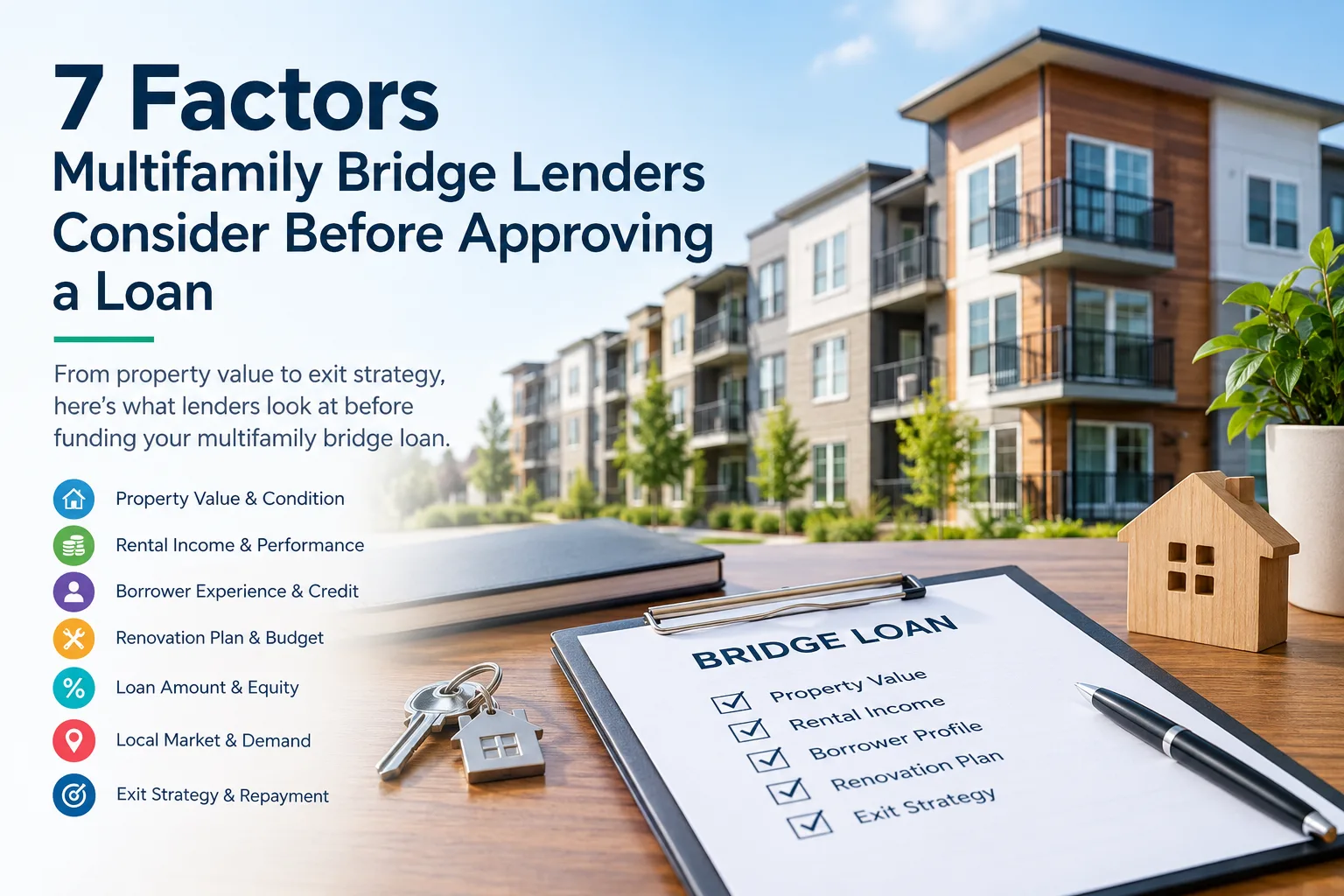
Multifamily bridge lenders generally evaluate seven important areas: property value and condition, rental income and financial performance, the borrower's experience and financial strength, the renovation plan and budget, the loan amount and available equity, the local rental market, and the exit strategy.
The exact requirements depend on the lender, property, loan structure, and investment plan. A strong application connects these factors and shows how the property can support the proposed financing and repayment plan.
1. Property Value, Condition, and Investment Potential
The first factor multifamily bridge lenders consider is the property itself. The apartment building serves as collateral for the loan, so lenders need to understand its current value, physical condition, and potential for improvement.
Unlike financing designed mainly for stabilized properties, multifamily bridge financing may be suitable for buildings that need repairs, have vacant units, or are not generating their full rental income. However, a property's potential does not automatically make it a good lending opportunity.
Lenders usually review the purchase price, property valuation, number of units, age of the building, maintenance history, and any major repairs that may be needed.
They may also consider the property's current condition compared with its expected condition after renovations.
What property details matter?
Investors should be prepared to explain:
- The property's current market value and purchase price.
- The number of residential units and their occupancy status.
- Existing structural, plumbing, electrical, or roofing issues.
- Required repairs and deferred maintenance.
- Any building code, zoning, safety, or environmental concerns.
- The expected property value after planned improvements.
A property inspection and an independent appraisal may help the lender understand the risks. Depending on the transaction, additional reports may be required.
How can investors prepare?
Before applying, inspect the property carefully and obtain contractor estimates for major repairs. Provide clear photographs, available inspection reports, and a realistic explanation of the property's current condition.
For example, an investor may want to purchase an older apartment building with vacant units and outdated interiors. The property could have potential, but the lender will want to understand whether the renovation costs are reasonable and whether the completed improvements can support the proposed investment plan.
A clear picture of the property's current condition helps lenders assess the opportunity without relying only on optimistic future projections.
2. Rental Income, Occupancy, and Financial Performance
The second factor is the property's ability to generate income. Even when an investor plans to renovate an apartment building, lenders need to understand its existing financial performance and how that performance may change.
A property with stable rental income may present less immediate operating risk than a building with substantial vacancies, unpaid rent, or rising expenses. However, some multifamily bridge lenders consider properties with weak current performance when the borrower presents a credible plan to improve them.
Lenders may review rent rolls, lease agreements, historical income statements, operating expenses, vacancy levels, and rent collection records.
Understanding net operating income
Net operating income, commonly called NOI, is the property's income after normal operating expenses are deducted, before debt service and certain other items.
For example, consider an apartment property that generates $500,000 in annual effective rental income and other operating revenue. If its annual operating expenses total $200,000, its approximate NOI would be $300,000.
This calculation helps lenders understand the property's current earning capacity.
Lenders may also examine projected NOI if the investor plans to increase occupancy, renovate units, improve rent collection, or reduce avoidable operating expenses. These projections should be supported by realistic assumptions rather than best case estimates.
Why occupancy matters
Occupancy affects the income available to cover operating costs and loan payments. A building with several vacant apartments may need additional money for utilities, maintenance, marketing, and other expenses while the owner works to attract tenants.
Multifamily bridge lenders may therefore ask:
- How many units are occupied?
- How many tenants are paying rent on time?
- Are existing rents close to comparable market rents?
- What is causing any current vacancy?
- How long could it take to lease vacant units?
- Are projected rents supported by local market evidence?
How can investors prepare?
Organize a current rent roll, historical operating statements, rent collection information, and a reasonable vacancy forecast.
If the property is underperforming, explain why and provide evidence that the proposed improvements can address the problem. A realistic financial picture is more useful than projections that overlook operating costs or assume every unit will be occupied immediately.
3. Borrower Experience, Credit Profile, and Financial Strength
The third factor is the borrower's ability to manage the investment and meet financial obligations.
Multifamily bridge loans may involve tight renovation schedules, unexpected repairs, tenant turnover, and changing market conditions. Lenders want to know whether the borrower has the resources and practical ability to manage these challenges.
The borrower's experience is important because a renovation plan is only valuable if the investor can execute it.
What experience do lenders consider?
Lenders may review previous experience with:
- Purchasing and operating apartment buildings.
- Managing multifamily rental properties.
- Completing renovations within a planned budget.
- Increasing occupancy and rental income.
- Refinancing or selling investment properties successfully.
- Working with property managers and contractors.
An investor who has completed similar projects may be able to demonstrate a clearer understanding of the costs and challenges involved.
However, limited experience does not automatically disqualify every applicant. Some lenders may consider a first time multifamily investor if the property, financial position, business plan, and supporting team are strong.
Why do credit and liquidity matter?
A borrower's credit profile can provide information about how financial obligations have been handled. Depending on the loan program, lenders may also review outstanding debts, net worth, liquid assets, and the borrower's ability to contribute equity.
Liquidity is especially important. Investors may need cash beyond the initial purchase contribution to cover closing expenses, renovation overruns, interest payments, insurance, taxes, and temporary operating losses.
A borrower who uses nearly all available cash to acquire the property may have limited flexibility if unexpected costs arise.
How can investors prepare?
Prepare an accurate personal or business financial statement, a list of owned real estate, information about existing debt, and a summary of previous investment projects.
If you are relatively new to multifamily investing, explain who will manage the property, oversee renovations, and handle leasing. Relevant experience from a qualified property manager or contractor can help demonstrate that the project has an appropriate support team.
Be honest about your experience and financial position. Lenders need a realistic understanding of the borrower, not just a promising description of the property.
4. Renovation Plan, Project Budget, and Timeline
The fourth factor becomes particularly important when an investor is purchasing a property that needs improvements.
Many multifamily bridge loans are used for value added investments. The investor may plan to renovate apartments, update common areas, repair major systems, improve property management, or increase occupancy. These improvements are expected to help the property perform better over time.
However, a lender needs evidence that the proposed work is practical and financially achievable.
What should a renovation plan include?
A well prepared plan should explain:
- Which repairs and improvements are necessary.
- The estimated cost of each major work category.
- Contractor bids or other support for cost estimates.
- The expected start and completion dates.
- Whether units must be vacant during renovations.
- How construction activity may affect rental income.
- The amount available for unexpected expenses.
The lender may also review permits, contractor qualifications, insurance, and the proposed process for paying renovation costs.
Some multifamily bridge financing structures allow approved renovation costs to be funded through controlled disbursements. The availability and terms of these arrangements vary by lender.
Why is the timeline important?
Delays can increase interest expenses, postpone rental income, and reduce the time available to stabilize the property before the loan matures.
For example, an investor may expect to renovate 20 apartments within four months. If material shortages, contractor delays, or unexpected plumbing repairs extend the project to eight months, the property may generate less income than planned.
The investor could then face higher costs and a shorter period to prepare for refinancing.
How can investors prepare?
Obtain detailed contractor estimates, develop a realistic work schedule, and include a contingency amount in the budget. Avoid assuming that every improvement will be completed on time or that every renovated unit will immediately achieve the highest projected rent.
A strong renovation plan explains what will happen, how much it should cost, and how the borrower will respond if the project takes longer than expected.
5. Loan Amount, Loan to Value, and Borrower Equity
The fifth factor is the amount of financing requested compared with the property's value and total project cost.
Investors naturally want to secure enough capital to complete the acquisition and planned improvements. However, the amount requested must fit the lender's risk limits and the financial details of the transaction.
Two common measures used in commercial real estate lending are loan to value and loan to cost.
What is loan to value?
Loan to value, or LTV, compares the loan amount with the property's recognized value.
For example, if a lender considers an apartment building worth $2 million and the proposed loan is $1.4 million, the LTV is 70 percent.
The calculation is:
LTV = Loan amount ÷ Property value × 100
A lower LTV generally means there is more equity supporting the loan. However, the appropriate LTV depends on the property's condition, transaction structure, lender guidelines, and other underwriting factors.
What is loan to cost?
Loan to cost, or LTC, compares the loan amount with the total eligible project cost. Depending on the lender's definition, project cost may include the acquisition price and approved renovation expenses.
For example, suppose an investor purchases an apartment property for $1.8 million and plans to spend $200,000 on improvements. The total project cost is $2 million. A $1.4 million loan would equal 70 percent of that project cost.
This example is illustrative. A lender may calculate eligible costs differently or apply separate limits to the acquisition and renovation portions.
Why does borrower equity matter?
Borrower equity shows how much of the investment the borrower is contributing. It also affects how much financial exposure the investor has if the property value falls or the renovation plan costs more than expected.
Lenders may consider the source of the equity, the borrower's remaining cash reserves, and whether the requested loan amount leaves enough room for unexpected expenses.
How can investors prepare?
Estimate the total project cost carefully and identify the amount of cash you can contribute. Include closing expenses, renovation costs, reserves, and other expected obligations.
Do not base the financing request only on the property's hoped for future value. Support your assumptions with a credible valuation and a detailed project budget.
A well structured request gives the lender a clearer understanding of the capital needed and the equity available to support the transaction.
6. Local Rental Market and Demand for Apartments
The sixth factor is the property's location and the strength of its rental market.
Even a well renovated apartment building may struggle if the surrounding area has weak rental demand, declining employment, excessive new apartment supply, or rents that local households cannot afford.
Multifamily bridge lenders consider whether the property is located in a market that can support the investor's operating and repayment plan.
What market factors matter?
Lenders may evaluate:
- Population and household growth.
- Employment opportunities and major local employers.
- Rental demand and competing apartment supply.
- Comparable rents for similar properties.
- Local vacancy trends and tenant demand.
- Property taxes, insurance costs, and other operating expenses.
- Recent comparable property sales.
The importance of each factor depends on the property and the lender's underwriting process.
Investors should also recognize that a growing city does not guarantee that every apartment building will perform well. Rental demand can vary substantially between neighborhoods, property types, and price ranges.
How does the market affect projected returns?
Suppose an investor expects to renovate an apartment building and increase monthly rent from $1,000 to $1,200 per unit. If comparable apartments in the neighborhood support rents of only $1,050, the proposed increase may be difficult to achieve.
Lower than expected rents can reduce NOI and the property's potential value. This may also make refinancing more difficult because a future lender will assess whether the property's income supports the new loan.
How can investors prepare?
Collect recent rental comparisons, relevant property sales, local vacancy information, and evidence of demand for the type of apartments being offered.
Explain why the property should attract tenants and how the proposed improvements compare with competing properties. Use conservative assumptions and consider what could happen if rent growth is slower than expected.
A credible market analysis helps demonstrate that the investment plan is based on local conditions rather than general optimism about the real estate market.
7. Exit Strategy and Repayment Plan
The seventh factor is one of the most important considerations in multifamily bridge financing: how the loan will be repaid.
Bridge loans are generally short term. They are designed to help investors move from one stage of an investment to another, such as acquiring a property, completing improvements, stabilizing operations, and obtaining longer term financing.
Because the loan has a defined maturity date, lenders need a credible explanation of how repayment is expected to occur.
What are common exit strategies?
Refinancing into permanent financing: The investor improves the property, increases occupancy, and establishes stronger operating performance before applying for a longer term commercial real estate loan.
Selling the property: The investor completes the planned improvements and sells the building. The sale proceeds are expected to repay the outstanding loan and transaction costs.
Refinancing with another suitable loan: Depending on eligibility and market conditions, the investor may refinance with another financing product that better matches the property's performance and long term objectives.
The right strategy depends on the investment plan, property performance, borrower resources, and available financing at the time of repayment.
Why can an exit strategy fail?
An investor may assume that the property's value will increase enough to qualify for permanent financing. However, refinancing depends on more than appreciation.
A future lender may evaluate the property's NOI, debt service coverage ratio, occupancy, valuation, interest rates, and other eligibility requirements. If rental income falls short of expectations or financing conditions change, the investor may not qualify for the expected loan amount.
A sale can also take longer than expected, particularly if buyer demand weakens or the property requires additional work.
How can investors prepare?
Build the exit strategy before applying for the bridge loan. Identify the conditions that must be achieved, the expected timeline, and the evidence supporting the proposed repayment plan.
For a refinance, estimate the future NOI and consider whether the property's projected cash flow could support a new loan under reasonable assumptions. For a sale, research comparable transactions and account for selling expenses.
It is also wise to prepare a backup plan. Additional reserves, a possible loan extension, a slower renovation schedule, or an alternative sale strategy may help address unexpected changes. Extensions and alternative financing are not guaranteed, so investors should review the loan agreement carefully.
The strongest exit strategy explains not only how the loan is expected to be repaid, but also what the investor will do if the original plan takes longer than anticipated.
How to Prepare a Strong Multifamily Bridge Loan Application
Understanding these seven factors is the first step. The next step is to organize the information a lender needs to evaluate the transaction.
Before submitting an application, investors should prepare the following items where applicable:
- Property details, purchase agreement, and information about the requested loan.
- Current rent roll, lease information, and historical operating statements.
- A renovation scope, itemized budget, and realistic completion schedule.
- Borrower financial statements, liquidity information, and relevant investment experience.
- Market rent comparisons and supporting property valuation information.
- An estimate of total project costs and the borrower's available equity.
- A primary exit strategy, a backup plan, and projected repayment timing.
The exact documentation requirements vary. A lender may also request appraisals, title information, insurance documents, environmental reports, inspections, or additional financial records.
Submitting a complete and consistent application can reduce avoidable delays and help the lender understand the investment more quickly. It does not guarantee approval, a particular interest rate, or a specific loan amount.
Final Thoughts
Multifamily bridge lenders evaluate more than the apartment building itself. They want to understand the property's value, income, physical condition, investment potential, and the borrower's ability to complete the proposed plan.
A strong application brings these details together. It explains what the property looks like today, what the investor intends to improve, how the project will be funded, and how the loan will be repaid.
For investors considering multifamily bridge loans, preparation can make the financing process clearer and help identify risks before they become expensive problems.
Simplending Financial provides private real estate financing solutions for investors evaluating property acquisitions and improvement projects. Investors exploring multifamily bridge financing can begin by organizing their property information, project budget, financial details, and repayment strategy before discussing their financing needs with a lender.
Frequently Asked Questions About Multifamily Bridge Loans
1. What do multifamily bridge lenders look for when approving a loan?
Multifamily bridge lenders commonly review property value and condition, rental income, occupancy, borrower experience, credit and liquidity, renovation plans, loan to value, local market conditions, and the exit strategy. Requirements vary by lender and transaction.
2. What are multifamily bridge loans used for?
Multifamily bridge loans are short term commercial real estate loans that may be used to acquire, refinance, renovate, or stabilize apartment buildings. Investors commonly use them when a property needs improvements or is not yet ready for permanent financing.
3. Do multifamily bridge lenders require prior real estate experience?
Not always. Some lenders prefer borrowers who have successfully managed or renovated similar properties, while others may consider less experienced investors with a strong financial position, a realistic business plan, and qualified professionals supporting the project. Eligibility depends on the lender's guidelines.
4. How much equity do I need for a multifamily bridge loan?
The required equity depends on the lender, property value, purchase price, project costs, borrower profile, and transaction risk. Lenders may evaluate loan to value and loan to cost when determining the amount they are willing to finance. Investors should also budget for closing costs and reserves.
5. Can I get a multifamily bridge loan for a property with low occupancy?
Possibly. Some multifamily bridge lenders consider properties with vacancies or below market performance when the borrower presents a credible plan to improve occupancy and income. The lender will evaluate local rental demand, the property's condition, available reserves, and the feasibility of the proposed plan.
6. What documents are needed to apply for multifamily bridge financing?
Common documents include a property summary, purchase agreement, rent roll, operating statements, borrower financial information, renovation budget, contractor estimates, market rent comparisons, and an exit strategy. Additional documents may be required depending on the transaction.
7. How long does it take to get a multifamily bridge loan approved?
The timeline varies by lender and transaction complexity. Property valuation, inspections, title review, environmental reports, legal documentation, and the completeness of the borrower's application can all affect the process. Investors should confirm the expected timeline directly with the lender rather than assume a guaranteed closing date.
8. Do multifamily bridge loans require an exit strategy?
An exit strategy is a central part of many multifamily bridge loan applications because the lender needs to understand how the short term debt will be repaid. Common strategies include refinancing into permanent financing or selling the property after completing planned improvements.
9. Can renovation costs be included in multifamily bridge financing?
Some lenders offer structures that include approved renovation costs. Funding may depend on the scope of work, project budget, property value, contractor information, and the lender's disbursement rules. Investors should confirm which expenses are eligible before finalizing their budget.
10. What can cause a multifamily bridge loan application to be rejected?
Common concerns include an unsupported property valuation, insufficient borrower equity, limited liquidity, unrealistic renovation assumptions, weak rental demand, incomplete documentation, and an unclear repayment strategy. A lender may also decline a transaction when the proposed loan amount is too high relative to the property's value or risk.
11. Are multifamily bridge loans better than traditional commercial real estate loans?
Neither option is always better. Bridge loans may offer flexibility for acquisitions, renovations, and properties that need stabilization, but they are typically short term and may have higher borrowing costs. Traditional commercial real estate loans may be more suitable for properties with stable income and borrowers seeking longer term financing. The best option depends on the property's condition, investment timeline, and repayment plan.
12. How can I improve my chances of getting approved for a multifamily bridge loan?
Prepare accurate property financials, document your experience and available equity, create a detailed renovation budget, research local rental demand, and develop a realistic exit strategy. Address potential risks early and make sure the requested loan amount fits the project's costs and financial performance.