
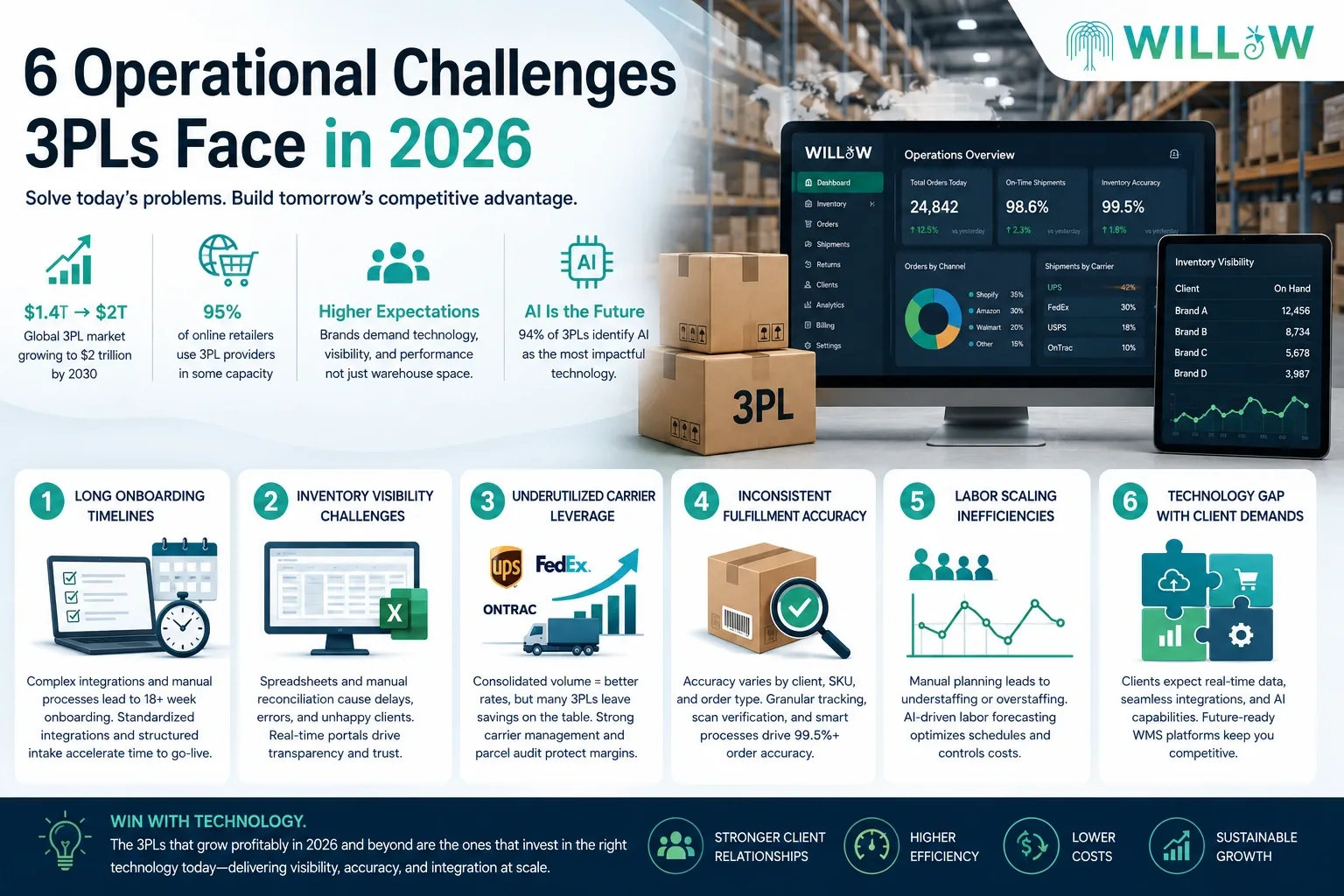
Running a third-party logistics operation in 2026 is fundamentally different from what it was five years ago. The client mix is more complex, ecommerce order volumes are less predictable, carrier relationships require more active management, and the technology requirements from brands evaluating 3PL partnerships have risen sharply. 95% of online retailers now use 3PL providers in some capacity, and the global 3PL market is on a trajectory from roughly $1.4 trillion today to $2 trillion by the end of the decade.
That growth is real, but so is the operational pressure that comes with it. 3PLs competing for mid-market and enterprise brand clients are increasingly evaluated on technology stack, integration capabilities, and data transparency, not just warehouse location and storage rates. The clients that generate the most revenue are also the ones with the most complex requirements.
This article covers six specific operational problems that 3PLs encounter repeatedly, with honest breakdowns of why they persist and what actually moves the needle on each one.
1. Client Onboarding Takes Three Times Longer Than It Should
The industry average for onboarding a new brand client to a 3PL platform is often cited as 18 weeks, particularly for complex integrations. Some implementations go longer. The financial cost of that timeline is real: the client is not yet generating revenue, the warehouse team is not yet operating efficiently for that account, and both sides are absorbing the friction of an onboarding process that is running in parallel with everything else.
Most of the delay is not in the physical side of onboarding. It is in the technology integration. Every brand arrives with a different combination of an ecommerce platform (Shopify, BigCommerce, WooCommerce), a marketplace stack (Amazon, Walmart, eBay), potentially an ERP or OMS, and specific data expectations for inventory visibility and order status reporting. Configuring the 3PL's WMS to receive orders correctly from each of these sources, push inventory updates back to each channel, and generate the reporting format the client expects is where the timeline expands.
3PLs that have invested in a flexible, prebuilt integration layer with a wide range of ecommerce platforms and marketplaces out of the box substantially reduce onboarding timelines. The difference between a WMS that requires custom development for each new integration and one with 40-plus standard connectors is often measured in months of implementation time. For a mid-size 3PL onboarding six to ten new clients a year, that difference compounds into a meaningful operational advantage.
The other lever is standardized onboarding documentation. PLs with a structured intake process that captures the client's full technology stack, SKU profile, order volume patterns, and fulfillment requirements before the integration work begins spend less time redoing configuration steps due to information discovered mid-implementation.
2. Multi-Client Inventory Visibility Is Still Being Done in Spreadsheets
Managing inventory visibility across multiple brand clients in a single warehouse environment should be a solved problem. In practice, for a significant number of 3PLs, it still involves some combination of WMS data exports, manual reconciliation spreadsheets, and client-specific reporting processes that take warehouse staff time to maintain.
The downstream consequences are predictable. When inventory data is not current, clients cannot make accurate reorder decisions. When a client calls to ask about their inventory levels and the answer takes two hours to produce, that interaction reflects on the 3PL's operational quality regardless of who is technically responsible for the data delay. When a warehouse discrepancy is identified during a cycle count, reconciling it against client-specific records is more time-consuming the less automated the data management is.
Best-in-class 3PL WMS platforms provide each client with a self-service portal offering real-time visibility into their inventory, inbound shipments, orders in progress, and billing. The warehouse team is not the bottleneck for client data requests because the data is accessible directly. Client satisfaction improves, warehouse staff attention is freed for actual warehouse operations, and the 3PL has a concrete technology differentiator to reference in sales conversations with new client prospects.
The investment in a WMS with strong client portal capabilities pays back through reduced client service overhead and higher client retention. Clients with real-time visibility into their inventory are less likely to attribute discrepancies or service failures to the 3PL and more likely to view the partnership as collaborative.
3. Carrier Contract Leverage Is Being Left on the Table
Individual brands negotiating carrier contracts on their own are working from a weaker position than a 3PL that consolidates volume across its entire client base. This is one of the most underutilized structural advantages in the 3PL model, and many 3PLs either do not fully capture it or do not effectively communicate it to client prospects.
Carrier pricing is volume-dependent. The rate tiers for UPS, FedEx, and regional carriers change meaningfully at different volume thresholds. A brand shipping 3,000 packages a month has significantly less negotiating leverage with a carrier than a 3PL shipping 300,000 packages a month across its client portfolio. The differences in base rates, accessorial structures, and minimum charge thresholds between these two scenarios are large enough to constitute a meaningful cost advantage.
The challenge for many 3PLs is that passing the negotiated rate benefit through to clients in a transparent way that serves as a sales differentiator requires billing infrastructure that some WMS platforms do not make easy. If the 3PL cannot clearly show a prospective client what their per-shipment cost would be using the 3PL's carrier contracts versus their current standalone rates, the advantage is real but not visible in the sales conversation.
Parcel audit integration is the other component. Carrier billing errors affect 3PLs at the same rate they affect direct shippers, but the scale means the dollar value of unaudited errors is higher. A 3PL shipping 400,000 parcels a month with a 1% error rate on surcharge billing is leaving substantial refund value on the table each billing cycle. Parcel audit software running against consolidated carrier invoices, even on a contingency basis, typically surfaces more than enough to justify the process.
4. Fulfillment Accuracy Varies Too Much Across Client Accounts
Fulfillment accuracy is the most direct measure of a 3PL's core operational quality. An industry benchmark for a well-run fulfillment operation is 99.5% or higher order accuracy. Below that threshold, the cost of error remediation, including customer service contacts, replacement shipments, return processing, and client relationship repair, becomes operationally significant.
The challenge is that accuracy tends to vary across client accounts within the same warehouse. High-SKU clients with complex product variants are more error-prone than clients with simple, homogeneous catalogs. Rush order processing during peak periods is more error-prone than standard processing. New product introductions before slotting and picking workflows are fully trained and are more error-prone than established SKUs.
Most 3PLs track overall accuracy but do not drill down into accuracy by client, SKU category, or order type. That aggregated view obscures where the actual error concentration is. A 99.3% overall accuracy rate might be 99.8% for one client and 98.1% for another. The client at 98.1% is experiencing a materially different service level than the overall number suggests, and they are likely aware of it.
The fix requires breaking the accuracy tracking down to the variables that actually predict errors. SKU complexity, pick path length, order urgency, and picking method all correlate with error rates. Operations that measure these combinations identify problem patterns early enough to intervene before they affect client relationships or produce chargebacks.
Technology helps here. Barcode scan verification at the point of pick, automated weight checks at the packing stage, and cartonization software that selects the right packaging before items are placed all reduce error rates at specific stages of the fulfillment process. The ROI of scan verification alone, measured by reduced error costs and lower client churn risk, is well documented.
5. Scaling Labor Up and Down During Peak Periods Is Costing More Than It Should
Labor is the highest variable cost in warehouse operations and the most difficult to manage with precision. The challenge during peak periods is that both understaffing and overstaffing are expensive. Under-staffing creates throughput bottlenecks that delay shipments, drive overtime, and produce service failures at exactly the moment clients need the 3PL to perform. Overstaffing to avoid those outcomes means paying for hours that do not generate throughput.
Traditional labor planning in warehouses is based on historical volume patterns, adjusted by management instinct. Peak-season staffing is planned using last year's peak as a baseline, adjusted for expected growth. The problem is that client growth is not uniform, order profiles change, and mid-year client additions alter the aggregate volume pattern. A staffing plan based on last year's client mix may significantly miss the actual peak volume for this year's mix.
AI-driven labor planning is one of the clearest ROI applications in warehouse operations right now. These models forecast daily order volume for each client using each client's sales channel data, historical patterns, and promotional calendars, then translate those forecasts into staffing requirements by shift and function. The result is a staffing plan that is updated continuously as the forecast updates, rather than being set quarterly and adjusted reactively.
For 3PLs specifically, the ability to provide clients with an accurate picture of capacity availability during peak periods is itself a competitive differentiator. A 3PL that can tell a client in October with reasonable confidence what their November throughput capacity looks like, and demonstrate that the staffing plan is based on data rather than guesswork, is a more compelling partner than one that promises peak capacity without the modeling to back it up.
6. Technology Requirements From Client Prospects Are Growing Faster Than Platform Capabilities
The gap between what sophisticated brand clients expect from a 3PL's technology stack and what many WMS platforms actually deliver has widened in the last three years. Mid-market brands that have invested in real-time inventory management, AI-driven demand forecasting, and multichannel marketplace management expect their 3PL's systems to integrate cleanly with all of those tools. When they cannot, the friction shows up in implementation delays, data quality issues, and, in some cases, clients choosing a different 3PL with a more compatible technology stack.
The specific capabilities that are increasingly becoming table stakes in 3PL technology evaluations include: API-first architecture that supports bidirectional integration with 40-plus ecommerce and marketplace platforms, real-time inventory updates rather than batch syncs, client-specific billing that can handle complex fee structures, returns management workflows that connect to client returns portals, and data reporting that clients can access directly rather than through warehouse staff intermediaries.
The 94% of 3PLs who told Inbound Logistics in 2025 that AI is the most impactful technology they are evaluating reflects the direction the market is moving. It is not that AI features are required for every 3PL engagement today. It is that the trajectory of client expectations is pointing in that direction, and 3PLs whose technology investments keep pace with that trajectory are better positioned in competitive situations than those who are not.
The practical implication for technology selection is that a WMS evaluation should not just assess what the platform does today. It should assess how frequently the platform releases updates, whether the roadmap addresses AI-driven fulfillment capabilities, and how the vendor supports integrations with the specific client platforms in your existing or target client mix. The cost of migrating a WMS with 50 active client integrations is high enough that the platform selection decision should be made with a five-year horizon, not a current-state feature comparison.
Building a 3PL Operation That Wins on Technology
The 3PLs that are winning the mid-market brand segment right now have invested in technology that makes their operations visible, accurate, and integrable with their clients' systems. Those three properties matter more than facility location for a growing share of brand clients making 3PL decisions.
Visible means clients can see their inventory and order status in real time without having to ask anyone. Accurate means fulfillment error rates are measured at a granular level and managed proactively, rather than reported in aggregate only after client complaints. Integrable means new client onboarding does not require months of custom development, because the platform's standard connector library covers most of what clients run.
None of these requires building proprietary technology. They require choosing platforms that have already solved these problems and configuring them well. The 3PLs that struggle with the six issues in this article are often not struggling because the solutions do not exist. They are struggling because the platform decisions made three to five years ago were not made with today's client expectations in mind. The answer is a technology review that is honest about that gap and a roadmap for closing it.