
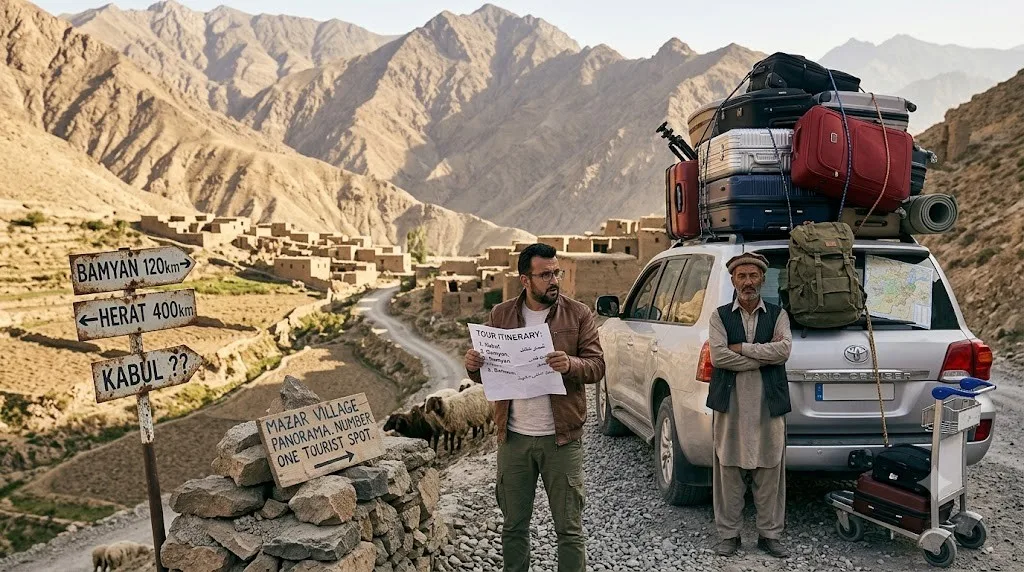
A carefully planned itinerary can look perfect on paper: Kabul today, Bamyan tomorrow, a historic site after lunch, and an early airport departure the following morning. But what happens between those destinations often determines whether the journey feels smooth or unnecessarily complicated.
Transportation is one of the least discussed parts of planning Afghan Tours, even though it affects almost every other part of the experience. Airport transfers, city movement, drivers, luggage, vehicle choice, road conditions, schedule changes, and even the timing of a simple dinner can influence how a day unfolds.
For international travelers, photographers, documentary filmmakers, and cultural explorers, understanding the transportation side of a journey is therefore just as important as choosing where to go.
Why is transportation often overlooked when planning travel in Afghanistan?
Transportation is often overlooked because travelers naturally focus on destinations, attractions, permits, accommodation, and itineraries. Yet Afghanistan is geographically diverse, and journeys between locations can require careful coordination. A realistic transport plan connects each part of the itinerary while allowing room for delays, changing circumstances, luggage, and practical needs.
A map may make two destinations look reasonably close together, but distance alone does not determine how easy a journey will be.
A useful transport plan considers:
- Where the traveler is starting and ending the day
- Whether the movement is within a city or between cities
- Road conditions and expected travel time
- The number of passengers
- Luggage and photographic equipment
- Vehicle suitability
- Driver availability
- Planned stops and sightseeing
- Flight arrival or departure times
- Flexibility if the schedule changes
This becomes particularly important on multi-day journeys. A vehicle isn't simply taking someone from Point A to Point B; it becomes part of the infrastructure supporting the entire itinerary.
For a photographer, that may mean accommodating camera equipment and additional stops. For a documentary team, it could mean coordinating several people and pieces of equipment. For a leisure traveler, it may simply mean having dependable transportation available when the day's plans change.
What is the difference between an airport transfer, city taxi, and tour transportation?
An airport transfer is usually a specific point-to-point movement, while a city taxi is designed for shorter local journeys and tour transportation supports a broader itinerary. Although the same vehicle might sometimes serve more than one purpose, the planning requirements are different.
Transportation typeTypical purposeMain considerationAirport transferAirport to hotel or another destinationFlight timing and luggageCity taxiLocal movement within a cityAvailability and flexibilityDay-trip transportVisiting destinations outside the cityVehicle suitability and timingMulti-day tour vehicleSupporting an extended itineraryDriver continuity, luggage and route planningGroup/production transportMoving travelers plus equipmentCapacity, equipment and schedule coordinationAn airport transfer is relatively straightforward. The important details are flight arrival time, meeting arrangements, luggage, destination, and what happens if the flight schedule changes.
City transportation is different. Travelers may need several separate journeys during one day, sometimes with little notice.
A multi-day tour requires more coordination because the vehicle and driver may effectively become part of the travel team. The same arrangement can support hotel departures, sightseeing, meals, intercity travel, and unexpected itinerary adjustments.
Can a taxi become part of a larger travel plan?
Yes. A taxi does not have to be treated as an isolated ride. When coordinated properly, local taxi transportation can connect airport transfers, hotel movements, meetings, sightseeing, and other parts of a wider itinerary.
This is especially useful when a traveler does not need a dedicated tour vehicle for every hour of every day.
For example, someone arriving in Kabul might need:
- Airport pickup
- Transfer to accommodation
- Local transportation for meetings or sightseeing
- Evening movement within the city
- Transportation to the airport several days later
These journeys can be planned individually or treated as one transportation requirement.
A 24/7 taxi service can be one practical option within that broader arrangement. The value is not simply the existence of a taxi; it is having transportation that fits around the traveler's actual schedule.
This distinction matters because transportation should support an itinerary rather than dictate it.
What should travelers consider when arranging transportation?
Travelers should consider the complete operating requirements of their journey rather than choosing transportation based solely on vehicle type or price. Passenger numbers, luggage, route, duration, timing, road conditions, equipment, driver arrangements, and schedule flexibility all affect whether a particular transport solution is appropriate.
Before arranging transportation, clarify the following:
1. How many people are traveling?
A vehicle suitable for one or two travelers may not work comfortably for a larger group.
2. How much luggage is involved?
Standard luggage is one consideration; camera cases, tripods, lighting equipment, research materials, or production equipment can change the requirement considerably.
3. Is the journey local or intercity?
A short city transfer and a full-day road journey have very different practical requirements.
4. What type of vehicle is appropriate?
The right choice depends on passengers, luggage, route, road conditions, and operating requirements—not simply on whether a vehicle looks comfortable.
5. Who is driving?
A professional driver familiar with the local area can make coordination easier, particularly when schedules or routes change.
6. How flexible is the itinerary?
Travel plans rarely remain perfectly static. Build reasonable flexibility into transportation arrangements.
7. How will communication work?
Confirm how travelers can reach the driver or transport coordinator if a meeting point, arrival time, or itinerary changes.
These questions are particularly valuable for travelers unfamiliar with local transportation arrangements.
Why can 24/7 transportation availability matter?
24/7 transportation availability can be useful because travel schedules do not always fit conventional office hours. Early flights, late arrivals, unexpected itinerary changes, and time-sensitive movements may require transportation outside a standard daytime window.
Consider an international traveler whose flight arrives late in the evening. The airport transfer cannot simply be scheduled according to normal business hours.
Likewise, an early morning departure may require leaving accommodation well before sunrise.
A flexible transportation arrangement can help with situations such as:
- Late-night airport arrivals
- Early-morning airport departures
- Schedule changes
- Additional local journeys
- Last-minute meeting movements
- Changes between accommodation and itinerary stops
- Unexpected extensions or adjustments to a day's plans
The important point is that 24/7 availability should be understood as an operational convenience, not a guarantee that every request can always be accommodated instantly. Vehicle availability, location, route requirements, and scheduling still matter.
How does luggage affect transportation planning?
Luggage can become surprisingly important when a journey involves multiple destinations because passengers may spend considerable time moving between vehicles, hotels, airports, and sightseeing locations. Travelers carrying professional photography, filming, research, or outdoor equipment should communicate those requirements before transportation is arranged.
A traveler with one small suitcase has different requirements from a documentary crew carrying:
- Camera bodies and lenses
- Tripods
- Audio equipment
- Lighting equipment
- Protective cases
- Personal luggage
Even when the passenger count appears small, equipment can consume substantial vehicle space.
This is why simply asking, “How many people are traveling?” may not provide enough information. A better question is: What needs to travel with them?
For visual storytellers, transportation planning can also affect creative opportunities. A suitable arrangement may make it easier to accommodate planned stops, safely store equipment, and avoid constantly repacking between journeys.
What happens when a travel schedule changes?
When a travel schedule changes, transportation arrangements may need to change with it. Flight delays, additional sightseeing, altered meeting times, weather, road conditions, or personal preferences can all affect the original timetable.
This is one reason travelers should avoid treating an itinerary as a rigid sequence of isolated bookings.
Imagine a traveler originally planning to leave the hotel at 8:00 a.m. A meeting is moved to 10:00 a.m., followed by an additional visit across the city. The transportation requirement has changed even though the destination list has not.
Good coordination allows the transport plan to evolve alongside the itinerary.
This does not mean every change is effortless or automatically possible. It means travelers should understand in advance how changes are communicated, whether additional vehicle time can be arranged, and who is responsible for coordinating adjustments.
What mistakes should travelers avoid?
The most common transportation mistakes are assuming that every journey is interchangeable, failing to communicate luggage requirements, leaving no flexibility in the schedule, and choosing transport based only on price or vehicle category.
A few practical mistakes are worth avoiding:
Booking the vehicle before explaining the itinerary.
The route and purpose should influence the transport decision.
Ignoring equipment.
Photography and filming equipment can substantially change space requirements.
Assuming airport transfers and tours are the same thing.
A single transfer requires different planning from transportation supporting several days of travel.
Leaving no buffer time.
Connecting a road journey directly to a flight or important appointment without reasonable contingency can create unnecessary pressure.
Not confirming communication arrangements.
Travelers should know how to contact the driver or coordinator.
Assuming availability without confirmation.
Particularly for early, late, or multi-day movements, confirm arrangements in advance.
Choosing purely on price.
The cheapest option may not provide the capacity, flexibility, vehicle suitability, or continuity the itinerary requires.
How can you arrange transportation more effectively?
The simplest approach is to provide the transportation provider with the complete picture: dates, locations, passenger numbers, luggage, equipment, flight details, planned movements, and any unusual requirements. The provider can then determine what type of transportation is appropriate for each stage.
A practical process looks like this:
- List every planned movement.
Include airports, hotels, sightseeing locations, meetings, and intercity journeys. - Identify fixed timings.
Flights, appointments, permits, and other time-sensitive activities should be clearly marked. - Describe passengers and luggage.
Include professional equipment rather than counting only personal bags. - Discuss vehicle requirements.
Consider capacity, route, comfort, and operating conditions. - Confirm driver arrangements.
Establish pickup procedures and communication channels. - Build in reasonable flexibility.
Ask how schedule changes will be handled. - Reconfirm critical movements.
Airport departures and other time-sensitive transfers deserve particular attention.
Organizations such as Afghan Logistics & Tours Pvt. Ltd. can be useful resources when transportation needs extend beyond a single taxi ride, particularly where airport transfers, local movement, drivers, vehicle arrangements, and broader itinerary coordination overlap.
What questions should you ask before arranging transportation?
Before confirming transportation, ask practical questions about the vehicle, driver, schedule, luggage capacity, communication, flexibility, and what is actually included. Clear questions at the planning stage can prevent misunderstandings later and make it easier to match transportation with the realities of the journey.
Use this checklist:
- What vehicle is being provided?
- How many passengers can it accommodate comfortably?
- How much luggage or equipment can it carry?
- Is a professional driver included?
- How will airport pickup work?
- What happens if a flight is delayed?
- Is transportation available outside normal daytime hours?
- Can the vehicle support multiple stops?
- How are itinerary changes handled?
- Who should be contacted if plans change?
- Are additional journeys possible during the day?
- Is the transportation suitable for the planned route?
- What costs are included, and which may be additional?
Getting clear answers to these questions is often more useful than simply asking for the cheapest available vehicle.
Is transportation really that important on an Afghanistan tour?
Yes. Transportation is not merely the mechanism for moving between attractions; it influences timing, comfort, flexibility, equipment management, and the overall rhythm of a journey. A well-planned itinerary can become difficult if its transportation arrangements are poorly matched to the route and travelers' practical needs.
For Afghan Tours, transportation deserves to be considered from the beginning rather than added after the destinations have already been selected.
The best approach is not necessarily to arrange the most elaborate transportation possible. It is to arrange appropriate transportation: the right vehicle, at the right time, with the right capacity, driver arrangements, communication, and flexibility for the journey being undertaken.
That principle applies whether the traveler is visiting historic sites, documenting cultural life, photographing landscapes, conducting research, or simply trying to move efficiently between appointments.
Getting around is the connective tissue of the trip. When that part is thoughtfully planned, travelers can spend less time worrying about logistics and more time paying attention to the places and people they came to experience.
Frequently Asked Questions
Is it easy to get around Afghanistan as a tourist?
Getting around depends heavily on the itinerary, destination, transportation arrangements, road conditions, and current local circumstances. Travelers should plan transportation in advance, particularly for intercity journeys, airport transfers, multi-day trips, and travel involving specialized equipment. Local coordination can also help when schedules or routes need to change.
Should I arrange airport transportation in advance?
Yes, arranging airport transportation in advance is generally sensible, particularly when arriving at an unfamiliar destination or traveling on a fixed schedule. Share flight details, accommodation information, passenger numbers, luggage requirements, and expected arrival time so the pickup arrangement can be coordinated properly.
Can I use taxis during a longer Afghanistan trip?
Yes. Taxis can be useful for local movement and can also form one component of a larger transportation plan. They may be appropriate for airport transfers, hotel movements, meetings, and city sightseeing, while longer or more complex itineraries may require a dedicated vehicle arrangement.
Do I need a special vehicle for photography equipment?
Not necessarily, but equipment should be communicated before booking. Professional photographers and filmmakers may carry cases, tripods, camera bodies, lenses, audio equipment, or other bulky items. Vehicle selection should therefore consider both passenger capacity and available luggage or equipment space.
What should I do if my flight is delayed?
Contact the transportation provider or designated coordinator as soon as possible and provide the updated flight information. Airport transportation should be planned around the actual arrival rather than the original schedule where possible. Confirm beforehand how flight delays and changes will be handled.
Is 24/7 taxi availability useful for travelers?
It can be particularly useful for travelers with early departures, late arrivals, or changing schedules. 24/7 Taxi Services can serve as one practical transportation option within a broader travel plan. However, 24/7 service should not be interpreted as unlimited instantaneous availability. Specific vehicles, routes, timings, and changes should still be confirmed in advance whenever possible.
Should I choose transportation based on price?
Price should be one factor, not the only factor. Travelers should also consider vehicle suitability, passenger and luggage capacity, driver arrangements, flexibility, route requirements, communication, and reliability. A cheaper option may not be the best value if it does not meet the practical needs of the itinerary.
How far in advance should transportation be arranged?
There is no single ideal timeframe for every journey. Simple local movements may require less planning, while airport transfers, multi-day trips, specialized vehicles, larger groups, and journeys involving professional equipment benefit from earlier coordination. The more complex the itinerary, the more useful advance planning becomes.
Can transportation plans change during a tour?
Yes. Itineraries can change because of flight adjustments, additional activities, meetings, road conditions, or personal preferences. Travelers should discuss the provider's process for modifying transportation before the journey begins. Having a clear communication channel makes changes easier to coordinate.
What is the most important transportation tip for travelers?
Plan transportation around the entire journey, not individual rides. Consider destinations, timing, passengers, luggage, equipment, vehicles, drivers, communication, and flexibility together. This approach reduces avoidable logistical problems and helps ensure that transportation supports the itinerary rather than becoming an obstacle to it.