India’s content appetite has never been more voracious. With over 500 million OTT subscribers projected by 2030 and platforms like Netflix, Amazon Prime Video, JioCinema, and Disney+ Hotstar racing to serve audiences across 22 officially recognized languages, the pressure on dubbing studios has reached an all-time high. A K-drama that goes viral on a Tuesday needs to reach Tamil, Telugu, and Bengali audiences by Thursday, and the studio that can’t match that pace simply doesn’t get the call.
At the heart of this challenge is one metric that separates the good from the great: dubbing turnaround time. How quickly a studio can deliver broadcast-ready, localized audio without cutting corners on lip-sync accuracy, vocal performance, or cultural nuance is increasingly the deciding factor in who wins long-term contracts with major platforms.
So what are the top-tier studios doing differently? Here are five workflow strategies that consistently shorten dubbing turnaround time while maintaining the kind of quality that viewers and platforms demand.
1. Parallel Workflows Replace Linear Assembly Lines
The old model of dubbing was sequential: receive content, translate the script, cast voice artists, record, mix, and deliver. Each stage waited for the previous one to finish. In a world where a single Hindi film might need simultaneous release in six regional languages, that approach is a bottleneck waiting to happen.
Leading studios have dismantled this linear model entirely. Translation, casting, booth scheduling, and audio engineering now run on overlapping timelines. While translators work on Episode 3, voice artists are already recording Episode 1, and the mix team is finalizing Episode 2. Project managers use cloud-based production dashboards to track every task in real time, flagging delays before they cascade.
This shift to parallel workflows can reduce dubbing turnaround time by 30 to 40 percent on multi-episode projects, a figure that makes an enormous difference when a platform is racing a competitor to a regional audience.
2. AI-Assisted Translation as a Launchpad, Not a Replacement
Artificial intelligence has entered the localization pipeline, but the studios getting the most value from it are careful about how they deploy it. Rather than relying on machine translation as a finished product, they use it to generate a first-pass draft that human translators then refine for cultural resonance, idiomatic accuracy, and tonal match.
When working across languages like Hindi, Tamil, Telugu, Marathi, Bengali, and Kannada, each carrying its own regional humor, cultural idioms, and social context, even a 70 percent accurate AI draft cuts hours off a translator’s workload. Glossaries, character voice notes, and style guides are fed into the system so the AI output already reflects the project’s vocabulary before a human even opens the document.
This hybrid approach doesn’t just speed up the script stage it also reduces back-and-forth revisions in the recording booth, since voice artists receive cleaner, more consistent copy from the start. The net result is a measurably shorter dubbing turnaround time across the project’s full lifecycle.
3. Remote Recording Infrastructure Has Become a Strategic Asset
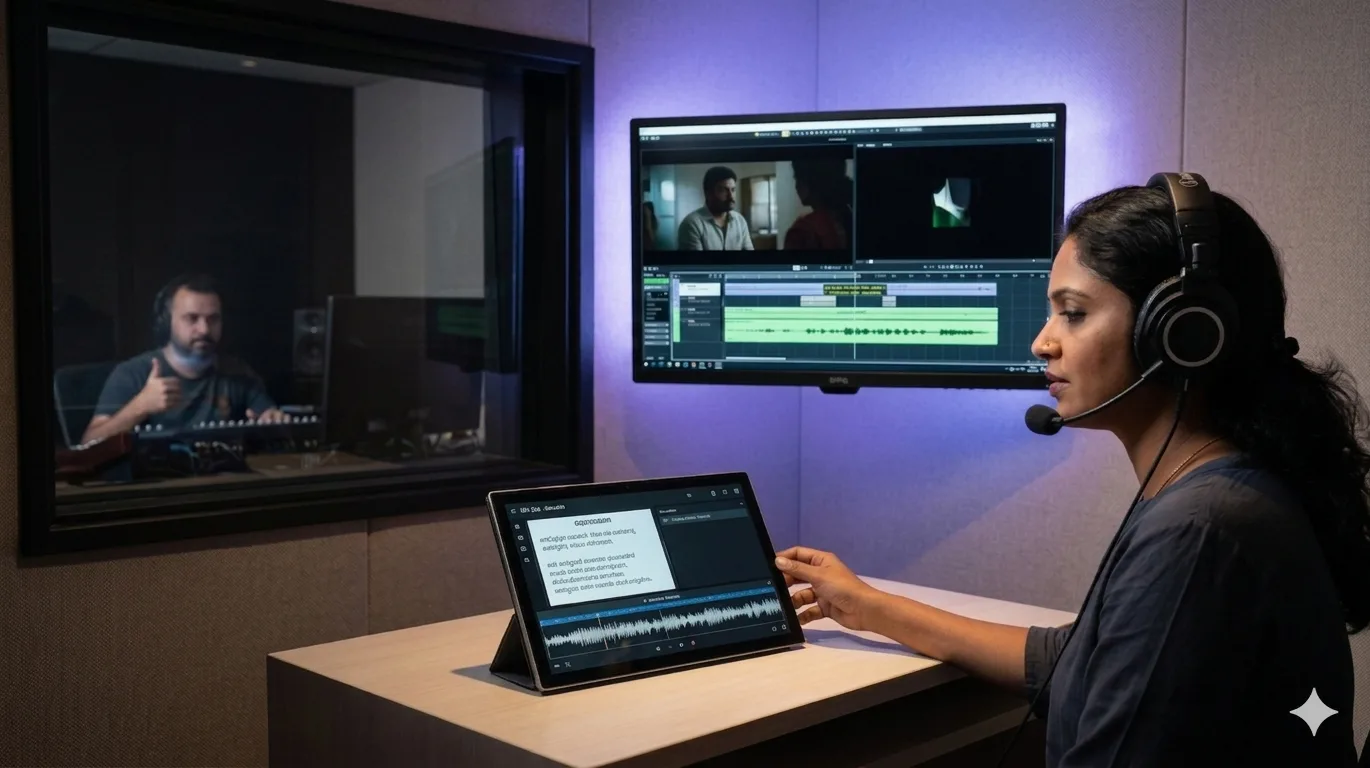
Until a few years ago, the idea of recording a professional dub from a voice artist’s home studio would have raised eyebrows. Today, it is standard practice for studios serious about compressing timelines. Voice artists in Mumbai, Chennai, Kolkata, and Hyderabad can record simultaneously without anyone boarding a flight or sitting in traffic.
The studios leading this charge have invested in more than just microphones and internet connections. They’ve built verified home studio certification programs, remote direction protocols using real-time communication platforms, and proprietary quality-monitoring pipelines that flag audio anomalies before files are submitted. The result is a distributed recording network that dramatically shrinks scheduling delays, one of the biggest hidden contributors to extended dubbing turnaround time.
For multilingual projects with regional casting requirements, this infrastructure is especially valuable. Finding and booking a native Kannada speaker in a city where they’re rare becomes a non-issue when geography is no longer a constraint.
4. Centralized Asset Management Eliminates Rework
Lost files. Mismatched script versions. Audio recorded against the wrong video cut. These are not glamorous problems, but they are among the most common reasons a dubbing project runs over time and over budget.
Top studios have solved this with centralized, cloud-based asset management systems where every stakeholder, translator, director, engineer, and QC supervisor works from a single source of truth. Version control is automatic. Approvals are logged. When the client sends a picture lock update, the entire team sees it simultaneously, and reshoots are scheduled against the corrected file, not the outdated one.
The reduction in rework alone can shave days off a project’s dubbing turnaround time. For a studio handling fifteen languages across a twelve-episode series, eliminating even one round of unnecessary re-records represents a significant efficiency gain and a significant cost saving that can be passed on to clients or reinvested in quality.
5. Quality Control Is Built In, Not Bolted On
The final and perhaps most counterintuitive secret to faster dubbing is investing more heavily in quality control, not less. Studios that rush through QC to hit a deadline often find themselves re-doing work that a more systematic review would have caught earlier, effectively extending the total project timeline rather than shortening it.
The studios consistently delivering the fastest dubbing turnaround times have moved QC from the end of the pipeline to inside it. Automated lip-sync analysis tools flag synchronization issues during the editing phase. Language supervisors conduct rolling spot-checks as recordings come in rather than waiting for a completed episode. Technical QC checking for clipping, noise floor issues, and loudness standardization runs in parallel with creative review.
This integrated approach means that when a project reaches final delivery, it is genuinely ready. There are no last-minute client rejections, no emergency re-records at midnight, and no embarrassing delays that force a platform to push back a regional premiere. The dubbing turnaround time on paper reflects the actual time needed, not an optimistic estimate followed by a quiet extension.
The Bigger Picture: Why This Matters for India’s Content Economy
India’s regional language content market is not a niche; it is the mainstream. Research consistently shows that audiences in states like Andhra Pradesh, West Bengal, Rajasthan, and Maharashtra strongly prefer consuming entertainment in their mother tongue, even when they are comfortable in Hindi or English. For OTT platforms, tapping into this preference is no longer optional; it is the primary growth frontier.
That makes efficient, high-quality multilingual dubbing one of the most strategically important capabilities in the Indian entertainment industry today. Studios that can consistently deliver short dubbing turnaround times at scale will find themselves at the center of a content economy that is only going to grow larger and more competitive.
The five strategies outlined above are not theoretical ideals; they are the operational realities of studios already winning in this environment. The gap between studios that have adopted them and those still working from outdated linear models is widening every year.