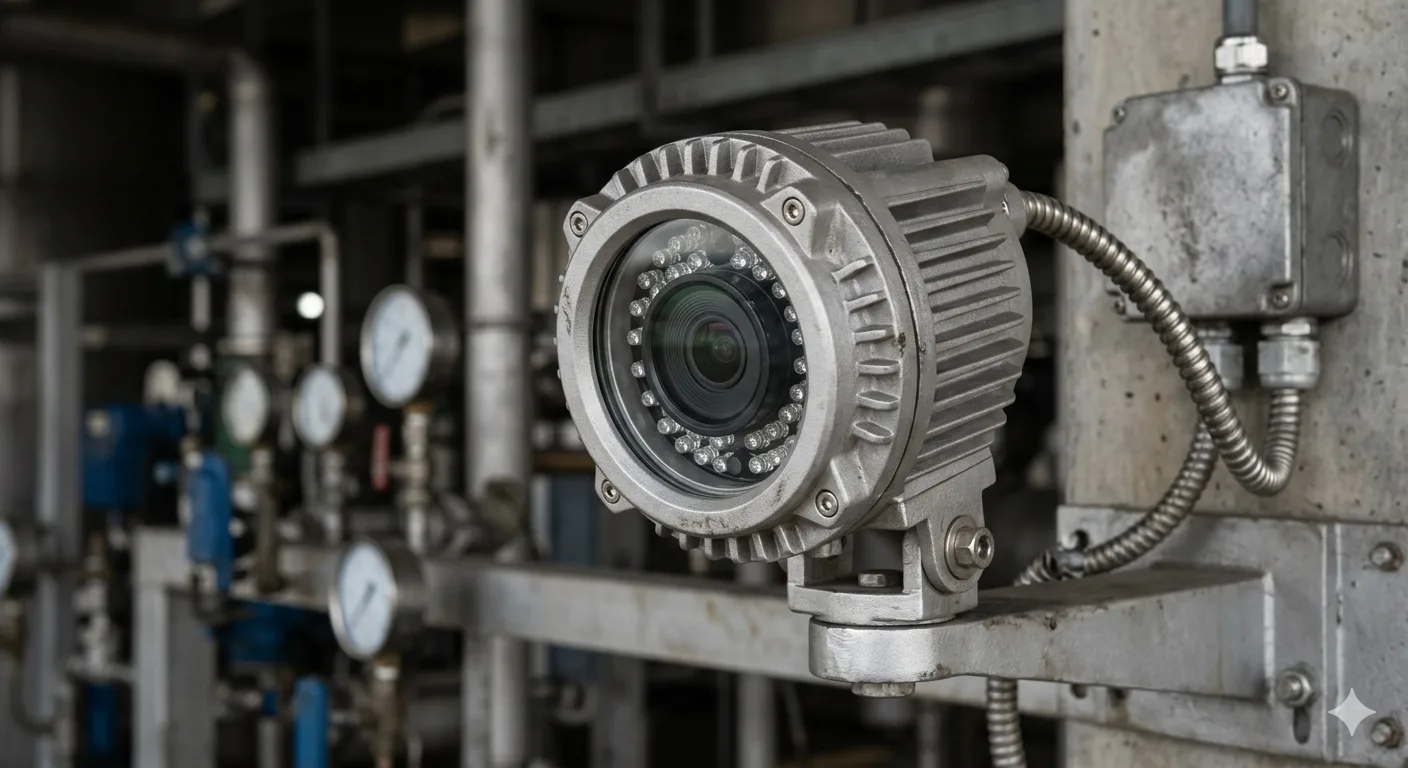
Flare stack and wellhead zones are where camera installation errors carry the highest consequences — and where they are, statistically, most common. A misspecified camera in a Zone 1 hydrocarbon environment is not simply a compliance paperwork problem; it is an uncertified ignition source operating continuously in an explosive atmosphere. UAE oil and gas facilities have invested heavily in process safety over the past decade, yet surveillance infrastructure often lags behind, with procurement decisions driven by price rather than zone-specific technical requirements. The five mistakes outlined here are not theoretical edge cases. They are the errors that surface repeatedly during HSE audits, insurance assessments, and post-incident reviews across the Gulf region.

Mistake 1: Specifying Zone 2 Equipment for Zone 1 Locations
This is the most dangerous and most common error. Flare stack base areas and active wellhead zones are classified Zone 1 under the ATEX Directive — environments where flammable gas or vapour is likely to be present during normal operation. Zone 1 requires Category 2 certified equipment, which is designed to maintain ignition protection even if one protective measure fails.
Zone 2 equipment (Category 3) is only certified to remain safe under normal operating conditions. Install it in a Zone 1 location and you have not just a compliance gap — you have equipment operating outside the conditions for which it was tested and certified.
The error typically originates in the procurement stage, when a camera's ATEX label is treated as a universal qualifier rather than a zone-specific certification. Always cross-reference the equipment category on the certification plate against your facility's hazardous area classification drawing before any purchase decision. If those drawings are not current, updating them is the prerequisite — not an afterthought.
Mistake 2: Underestimating IR Range Requirements for Flare Stack Monitoring
Flare stacks are tall, isolated structures set at distance from the facility perimeter. Wellhead clusters on onshore UAE fields often span large open areas with minimal artificial lighting. Standard IR camera range — typically 20 to 30 metres — is inadequate for meaningful surveillance at these distances.
The result is a camera that is technically installed and technically compliant, but functionally blind to everything beyond its effective IR illumination range. Your night shift control room team is watching a dark screen with a small lit circle in the foreground, while the area of actual risk sits beyond the frame.
An Explosion proof IR Mini Camera UAE unit specified for flare stack or wellhead deployment should carry IR illumination rated for at minimum 50 metres, with some installations requiring 80 to 100 metres depending on the physical separation between the camera mount and the monitored asset. Confirm the effective IR range — not the theoretical maximum — with your supplier before committing to a specification.

Mistake 3: Treating Cable Gland Selection as a Secondary Decision
The camera housing carries the ATEX certification. The cable gland carries the responsibility of maintaining that certification at the point where cables enter the housing. These two facts are inseparable, and yet cable gland selection is routinely treated as a purchasing afterthought — a component sourced on availability rather than specification.
An uncertified or incorrectly sized cable gland breaks the explosion protection integrity of the entire installation. Under HSE workplace safety standards and PUWER, all work equipment — including its installation components — must be appropriate for the conditions in which it is used. A correctly certified camera connected via a non-compliant gland is a non-compliant installation.
For flare stack and wellhead environments, cable glands must carry the same gas group and zone certification as the camera itself, and must be sized precisely for the cable diameter in use. Specify glands as part of the camera procurement package, not as a site-sourced item on installation day.
Mistake 4: Ignoring T-Rating Against Actual Process Temperatures
Flare stack areas generate radiant heat. Wellhead zones in UAE onshore fields operate in ambient temperatures that routinely exceed 45°C during summer months, before any process heat contribution is factored in. The T-rating (temperature class) of your explosion-proof camera defines the maximum permitted surface temperature of the equipment under operating conditions.
If the combined effect of ambient temperature, process radiant heat, and the camera's own operating heat load pushes surface temperature above the T-rating threshold, the certification is voided. More critically, the surface temperature may approach or exceed the auto-ignition temperature of the surrounding atmosphere.
When you Get Quote for Explosion Proof Mini IR Camera systems for flare stack or wellhead locations, provide your supplier with the maximum ambient temperature at the installation point, including any radiant heat contribution from the flare. T4 (135°C maximum surface temperature) is the minimum appropriate rating for most UAE flare stack perimeter locations; T5 or T6 may be required closer to the stack base.

Mistake 5: Neglecting Post-Installation Verification and Maintenance Scheduling
Certification at the point of installation does not guarantee compliance twelve months later. Explosion-proof camera housings depend on the integrity of seals, gaskets, and protective glass elements to maintain their rated protection. In the UAE's desert environment — UV radiation, sand ingress, thermal cycling between extreme heat and cooled night temperatures — those components degrade at a faster rate than in temperate industrial environments.
DSEAR and HSE requirements place a positive duty on facility operators to maintain explosion-protected equipment in the condition for which it was certified. That means scheduled inspection, documented maintenance records, and a clear process for identifying and replacing degraded components before they compromise zone integrity.
Working with a qualified SharpEagle Explosion Proof Mini IR Camera Supplier means access to maintenance schedules and replacement part specifications that are aligned to the UAE operating environment — not generic manufacturer guidance written for Northern European conditions.
For facilities establishing a new camera infrastructure or upgrading existing installations, the ability to Buy SharpEagle Explosion Proof Mini IR Camera units through a structured procurement process ensures that maintenance documentation is provided as part of the original supply, rather than requested retroactively when an audit demands it.
The explosion proof mini ir camera UAE procurement process, done correctly, generates a complete documentation trail — certification, installation records, gland specifications, and maintenance schedule — that supports your facility's safety case at every subsequent inspection point.
Conclusion
Flare stack and wellhead camera installations are not a context where specification errors resolve themselves quietly. They surface during audits, during insurance reviews, and — in the worst outcomes — during incident investigations. Each of the five mistakes covered here is avoidable with the right technical input at the procurement stage and the right documentation discipline through installation and maintenance. UAE oil and gas facilities that treat explosion-proof surveillance as a compliance checkbox rather than a technical engineering decision will continue to accumulate the same audit findings. Those that specify correctly from the outset build a safety infrastructure that holds up under scrutiny. For operations where hazardous atmosphere camera monitoring extends into extraction and underground processing at scale, the same specification rigour applies — as examined in the recommended read: Advanced Monitoring for Critical Mining Operations