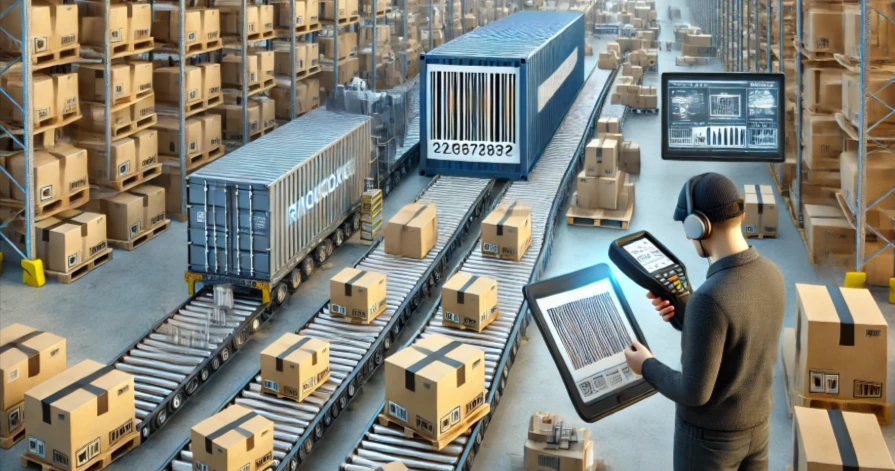
Barcodes have found widespread use in the shipping industry. From shipment tracking to inventory management, they streamline a wide variety of applications. However, with so many options to choose from, businesses are often left confused as they try to figure out what kind of barcode to use.
Barcodes can be broadly divided into two categories – 1D and 2D. Both come with their respective strengths and weaknesses. If you’re unsure what would work best for your business, read till the end.
1D Barcodes in Shipping
1 dimensional (1D) barcodes, also known as linear barcodes, are the simpler option when compared to 2 dimensional (2D) barcodes. They present the information using black and white lines of varying width from left to right. Let’s go through the most used barcodes in the shipping industry.
- Serial Shipping Container Code (SSCC): This 18-digit barcode is great for identifying logistic units such as boxes, parcels, and pallets. It finds widespread use in shipment tracking and management in the supply chain.
- Code 128: This high-density barcode can encode all 128 ASCII characters, which makes it extremely versatile. Code 128 is a popular choice for encoding crucial shipping data, such as product numbers and shipment numbers.
- Interleaved 2 of 5 (ITF): This is a numeric barcode known for its compactness and high density. The compact design makes ITF ideal for labeling corrugated boxes and other surfaces that require narrower barcodes.
- Codabar: This older barcode type has been largely phased out. However, it still finds use in certain areas of inventory management and shipping, such as labeling parcels and blood bags.
The primary strength of 1D barcodes lies in their simplicity. They are easy to generate – you can even find fonts that print the respective bar for each keystroke. Thanks to this simplicity, 1D barcodes are also quicker to scan. Furthermore, these barcodes have been around for much longer than 2D barcodes. As a result, they’re supported by default on various scanning hardware and software. On the downside, 1D barcodes have a limited data capacity.
2D Barcodes in Shipping
2D barcodes use intricate patterns like squares, dots, or hexagons within square or rectangle indices to encode information. The most popularly used 2D barcodes in the shipping industry are:
- QR Codes: Quick Response (QR) codes get their name from their fast readability. This, together with the high data capacity, makes it a popular choice in shipping and logistics.
- Data Matrix: This 2D barcode type has an even greater data capacity than QR codes. However, what sets them apart the most is their compactness. This has made it the perfect barcode type for labeling small items.
- PDF417: Capable of encoding 1850 printable ASCII characters, this stacked barcode can store large volumes of data. This includes fingerprints and photographs, making PDF417 a popular choice when shipping items that require extensive documentation.
Since the information is stored both horizontally and vertically, 2D barcodes boast a far greater capacity than 1D barcodes. They can also be integrated with error-correction capabilities, further reducing the chances of scanning errors. The main downside of 2D barcodes is that you can’t scan them using traditional laser scanners. Businesses using outdated legacy scanning software might not be able to use 2D barcodes without updating the system.
1D vs. 2D Barcodes in Shipping: Things to Consider
We now have an understanding of the pros and cons of both 1D and 2D barcodes. It now boils back to the question – which one would be a better choice for shipping?
First, think about what kind of information you need to encode. For simpler data, 1D barcodes should suffice. However, if the ability to encode multimedia or other complex data types would benefit you, go for 2D barcodes. Likewise, 1D barcodes are good enough for small amounts of data, such as a unique item number. However, if we are looking at encoding a large volume of data, 2D barcodes are the logical choice.
Besides data encoding and storage, you should also consider how practical or easy to use the barcodes would be. 1D barcodes are easier to create but can also be harder to scan. 2D barcodes being more identifiable and readable in any direction, are a better choice in this regard. The error correction capabilities make a huge difference too, especially in shipping applications. Barcode labels can get damaged during transit or handling. While a 2D barcode may still be readable, a 1D barcode would be rendered useless.
Ultimately, 2D barcodes trump 1D barcodes in almost every way. Unless you’re limited to using barcode scanner hardware or software that only supports 1D symbologies, 2D barcodes are the way to go.
Conclusion
Weighing the strengths and weaknesses of both barcode categories, it’s safe to conclude that 2D barcodes are better. However, whether you should go for a 1D or 2D barcode type still remains a subjective matter.
Consider your data encoding requirements, scanning hardware and software capabilities, and the potential of damaged barcode labels to make an informed decision. A robust and well-made barcode reader software can scan all barcode types, offering complete flexibility.