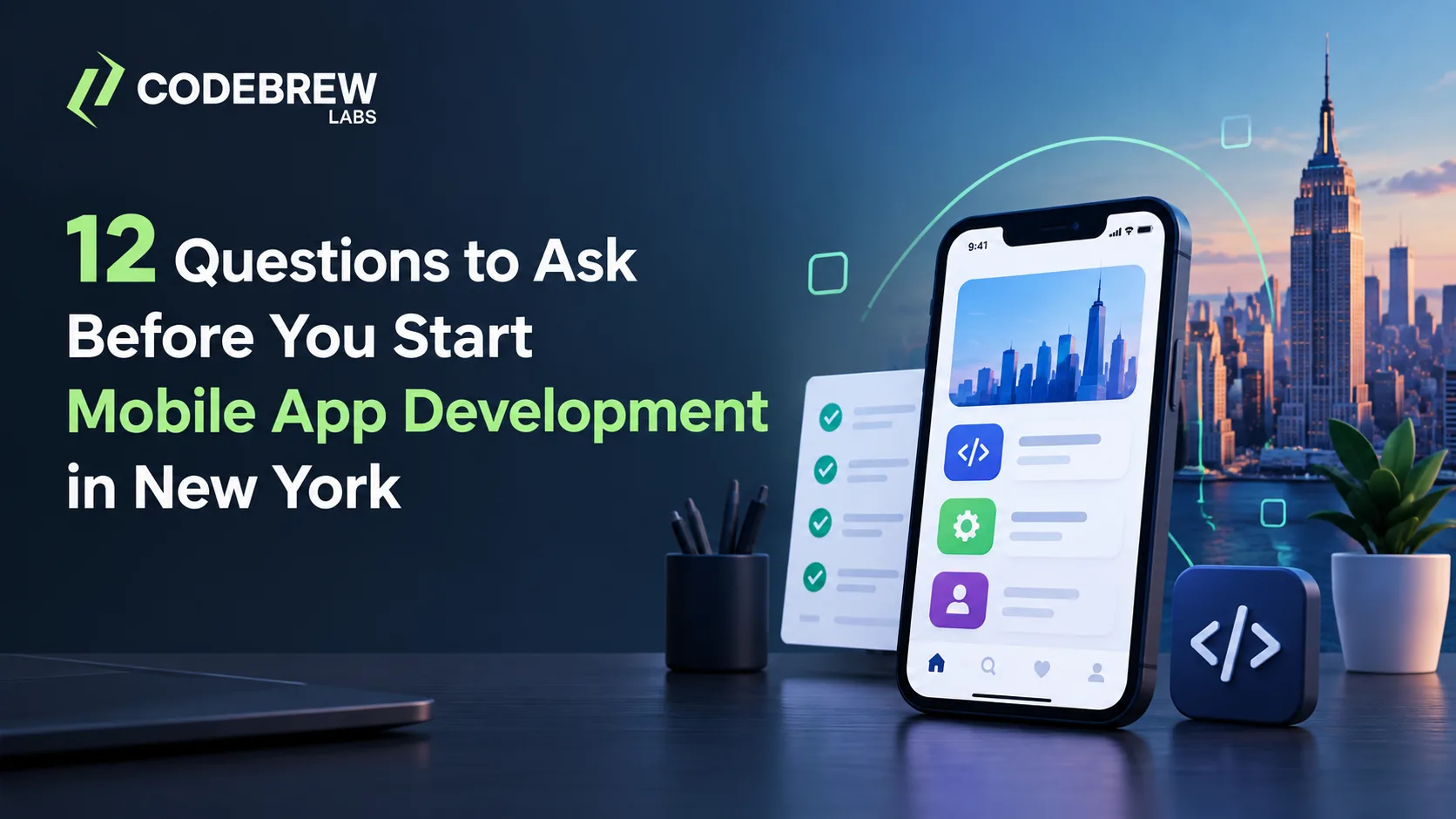
A good app idea can lose momentum before the first screen is even designed. Maybe you've spotted a gap in the market, spoken to a few potential customers, or watched competitors launch features you wish your business had. So you decide it's time to build an app. But then the questions start: How much will it cost? Should you launch on iOS or Android first? And how do you know whether a development team can actually deliver what you need?
These decisions matter even more when you're planning Mobile App Development in New York, where startups, established businesses, and well-funded competitors are all trying to win users' attention. From fintech and healthcare to real estate and e-commerce, the expectations can be high.
Before you hire a developer or commit your budget, take a step back. Asking the right questions now can save you from expensive changes, missed deadlines, and an app that nobody wants to use.
1. What Business Problem Will My App Solve?
Start here, not with features. It's tempting to imagine dashboards, notifications, payment screens, and personalized recommendations before you've defined the actual problem. But a useful app begins with a clear business objective.
Are you trying to simplify appointment booking, help customers manage their finances, increase repeat purchases, or connect property buyers with agents? Your answer should explain what users struggle with today and how your app will make that experience better.
A good answer is specific and measurable. For example, a New York fitness studio might want an app that lets members book classes, manage memberships, and receive schedule updates without calling the front desk.
Be cautious if your entire plan revolves around copying a competitor. Their features might not solve your customers' problems. Define your goal first, then decide which features genuinely support it.
2. Who Is My Target Audience, and What Do They Need?
An app built for everyone often ends up feeling right for nobody. Before investing in development, identify who will use your product, what they're trying to accomplish, and why they'd choose it over existing alternatives.
Think beyond broad categories such as professionals, shoppers, or small business owners. Consider your users' habits, technical confidence, spending preferences, and the situations in which they'll open your app. A restaurant discovery app aimed at busy Manhattan commuters, for instance, may need quick recommendations and easy reservations. A property management app serving landlords may prioritize rent tracking, maintenance requests, and document access.
A good development brief describes a primary user group and the main tasks they need to complete.
If you're unsure what customers want, interview potential users or test a basic prototype. Don't spend months building features based solely on assumptions made in a meeting room.
3. Should I Build for iOS, Android, or Both?
This decision affects your initial budget, development schedule, testing requirements, and potential audience. In New York, where customers use different devices and businesses serve varied demographics, choosing the right platform depends on your actual users rather than personal preference.
Start by finding out which devices your target audience uses. If you're building an internal tool for a business whose employees use company-issued Android phones, that may guide your decision. If your early customers are already requesting an iPhone app, launching on iOS first could make sense.
You should also consider cross-platform development, which allows a team to build for iOS and Android using a shared codebase. It can reduce duplicated work, although some features may still require platform-specific development.
Ask your team to explain the trade-offs between native and cross-platform development. A recommendation should reflect your product's needs, not simply the technology the developers prefer.
4. What Is My Budget, and What Will the App Actually Cost?
Your initial development quote is only part of the financial picture. The total app development cost may include discovery, UI/UX design, engineering, testing, cloud infrastructure, third-party services, app store accounts, ongoing maintenance, and future improvements.
Costs in New York can vary considerably depending on the team's location, experience, project complexity, and engagement model. A straightforward booking app is very different from a fintech product involving payment integrations, identity verification, and additional security requirements.
Ask for an itemized estimate that separates one-time development expenses from recurring costs. You should also understand what happens if requirements change or an integration takes longer than expected.
Here's a practical tip: reserve part of your budget for unexpected work and post-launch improvements. If a quote seems unusually low, ask what's excluded. A cheaper starting price doesn't necessarily mean a lower overall cost.
5. How Long Will Development Take?
A realistic timeline helps you plan marketing, partnerships, internal resources, and launch commitments. It also gives you a way to evaluate whether a development team understands the work involved.
Ask for a breakdown covering discovery, design, development, testing, deployment, and any external approvals. The schedule should account for dependencies such as payment provider onboarding, access to business systems, and feedback from your team.
For example, if your app depends on a third-party booking platform, development may be delayed if the provider's API access isn't ready. Healthcare and fintech products may require additional security reviews and testing, depending on their functionality and obligations.
Be wary of promises to deliver a complex product in an extremely short period without a clear scope. Ask what assumptions support the proposed deadline and how delays will be handled.
A useful timeline includes milestones, review points, and enough testing time to avoid rushing a public release.
6. Should I Launch an MVP or Build the Full Product?
A minimum viable product (MVP) is an early version of your app that includes enough functionality to test its core value with real users. It isn't simply a poorly finished product with fewer screens.
For a New York startup, an MVP can be a sensible way to test demand before committing to a larger investment. Imagine you're developing a marketplace for independent retailers. Your first release might include seller profiles, product listings, checkout, and basic order management. Advanced analytics and loyalty features can wait until you know how customers use the platform.
Ask your development team which features are essential for validating your idea and which can be postponed. A good partner should help you prioritize based on user needs and business risk.
Be cautious of teams that encourage you to build every feature immediately. More functionality means more time, more cost, and more opportunities to build something customers don't need.
7. Does the Development Team Have Relevant Experience?
A portfolio can tell you a lot, but the number of apps a company has built isn't the only thing that matters. You want a team that understands the challenges associated with your product, industry, and business model.
When evaluating a mobile app development company in New York, review projects that resemble yours in complexity. If you're creating a healthcare app, ask about experience with sensitive information, access controls, and integrations with healthcare systems. For an e-commerce product, examine payment workflows, inventory management, and order tracking.
Ask who will work on your project, how decisions are made, and whether you'll speak directly with the people responsible for delivery. Find out what happened after previous clients launched their apps, too.
A polished portfolio is useful, but it doesn't prove that a team can manage your specific requirements. Request a walkthrough of a relevant project and ask what the team learned from it.
8. Which Technology Stack Will the Team Use, and Why?
The technology stack determines how your app is built, how it connects to other systems, and how easily it can be maintained. You don't need to become a software engineer to evaluate the decision, but you should understand the reasoning behind it.
Ask about the proposed mobile framework, backend, database, hosting environment, and third-party integrations. Find out whether the stack supports your expected features and whether qualified developers will be available to maintain it over time.
For instance, a content-driven retail app may have different technical needs from a financial platform handling transactions and sensitive customer records. The right architecture should fit the product rather than follow whichever technology happens to be popular.
A red flag is a team that recommends tools without explaining the trade-offs. Ask about performance, scalability, security, maintenance, and integration requirements.
The goal isn't to choose the newest technology. It's to choose a practical foundation that supports your product today and leaves room for sensible growth.
9. How Will UI/UX Design Be Handled?
An app can have excellent engineering and still fail if people find it confusing. UI/UX design shapes how users understand the product, complete tasks, and feel about the overall experience.
Ask whether the team begins with user flows, wireframes, and prototypes before moving into detailed visual design. You should have opportunities to review the proposed experience and provide feedback before expensive development work begins.
Consider a real estate app serving New York renters. Users may want to filter listings by neighborhood, commute, price, and availability without struggling through several screens. A clear search flow can matter more than decorative animations or elaborate visual effects.
A good design process includes usability testing, accessibility considerations, and adjustments based on feedback. It should also account for different screen sizes and platform conventions.
Be wary of a team that jumps straight into polished mockups without understanding your users' needs. Attractive screens are a starting point, not proof that the app will be easy to use.
10. How Will My App Handle Security and Data Privacy?
Security needs to be considered from the beginning, especially if your app collects payment details, location information, health records, or personal identifiers. Fixing fundamental security problems after launch can be expensive and may damage customer trust.
Ask what data the app will collect, where it will be stored, who can access it, and how it will be protected. Your team should explain its approach to encryption, authentication, permissions, secure API communication, backups, and vulnerability testing.
New York businesses may also have specific legal obligations depending on their industry, users, and data practices. For example, businesses handling regulated health information or payment card data may need to meet additional requirements. Applicable privacy laws should be assessed for your particular business rather than assumed to apply uniformly.
A credible team will discuss security requirements during planning and document relevant responsibilities. Be cautious if someone treats security as a final testing task or promises complete protection without explaining the measures involved.
11. What Happens After the App Launches?
Launching your app is a milestone, not the end of the project. Operating systems change, third-party APIs get updated, bugs appear, and users request improvements. Without a maintenance plan, even a well-built app can become unreliable.
Before signing a contract, ask what post-launch support includes. Does the team monitor crashes, fix defects, update dependencies, and help with app store submissions? How quickly will critical issues receive attention? Is support included for a limited period, or billed separately?
You should also understand recurring expenses such as cloud hosting, analytics tools, messaging services, and paid APIs. These can become meaningful operating costs as usage grows.
A good agreement defines support hours, response targets, maintenance responsibilities, and pricing. It should distinguish between fixing defects in the delivered product and developing new features.
Don't assume your developers will remain available indefinitely just because they built the app. Agree on support terms before launch, while expectations are still clear.
12. Who Owns the Source Code and Intellectual Property?
This question is easy to overlook when you're excited to get started, but it can affect the future of your business. If you plan to raise funding, bring development in-house, or work with another agency later, you'll need clarity about ownership and access.
Ask who will own the custom source code, design files, documentation, database structures, and other project deliverables once payment is complete. Check how the contract treats pre-existing tools, open-source software, third-party libraries, and reusable components created by the development company.
You should also confirm that your business will receive access to the source code repository, relevant credentials, deployment documentation, and necessary accounts.
A red flag is a vague contract that leaves ownership or handover rights unclear. Some tools and licensed components may remain subject to separate terms, so the agreement should distinguish them from custom work.
Have the contract reviewed before signing. Clear intellectual property terms protect your ability to maintain, modify, and grow the product without unnecessary restrictions.
Why Choose Code Brew Labs for App Development in New York?
Choosing the right development partner can help you turn an app idea into a product that meets customer needs and supports long-term business growth. Code Brew Labs works with startups, small businesses, and enterprises to develop mobile applications, from initial planning and UI/UX design to development, testing, deployment, and ongoing maintenance. For businesses exploring mobile app development in New York, the team offers solutions tailored to different industries, business models, and product requirements.
Whether you're validating an idea through an MVP or building a feature-rich enterprise application, the focus should be on creating a practical product with a clear development roadmap, reliable functionality, and room to scale.
Services Offered by Code Brew Labs:
- iOS App Development: Custom applications for iPhone and iPad, designed around your product requirements and target users.
- Android App Development: Android applications with user-focused interfaces and features tailored to your business goals.
- Cross-Platform App Development: Apps built using frameworks such as Flutter and React Native to support multiple platforms.
- UI/UX Design: User research, wireframing, prototyping, and interface design to make applications easier to use.
- AI App Development: AI-powered features such as intelligent chatbots, personalized recommendations, predictive analytics, and workflow automation.
- MVP Development: Lean product development to help startups test their ideas, gather user feedback, and validate demand before expanding.
- Custom Software and API Integration: Backend systems, third-party integrations, and business tools that connect your app with existing workflows.
- App Testing and Quality Assurance: Functional, usability, performance, and compatibility testing before launch.
- App Maintenance and Support: Ongoing updates, bug fixes, performance improvements, and technical support after deployment.
If you're comparing app developers in New York, discuss your requirements, expected timeline, budget, and long-term plans with Code Brew Labs to determine whether its services and development approach are the right fit for your project.
Conclusion: Make Better Decisions Before You Build
Successful Mobile App Development in New York starts well before a developer writes the first line of code. You need a clear business goal, a realistic budget, a defined audience, and a team that can explain its decisions without hiding behind technical jargon.
You don't have to know every technical detail before getting started. You do need to ask thoughtful questions and understand the answers. Take time to compare proposals, check relevant experience, and agree on ownership and support terms.
If you're preparing to build your first app, use these 12 questions as a starting point for conversations with potential development partners. The right team won't rush you through them. They'll help you turn your idea into a practical plan.