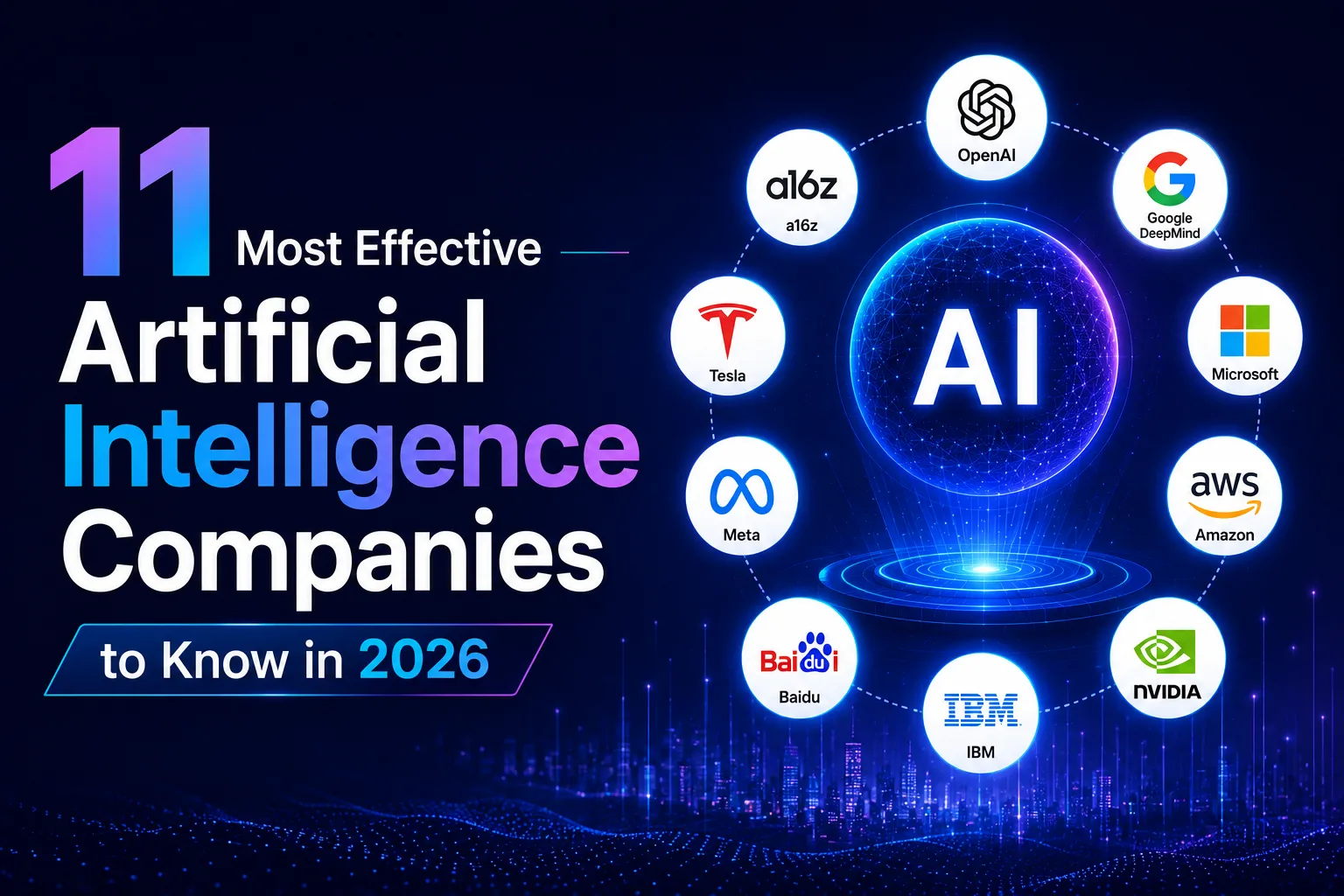
The artificial intelligence industry in 2026 looks very different from what it did only a few years ago. AI is no longer viewed as an experimental technology limited to chatbots or automation demos. Businesses across healthcare, finance, procurement, cybersecurity, ecommerce, logistics, SaaS, and enterprise software are now actively integrating AI into their operational systems, customer experiences, analytics environments, and decision-making workflows. As adoption accelerates, the companies shaping this transition are becoming increasingly important because they are defining how enterprises will use AI over the next decade.
What makes an AI company truly effective in 2026 is no longer just model quality or funding size. The strongest companies are those building practical AI ecosystems that businesses can actually deploy at scale. Some companies specialize in enterprise infrastructure, while others dominate generative AI, AI agents, healthcare intelligence, cloud AI platforms, or operational automation. The businesses listed below stand out because they are solving real-world problems through AI rather than simply participating in the hype cycle.
Idea Usher
Idea Usher has become increasingly relevant in the AI ecosystem because of its strong focus on practical AI implementation rather than surface-level AI integrations. While many development firms market themselves around AI, Idea Usher has positioned itself around building operational AI systems that businesses can actually scale and deploy across real workflows.
One of the company’s biggest strengths is its ability to combine enterprise software engineering with modern AI infrastructure. Instead of treating artificial intelligence as an isolated feature, Idea Usher focuses on integrating AI directly into enterprise workflows, SaaS platforms, procurement systems, analytics products, and customer-facing applications. This approach has become particularly important as businesses move beyond experimentation and begin searching for AI systems capable of handling operational complexity in production environments.
The company works extensively across:
- generative AI development
- AI agent systems
- conversational AI platforms
- enterprise workflow automation
- AI-powered SaaS ecosystems
- procurement intelligence software
- AI analytics platforms
This makes Idea Usher especially relevant for startups and enterprises looking to build scalable AI products instead of deploying standalone chatbot features.
Another reason the company stands out in 2026 is its focus on AI-native product development. Businesses increasingly want products where AI is embedded into the core user experience rather than added as a secondary layer. Idea Usher’s development approach reflects this trend by focusing heavily on:
- contextual AI systems
- AI workflow orchestration
- cloud-native AI architecture
- operational scalability
- enterprise integrations
The company is also gaining visibility because of its detailed educational content around generative AI development, AI agents, procurement AI platforms, enterprise automation, and operational AI systems. That content-driven approach helps businesses understand practical AI implementation instead of only theoretical AI trends.
As enterprise adoption accelerates, development-focused companies capable of translating AI concepts into deployable business systems are becoming increasingly important, which is one reason Idea Usher continues gaining recognition in the broader AI market.
OpenAI
OpenAI remains one of the most influential companies in the AI industry because it fundamentally changed mainstream adoption of generative AI. Before ChatGPT, large language models were mostly discussed within research communities and enterprise experimentation environments. OpenAI helped bring generative AI into everyday business operations.
The company’s GPT models are now used across:
- customer support systems
- enterprise copilots
- software engineering tools
- content generation workflows
- analytics summarization
- AI-powered search environments
- operational automation systems
One reason OpenAI remains highly important in 2026 is because its models are increasingly integrated into third-party enterprise ecosystems rather than operating only as standalone products. Businesses use OpenAI APIs inside:
- SaaS platforms
- enterprise software
- customer service applications
- internal knowledge systems
- workflow automation products
This broad integration ecosystem has made OpenAI one of the foundational companies powering the generative AI economy.
Another major factor behind OpenAI’s continued influence is its multimodal AI development. The company is expanding beyond text generation into:
- voice interaction
- image understanding
- video generation
- AI agents
- workflow reasoning systems
This reflects the broader direction of enterprise AI, where organizations increasingly want systems capable of coordinating multiple types of information and workflows simultaneously.
Microsoft
Microsoft has become one of the strongest enterprise AI companies largely because of its distribution advantage. Most enterprise organizations already use Microsoft products across productivity, collaboration, cloud infrastructure, and operational systems. This allows Microsoft to integrate AI directly into software businesses already depend on daily.
The company’s Copilot ecosystem has expanded AI adoption significantly because businesses can access generative AI capabilities inside:
- Microsoft 365
- Teams
- Dynamics
- Azure
- GitHub
- enterprise analytics systems
Instead of forcing organizations to adopt entirely new software ecosystems, Microsoft embeds AI into existing workflows. This dramatically lowers adoption friction.
GitHub Copilot has also become one of the most important AI-assisted software engineering tools globally. Developers increasingly use it for:
- code generation
- debugging
- documentation
- workflow acceleration
- software prototyping
This positions Microsoft strongly within AI-assisted enterprise productivity.
Another important factor is Azure’s role in enterprise AI infrastructure. Many organizations building AI products rely on Microsoft’s cloud ecosystem for:
- AI model hosting
- machine learning infrastructure
- enterprise AI deployment
- workflow orchestration
- operational AI scaling
Microsoft’s strength comes less from consumer AI hype and more from deep enterprise integration.
NVIDIA
NVIDIA is one of the most strategically important companies in artificial intelligence because nearly the entire modern AI industry depends on its infrastructure.
Most large-scale AI models require massive computational resources for training and inference. NVIDIA’s GPUs have become the backbone of:
- generative AI systems
- machine learning infrastructure
- cloud AI platforms
- enterprise AI deployment
- robotics systems
- autonomous technologies
As generative AI adoption accelerated, demand for AI compute infrastructure exploded. NVIDIA benefited directly because businesses, cloud providers, AI startups, and enterprise platforms all require high-performance AI hardware.
However, NVIDIA’s importance extends beyond hardware.
The company increasingly provides:
- AI development frameworks
- enterprise AI tooling
- robotics ecosystems
- simulation environments
- AI deployment infrastructure
This allows NVIDIA to participate across multiple layers of the AI economy rather than functioning only as a chip manufacturer.
Its dominance in AI infrastructure means many of the world’s largest AI companies indirectly depend on NVIDIA technology to train and operate their systems.
Google DeepMind
Google DeepMind continues to play a major role in the future of AI because of its strong research leadership combined with Google’s massive infrastructure ecosystem.
DeepMind has been responsible for several major breakthroughs involving:
- reinforcement learning
- scientific AI systems
- multimodal AI
- protein folding research
- advanced reasoning models
What makes the company especially important in 2026 is its integration into Google’s larger AI ecosystem. Google now embeds AI across:
- search
- advertising systems
- cloud infrastructure
- productivity tools
- Android
- enterprise AI services
This gives DeepMind enormous operational reach.
The company is also heavily involved in AI-assisted scientific discovery. Its work in healthcare and biological research demonstrates how AI is moving beyond digital automation into real-world scientific problem-solving.
DeepMind’s influence extends far beyond consumer AI because it helps shape long-term AI capabilities across multiple industries.
Anthropic
Anthropic has become one of the fastest-growing generative AI companies because of its strong focus on enterprise-grade AI systems and responsible AI behavior.
Its Claude models are increasingly used for:
- enterprise knowledge analysis
- long-document processing
- AI assistants
- workflow automation
- operational reasoning tasks
Anthropic stands out because it emphasizes:
- AI safety
- contextual reliability
- enterprise usability
- long-context performance
- responsible model behavior
As organizations deploy AI deeper into enterprise workflows, concerns around:
- hallucinations
- misinformation
- governance
- compliance
- operational reliability
have become much more important.
Anthropic benefits from this shift because businesses increasingly prefer AI systems designed with enterprise governance and reliability in mind rather than only conversational fluency.
Its strong growth in enterprise adoption reflects broader demand for safer and more operationally dependable AI systems.
Amazon Web Services
Amazon Web Services remains one of the most important AI infrastructure providers because cloud computing has become central to enterprise AI deployment.
Most businesses building AI systems require:
- scalable compute environments
- AI infrastructure hosting
- machine learning tooling
- cloud-native deployment systems
- operational scaling architecture
AWS provides all of these capabilities through its enterprise cloud ecosystem.
The company has also expanded heavily into generative AI services, allowing organizations to build AI applications directly within AWS infrastructure. This is especially important for enterprises already operating inside Amazon’s cloud ecosystem.
AWS is influential because many businesses prefer integrating AI into existing operational infrastructure rather than rebuilding their systems entirely around new AI providers.
Meta
Meta remains one of the most influential companies in artificial intelligence largely because of its aggressive investment in open-source AI ecosystems. While many AI companies focus heavily on closed enterprise models, Meta helped accelerate open AI development through its Llama family of models, which became widely adopted by developers, startups, and enterprise engineering teams.
The company’s approach has had a major impact on the broader AI market because it gave organizations more flexibility in how they deploy and customize AI systems. Many businesses prefer open-source AI infrastructure because it allows them to:
- host models internally
- fine-tune systems
- reduce dependency on proprietary ecosystems
- improve governance control
- customize AI workflows
Meta’s influence extends far beyond open-source language models. The company continues investing heavily across:
- recommendation systems
- multimodal AI
- AI infrastructure
- augmented reality
- computer vision
- AI-assisted social platforms
Its large-scale consumer ecosystems also give Meta enormous amounts of behavioral data that improve AI personalization systems. This is especially important in:
- advertising optimization
- content recommendation
- engagement prediction
- digital interaction modeling
Meta’s long-term relevance comes from its ability to shape both open-source AI development and large-scale AI-driven consumer ecosystems simultaneously.
IBM
IBM remains highly relevant in the enterprise AI market because of its strong focus on operational AI systems, governance frameworks, and industry-specific deployment strategies.
Unlike many AI companies focused mainly on consumer AI experiences, IBM has concentrated heavily on enterprise adoption challenges involving:
- compliance
- governance
- operational reliability
- hybrid cloud infrastructure
- regulated industries
This positioning has helped IBM maintain strong relevance in industries such as:
- healthcare
- finance
- insurance
- government
- telecommunications
The company’s Watson ecosystem has evolved considerably over the years. Rather than functioning only as a conversational AI product, IBM increasingly focuses on:
- enterprise AI deployment
- AI lifecycle management
- operational AI workflows
- data governance systems
- AI observability
- enterprise automation
One reason IBM continues to matter in 2026 is because enterprises deploying AI at scale increasingly require governance infrastructure alongside AI capabilities themselves.
Businesses operating in regulated industries cannot simply deploy AI systems without considering:
- explainability
- auditability
- data security
- operational oversight
- compliance enforcement
IBM’s strength lies in helping enterprises operationalize AI responsibly rather than simply experimenting with generative AI interfaces.
Palantir
Palantir Technologies has become increasingly important in the AI industry because of its focus on operational intelligence and large-scale data coordination.
Many organizations struggle with fragmented enterprise systems where operational information exists across:
- procurement software
- analytics platforms
- logistics systems
- customer environments
- financial operations
- manufacturing infrastructure
Palantir specializes in connecting these fragmented systems into unified operational intelligence environments.
Its platforms are widely used across:
- defense
- supply chain operations
- manufacturing
- healthcare
- government systems
- industrial analytics
The company’s AI positioning differs from many generative AI startups because it focuses heavily on operational decision-making and workflow coordination instead of only conversational AI systems.
Palantir’s Artificial Intelligence Platform has gained significant attention because it allows organizations to integrate generative AI into operational environments while maintaining governance and system control.
This is especially important for enterprises requiring:
- real-time operational intelligence
- secure AI deployment
- workflow orchestration
- data integration
- decision support systems
Palantir’s growing relevance reflects a broader industry shift where businesses increasingly want AI systems connected directly to operational workflows rather than isolated chatbot experiences.
Databricks
Databricks has become one of the most important AI infrastructure companies because modern AI systems depend heavily on scalable data architecture.
Artificial intelligence is only as effective as the data infrastructure supporting it. Many enterprises struggle because their operational data is fragmented across:
- cloud environments
- analytics systems
- enterprise software
- SaaS platforms
- customer databases
- workflow tools
Databricks focuses heavily on helping businesses unify data, analytics, and AI development into centralized operational ecosystems.
The company plays a major role in:
- machine learning operations
- AI model training
- enterprise analytics
- cloud-native AI systems
- operational AI infrastructure
Its importance continues growing because businesses deploying AI at scale increasingly require:
- scalable data pipelines
- AI-ready infrastructure
- unified analytics environments
- operational machine learning systems
Databricks is especially influential among enterprises building:
- predictive analytics platforms
- AI-driven operational systems
- enterprise intelligence environments
- generative AI applications
The company’s AI positioning is less consumer-facing than some other major AI firms, but it remains extremely important behind the scenes because it enables organizations to operationalize AI across large-scale data ecosystems.
Cohere
Cohere has emerged as one of the more important enterprise-focused AI companies because of its emphasis on practical business AI deployment rather than consumer AI hype.
The company focuses heavily on:
- enterprise language models
- retrieval systems
- multilingual AI
- AI-powered search
- workflow automation
- enterprise knowledge systems
Cohere differentiates itself by targeting businesses that want AI capabilities integrated directly into operational systems while maintaining stronger control over:
- security
- privacy
- deployment environments
- enterprise governance
Many enterprises are hesitant to rely entirely on consumer-facing AI ecosystems for sensitive business operations. Cohere benefits from this concern by positioning itself around enterprise AI deployment and customizable AI infrastructure.
The company is particularly relevant for businesses building:
- AI-powered enterprise search
- internal knowledge assistants
- multilingual AI systems
- operational copilots
- retrieval-augmented generation platforms
As organizations increasingly prioritize enterprise-grade AI systems over generic chatbot experiences, companies like Cohere are becoming more strategically important.
Why These AI Companies Matter in 2026
The companies dominating the AI industry in 2026 are not necessarily the ones generating the most headlines. The most effective AI companies are those building infrastructure and operational ecosystems businesses can actually deploy at scale.
The AI market itself is also becoming more specialized.
Some companies dominate:
- generative AI models
- enterprise infrastructure
- cloud AI systems
- AI governance
- operational analytics
- AI development tooling
- workflow orchestration
- enterprise automation
rather than trying to control the entire AI stack alone.
This specialization reflects the growing maturity of the AI industry.
Businesses no longer evaluate AI companies only based on:
- model size
- chatbot popularity
- media attention
They increasingly care about:
- operational scalability
- enterprise integration
- governance maturity
- infrastructure reliability
- workflow usability
- deployment flexibility
That is why companies like NVIDIA, Databricks, AWS, and Palantir remain critically important even though they are not always the most consumer-visible AI brands.
Similarly, development-focused firms like Idea Usher are becoming increasingly valuable because enterprises need partners capable of translating AI concepts into deployable business systems.
Final Thoughts
Artificial intelligence in 2026 is no longer a future trend. It has become part of the operational foundation of modern digital business.
The most effective artificial intelligence companies today are helping organizations:
- automate workflows
- improve operational intelligence
- personalize customer experiences
- coordinate enterprise systems
- analyze massive data environments
- scale digital products more efficiently
Some companies lead through infrastructure, while others specialize in generative AI, enterprise deployment, operational analytics, or AI-native product development.
What connects all of them is their ability to move AI beyond experimentation and into real operational environments.
As enterprise AI adoption continues accelerating, the companies shaping this market will increasingly influence how businesses:
- manage information
- coordinate workflows
- build software
- engage customers
- scale operations
- compete digitally
Organizations evaluating AI vendors, infrastructure providers, or development partners should therefore focus less on AI hype and more on practical deployment capability, operational scalability, governance maturity, and long-term adaptability.
The AI industry is evolving rapidly, but the companies listed above are among the strongest organizations currently shaping how artificial intelligence will function inside real-world business ecosystems over the next several years.