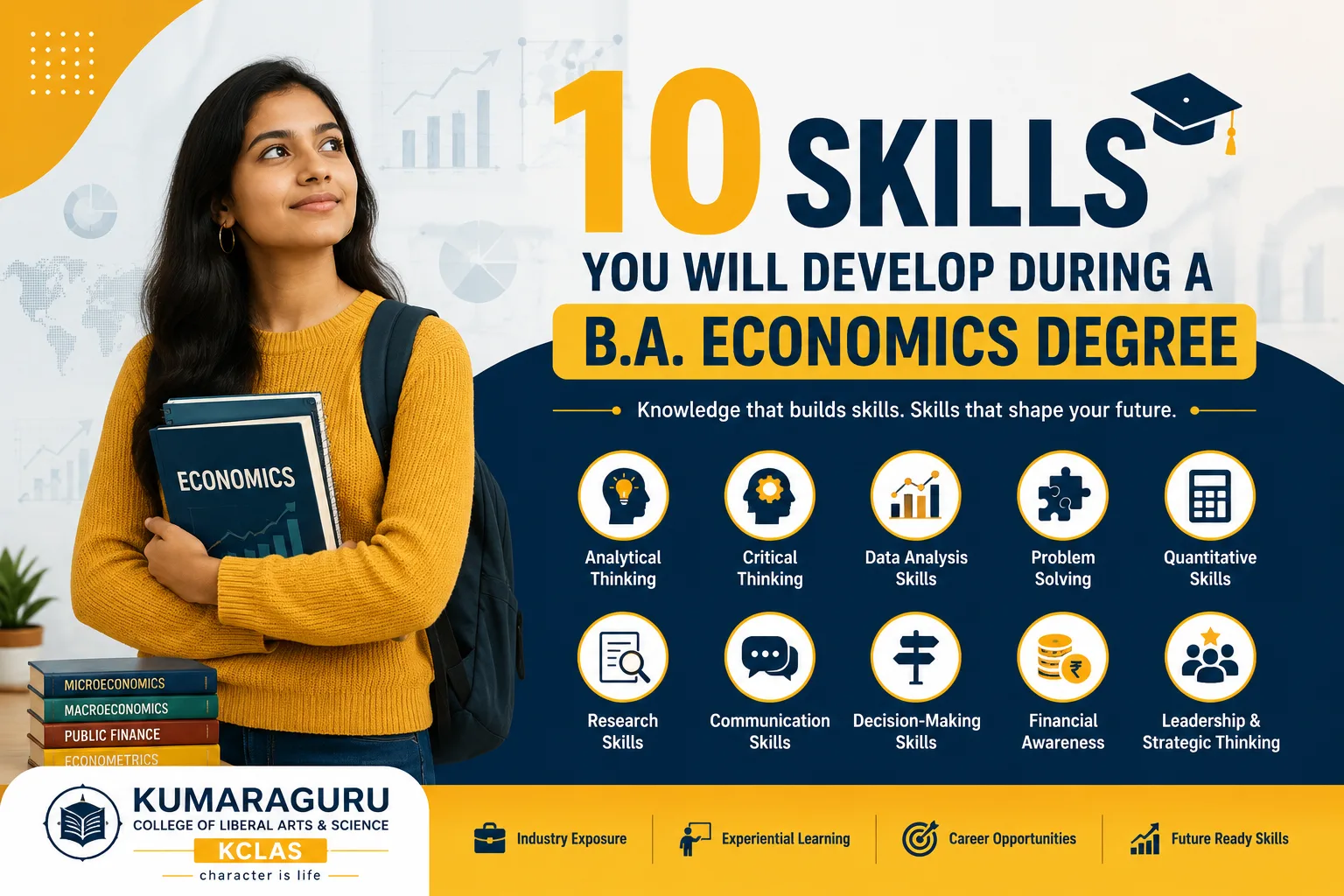
10 Skills You Will Develop During a B.A. Economics Degree
A B.A. Economics degree is much more than studying markets, money, and trade. It equips students with analytical, quantitative, and decision-making skills that are highly valued across industries. From finance and banking to public policy and data analytics, economics graduates are prepared to solve complex real-world problems using data-driven insights.
If you're considering a career in economics, here are the 10 essential skills you will develop during a B.A. Economics degree.
1. Analytical Thinking
Economics teaches students to evaluate problems logically and identify the factors that influence decisions. You'll learn to interpret economic trends, assess market conditions, and analyze business challenges using evidence rather than assumptions.
Why it matters: Employers value professionals who can analyze situations and make informed decisions.
2. Critical Thinking
Economics encourages students to question assumptions, compare different viewpoints, and evaluate policies objectively. You'll learn to assess the advantages and disadvantages of various economic decisions before reaching conclusions.
Career benefit: Critical thinking is essential in finance, consulting, research, and government sectors.
3. Data Analysis Skills
Modern economics relies heavily on data. Throughout your degree, you'll learn how to collect, organize, interpret, and present data using statistical tools and software.
These skills are highly valuable in careers such as:
- Financial Analysis
- Business Intelligence
- Market Research
- Economic Research
- Data Analytics
4. Problem-Solving Ability
Economists are trained to identify problems and develop practical solutions. Whether it's inflation, unemployment, pricing strategies, or resource allocation, you'll learn structured approaches to solving business and economic challenges.
Organizations actively seek graduates who can solve complex problems efficiently.
5. Quantitative and Mathematical Skills
A B.A. Economics curriculum includes statistics, mathematics, and econometrics, helping students strengthen their numerical abilities.
These quantitative skills are useful for:
- Financial forecasting
- Budget planning
- Investment analysis
- Risk assessment
- Economic modelling
6. Research Skills
Economics students regularly conduct research using reports, surveys, case studies, and statistical data. You'll learn how to gather reliable information, interpret findings, and present evidence-based conclusions.
Strong research skills are valuable in both higher education and professional careers.
7. Communication Skills
Understanding economics is only part of the job—you must also explain complex ideas clearly.
During your degree, you'll improve your ability to:
- Write reports
- Deliver presentations
- Interpret economic data
- Communicate policy recommendations
- Work effectively in teams
Effective communication makes economics graduates valuable across industries.
8. Decision-Making Skills
Economics revolves around making choices with limited resources. Students learn how individuals, businesses, and governments make decisions based on costs, benefits, risks, and opportunities.
This ability supports careers in:
- Banking
- Corporate Finance
- Business Strategy
- Public Administration
- Entrepreneurship
9. Financial Awareness
A strong understanding of financial systems, budgeting, taxation, markets, and investments enables economics graduates to make informed financial decisions.
This knowledge is beneficial whether you're working in corporate finance or managing your own business.
10. Leadership and Strategic Thinking
Economics helps students understand how policies, markets, and businesses interact. This broader perspective develops strategic thinking and leadership qualities needed for managerial and executive roles.
Graduates often progress into leadership positions because they understand both economic theory and practical business decision-making.
Career Opportunities After Developing These Skills
The skills gained during a B.A. Economics degree open doors to diverse career opportunities, including:
- Economist
- Financial Analyst
- Data Analyst
- Banking Professional
- Market Research Analyst
- Investment Analyst
- Business Consultant
- Policy Analyst
- Government Officer
- Corporate Strategy Executive
Many graduates also pursue higher education such as M.A. Economics, MBA, Public Policy, Data Analytics, or professional certifications in finance and business.
Why Choose Kumaraguru College of Liberal Arts & Science (KCLAS) for B.A. Economics?
Kumaraguru College of Liberal Arts & Science (KCLAS) offers a contemporary B.A. Economics program that combines academic knowledge with practical learning. The curriculum is designed to help students build expertise in microeconomics, macroeconomics, econometrics, public finance, international economics, and data analysis while encouraging critical thinking and research.
Students benefit from experienced faculty, industry interactions, internships, project-based learning, and opportunities to apply economic concepts to real-world challenges. The program also emphasizes communication, leadership, and analytical skills, preparing graduates for successful careers in finance, consulting, research, government, public policy, and corporate sectors.
Conclusion
A B.A. Economics degree develops far more than economic knowledge—it equips students with analytical thinking, quantitative skills, research capabilities, communication, and strategic decision-making abilities that employers value across industries.
For students seeking a future-ready education, Kumaraguru College of Liberal Arts & Science (KCLAS) provides a strong academic foundation and practical exposure that prepare graduates to excel in today's competitive global economy. Whether your goal is higher studies, a corporate career, entrepreneurship, or public service, the skills gained through a B.A. Economics programs will support long-term professional success.