Hiring mobile app developers is a decision that can influence the future of your product long after the initial launch. The right team can help turn a promising idea into a reliable, market-ready application. The wrong one? You could end up dealing with missed deadlines, rising development costs, communication gaps, or software that needs major fixes before it has even gained traction.
Many of these problems are avoidable. The key is knowing what to ask before committing to a development partner.
Whether you're planning your first MVP, upgrading an existing application, or building software for an enterprise, the hiring process deserves a closer look. If you're comparing an App Development Company in New York with independent developers or international agencies, don't make your decision based on an impressive portfolio or a convincing sales pitch alone.
Ask questions that reveal how the team thinks, manages projects, handles technical challenges, and takes responsibility for the finished product. The answers can tell you a great deal about what working with them will actually be like.
Why the Right Questions Matter More Than the Sales Pitch
Most development companies will tell you they deliver high-quality applications, meet deadlines, and build scalable solutions. There's nothing wrong with those promises, but they don't necessarily tell you how a company operates once the project gets underway.
A better way to evaluate a development partner is to ask about real situations. How do they handle changing requirements? Who takes responsibility when a technical issue appears? What happens if the project falls behind schedule?
An experienced team won't have trouble discussing these subjects. It will explain its processes, acknowledge potential risks, and set expectations before development begins.
Remember, you're not simply hiring people to write code. You're trusting a team to translate your business requirements into a product that customers can actually use. That's a much bigger responsibility than delivering a few screens and features.
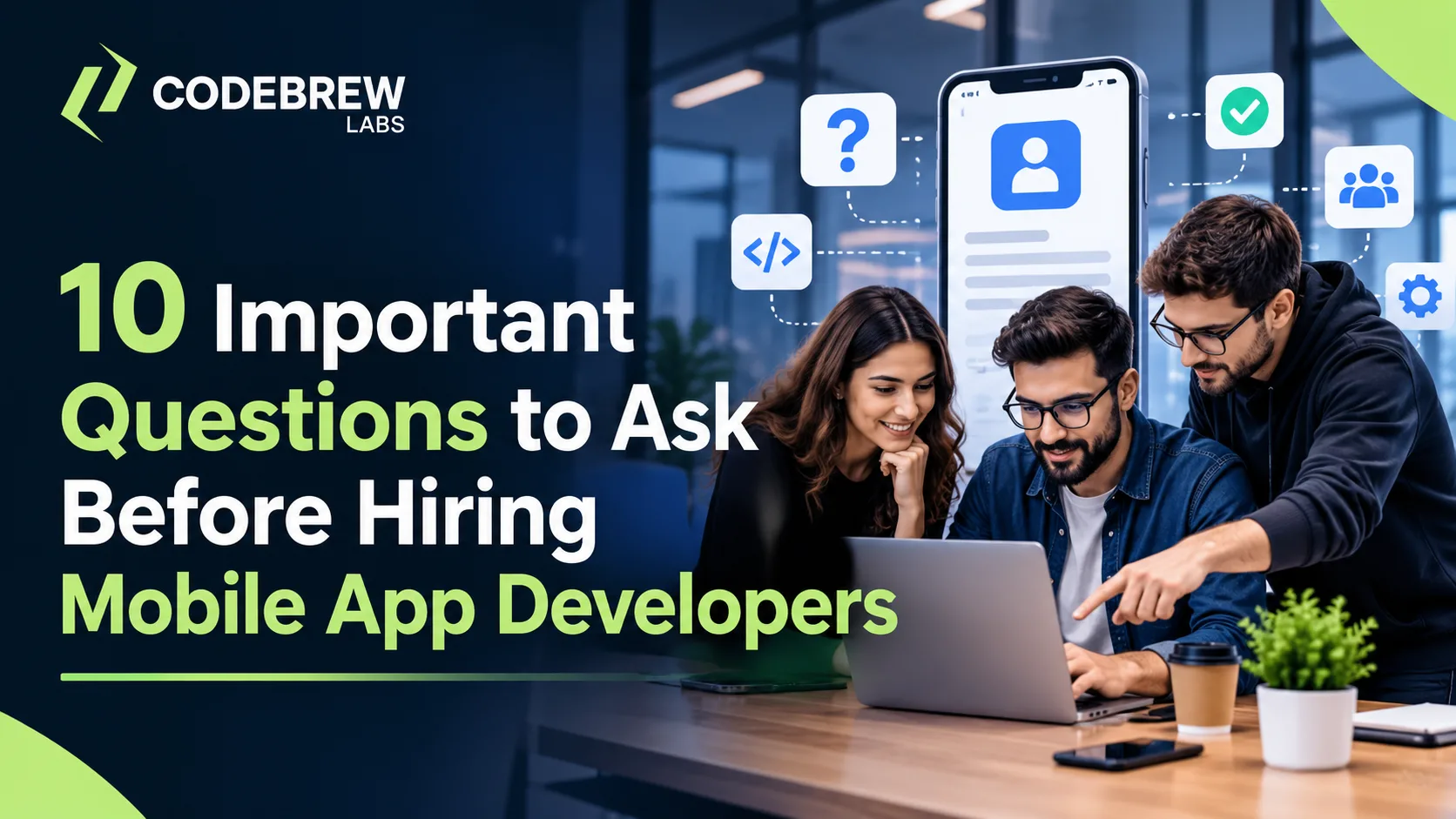
10 Important Questions to Ask Before Hiring Mobile App Developers
1. Who Will Own the Source Code and Intellectual Property After Development?
This is one of the first things to clarify, even though many businesses leave it until the contract is nearly ready to sign.
When you pay a development company to build an application, you should know exactly which assets belong to your business. Does the agreement transfer ownership of the source code, UI/UX designs, technical documentation, databases, and other agreed deliverables? Are there any components the development company intends to retain rights to?
It matters more than you might think. You could eventually decide to bring development in-house, work with another agency, or sell the business. In each situation, having clear ownership rights makes a difference.
What a good answer looks like: The company explains its intellectual property terms in writing and confirms how ownership of the agreed deliverables transfers to you, including any payment conditions. It should also clarify how third-party libraries, open-source components, and licensed software are treated.
Red flag: The developer claims you'll own the completed application but cannot explain whether you will receive the source code, repository access, and associated intellectual property rights.
Before signing the agreement, check that it addresses:
- Ownership and transfer of source code.
- Access to development repositories.
- Rights to UI/UX designs and technical documentation.
- Third-party software licenses and dependencies.
- Access to relevant cloud infrastructure and project accounts.
A working application is valuable. But if you cannot access, maintain, or modify it independently, your business could become unnecessarily dependent on the original development team.
2. Have You Developed Applications Similar to Mine?
A long portfolio might look impressive, but the number of applications a company has built doesn't tell you whether it has the right experience for your project.
Consider the differences between a food delivery app, a fintech platform, a healthcare application, and a subscription-based SaaS product. Each comes with its own technical challenges, integrations, security requirements, and expectations from users.
Rather than asking whether a company has developed mobile apps before, find out whether it has worked on products that share your business model or technical requirements.
For example, a healthcare application may need secure patient information management, role-based access controls, encrypted data transmission, and compliance with applicable privacy requirements. A fintech product, on the other hand, may require payment integrations, transaction monitoring, and additional security measures.
What a good answer looks like: The team presents relevant case studies and explains the challenges involved, the technologies used, and the decisions made during development. You should be able to understand what the developers actually contributed, not just see screenshots of the finished product.
Red flag: Every project is presented as a success story, but the company struggles to explain its technical contribution or the problems it solved.
Ask to review two or three projects that are reasonably close to yours. Pay attention to how the developers talk about their work. Their ability to explain technical trade-offs and practical challenges is often more revealing than a polished portfolio.
3. Who Will Actually Work on My Project?
The people handling your initial sales discussions may not be the same developers who eventually build your application. It's worth finding that out before the agreement is signed.
Development companies use different team structures. Some have dedicated in-house engineers, while others work with freelancers, subcontractors, or distributed teams. None of these arrangements is necessarily a problem. What matters is knowing who is responsible for the work and how accountability is managed.
You should have a clear picture of the people handling development, product design, quality assurance, project management, and technical decisions.
What a good answer looks like: The company introduces the proposed team, explains individual responsibilities, identifies the technical lead, and tells you whether any part of the project will be outsourced.
Red flag: You meet an experienced team during the sales process, but the company cannot confirm who will actually handle development after the contract is signed.
A few follow-up questions can help:
- Will I have a dedicated project manager?
- Who will make the major technical decisions?
- Will the same developers remain involved throughout the project?
- Are any development activities outsourced?
- How will I be informed about changes to the project team?
One detail worth paying attention to is team continuity. Frequent changes in developers can lead to lost technical knowledge, repeated explanations, and unnecessary delays. A clearly defined team structure helps avoid these issues.
4. How Will You Communicate Progress and Keep Me Updated?
An application can have a talented engineering team behind it and still run into trouble if communication is poor.
Imagine waiting several weeks for an update, only to discover that a key feature is behind schedule or an important requirement has been misunderstood. These situations can be frustrating, particularly when your launch plans depend on the development timeline.
Before hiring, find out how communication will work throughout the project. A promise to keep you updated regularly isn't enough. You need to know how often updates will happen, which tools the team uses, and who you should contact when something needs attention.
What a good answer looks like: The company outlines a communication plan that includes progress reports, scheduled meetings, sprint reviews, project management tools, and a process for escalating urgent issues.
Red flag: The team promises excellent communication but cannot explain how progress is tracked or who will serve as your main point of contact.
A practical communication arrangement could include:
- Weekly project updates.
- Scheduled sprint reviews and milestone demonstrations.
- Shared access to project management software.
- A dedicated communication channel.
- Written updates covering delays, technical blockers, and outstanding decisions.
Response times deserve attention, too. Ask how quickly the team typically responds to questions and how urgent issues are handled. This becomes particularly relevant when working with developers across different time zones.
5. How Do You Handle Changes in Project Scope or New Requirements?
It's rare for a mobile app project to follow the original plan without a single adjustment.
You might identify a feature that needs improvement during testing. Customer feedback could change your priorities, or a third-party integration might prove more complicated than anticipated.
That's part of product development. What matters is how your development partner responds.
Some teams agree to additional requests without explaining the impact on the timeline. Others introduce unexpected charges once development is already underway. Neither approach makes for a healthy working relationship.
What a good answer looks like: The company has a defined change-request process. It explains how new requirements are reviewed, estimated, approved, and added to the development schedule. Any impact on the budget or delivery date is discussed before work begins.
Red flag: Developers promise unlimited changes at no additional cost or cannot explain how additional requirements will affect the original agreement.
Before development starts, make sure both sides understand the difference between:
- Features included in the agreed project scope.
- Optional features that may be added later.
- Changes requiring additional development time.
- Improvements that can be scheduled for a future release.
You don't need to have every detail figured out before the first line of code is written. You do need a team that can accommodate reasonable changes without turning each new requirement into a contractual dispute.
6. What Security Measures Do You Follow to Protect My App and User Data?
Security needs to be part of the development conversation from the beginning, not something added just before launch.
If your application handles personal information, payment details, healthcare records, or confidential business data, the way that information is collected, stored, and transmitted needs careful consideration.
Ask developers about their approach to authentication, encryption, access permissions, API security, vulnerability testing, and data storage. If you're operating in a regulated industry, find out how the team accounts for applicable requirements such as HIPAA, PCI DSS, or GDPR, depending on your business model and the users you serve.
What a good answer looks like: Developers can explain the security measures built into the application architecture, how testing is performed, who can access sensitive information, and how relevant compliance requirements are addressed. They should also recognize when specialist security or legal advice is needed.
Red flag: The company relies on vague assurances such as "We use the latest security technology" but cannot explain how your application or customer information will be protected.
It's worth asking a few more specific questions:
- Who will have access to production data?
- How are passwords, API keys, and other sensitive credentials stored?
- How frequently is security testing performed?
- What is the process for identifying and fixing vulnerabilities?
- Is there a documented backup and recovery procedure?
Also, confirm whether security testing is included in the original development estimate. Essential security work shouldn't become an unexpected expense after most of your budget has already been allocated.
7. Can You Provide a Transparent Breakdown of the Development Cost?
A low development quote can look attractive, especially if you're working with a startup budget. But the cheapest proposal doesn't always offer the best value.
A project that initially appears affordable can become considerably more expensive when essential integrations, additional testing, infrastructure, or post-launch support are billed separately.
Ask for an itemized estimate instead of accepting a single total figure. You should understand where the money is going and what the company expects to deliver for it.
What a good answer looks like: The development company provides a detailed estimate, explains its pricing assumptions, identifies exclusions, and outlines the payment schedule.
Red flag: You receive one appealing figure without a clear explanation of what's included or which circumstances could increase the final cost.
Before approving the budget, review the following areas:
Before agreeing to the budget, clarify:
Cost areaWhat you should understandDiscovery and planningWhether requirements analysis is includedUI/UX designNumber of screens and revision roundsDevelopmentPlatforms, features, and integrations coveredTesting and QATypes of testing includedDeploymentApp Store and Google Play submission responsibilitiesMaintenancePost-launch support and ongoing costsThird-party servicesHosting, APIs, licenses, and subscription feesAlso ask whether the payment schedule is linked to completed milestones. Paying against clearly defined deliverables gives you better visibility into project progress.
8. What Happens After the App Is Launched? Do You Provide Ongoing Support?
Getting your application published is a major achievement, but development doesn't stop there.
Once real customers start using the product, you may discover performance issues, device compatibility problems, bugs that weren't identified during testing, or features that need improvement. Even a well-tested application requires attention as operating systems, devices, and user expectations change.
That's why post-launch support should be discussed before you sign the development agreement.
What a good answer looks like: The company provides a written support arrangement covering the warranty period, bug-fixing responsibilities, maintenance options, response times, and the cost of future improvements.
Red flag: The developer says, "We'll take care of everything after launch," but cannot explain what that support actually includes.
Pay particular attention to the difference between warranty support and ongoing maintenance.
Warranty support generally covers qualifying defects in the delivered application during an agreed period. Maintenance is broader. It may involve operating system compatibility updates, dependency upgrades, security patches, performance monitoring, and infrastructure management.
Ask whether the company offers different support arrangements depending on your application's complexity and business requirements.
There's one more thing to clarify: what happens if you eventually want another company to maintain your application? You should have access to the source code, documentation, and infrastructure needed to make that transition without unnecessary disruption.
9. Have You Handled App Store and Google Play Submissions Before?
Completing the development work doesn't automatically mean your application is ready for publication.
Apple's App Store and Google Play have their own submission guidelines, privacy requirements, technical standards, and review processes. Missing privacy disclosures, incorrect permissions, incomplete account configurations, or other submission issues can delay publication.
If you're launching your first application, it's easy to assume that the development team will handle everything. That's not always the case.
What a good answer looks like: The company can explain its experience with both publishing processes, including app signing, store listings, privacy disclosures, testing requirements, and responding to review feedback or rejection.
Red flag: The developer considers its responsibility complete once the application is built, even though end-to-end development and deployment were part of the original agreement.
Before hiring, establish who will handle:
- Apple Developer and Google Play Console account configuration.
- Application builds and signing credentials.
- Store listing assets, screenshots, and descriptions.
- Required privacy and permission disclosures.
- Responses to reviewer feedback.
- Resubmissions if the application is rejected.
Ideally, your business should retain ownership and administrative control of its developer accounts. The development company can receive the permissions it needs without becoming the permanent owner of your publishing infrastructure.
10. What Happens If the Project Gets Delayed or Doesn't Go According to Plan?
This might not be the easiest question to bring up during an initial meeting, but it's one of the most useful.
Mobile app development involves several moving parts. Unexpected technical challenges, changes in personnel, budget constraints, or disagreements over requirements can affect progress. Even a well-planned project can encounter setbacks.
What you need to understand is how the development company responds when something goes wrong.
What happens if a major milestone is missed? What if the technical lead leaves halfway through development? And what options do you have if the project stops progressing?
What a good answer looks like: The company explains its escalation process, milestone tracking, risk management practices, replacement arrangements, documentation standards, and contractual options if either party needs to end the engagement.
Red flag: The team insists that delays never happen or avoids discussing termination terms, handover responsibilities, and ownership of unfinished work.
Make sure your contract covers:
- Project milestones and delivery expectations.
- How delays are reported and managed.
- Responsibilities if key team members leave.
- Ownership of completed work.
- Payment obligations for unfinished milestones.
- Conditions for terminating the agreement.
- Transfer of source code, documentation, and project access.
There's a useful distinction here: a development partner that openly discusses potential risks is often easier to work with than one that guarantees everything will go perfectly.
You're not expecting the project to fail. You're making sure everyone knows what to do if circumstances change.
Must Read: How Much Does Mobile App Development Cost in New York?
Does Hiring a New York Development Company Give You an Advantage?
Location can influence how easily you collaborate with a development team, although it shouldn't be the deciding factor.
Working with an App Development Company in New York may make certain aspects of project management easier. Convenient time-zone alignment, opportunities for face-to-face meetings, and familiarity with the local business environment can be useful, particularly when your project involves frequent stakeholder discussions or region-specific requirements.
That said, proximity doesn't guarantee better development work.
A local agency might have limited experience with your industry, while a remote team could bring the technical expertise and delivery structure your product needs. The important thing is to compare capabilities rather than office addresses.
Look at the company's previous projects, engineering expertise, communication process, security practices, and ability to support your application after launch. If those areas are covered, working with a distributed development team can be a practical option for New York businesses.
Why Choose Code Brew Labs for App Development?
Finding developers who can build an application is one thing. Finding a technology partner that understands your business requirements, makes sound technical decisions, and can support the product beyond its initial release is another.
That's where Code Brew Labs is worth considering.
With more than 13 years of digital engineering experience, over 2,600 projects, and a team of 650+ in-house engineers, Code Brew Labs works across mobile application development, artificial intelligence, blockchain, and enterprise technology. Its experience includes projects for startups, established businesses, and enterprise-level organizations across multiple industries.
One aspect of its approach is the emphasis on the complete product lifecycle. Rather than limiting its involvement to application development, the company works across idea validation, business planning, product design, engineering, deployment, and ongoing technical support.
Its core app development services include:
- iOS and Android Development: Native mobile applications built around specific business requirements, platform capabilities, and user expectations.
- Cross-Platform Development: Flutter and React Native solutions for businesses looking to reach iOS and Android users through a shared development approach.
- AI-Powered App Development: Integration of generative AI, machine learning, intelligent agents, chatbots, and workflow automation.
- UI/UX Design: User-focused product design, wireframing, prototyping, and interface development through its in-house design studio, Allurive.
- Backend and API Development: Scalable application architecture, database management, backend engineering, and third-party integrations.
- Enterprise Application Development: Custom business applications, SaaS platforms, and enterprise mobility solutions.
- Maintenance and Support: Post-launch updates, bug fixes, performance improvements, and continued technical assistance.
Industry experience is another factor worth considering. Code Brew Labs works across fintech, healthcare, logistics, retail, on-demand services, marketplaces, and other business sectors. This range of exposure can be useful for projects involving specialized integrations, complex user journeys, or industry-specific security requirements.
For businesses evaluating an App Development Company in New York, Code Brew Labs is an option to explore, particularly if the project involves AI integration, cross-platform development, or a combination of mobile applications and enterprise software.
Its international delivery experience also makes it relevant for companies that are open to working with a development partner outside their immediate location.
Of course, the right choice still comes down to the proposed solution. Before moving forward, discuss the actual development team, source code ownership, project estimates, delivery milestones, security practices, and post-launch responsibilities. These conversations will help you determine whether Code Brew Labs' capabilities align with your business objectives and technical requirements.
Final Thoughts
Hiring mobile app developers involves more than comparing portfolios, collecting quotations, and choosing the company with the most impressive presentation. You need to understand how the team works, what it will deliver, who owns the finished product, and what happens when the application needs attention after launch.
The best app development companies in New York won't hesitate when you ask detailed questions. They'll explain their processes, discuss potential risks, and give you realistic expectations rather than making promises they can't support.
Take these ten questions into your next hiring discussion. Spend time understanding the answers, review the agreement carefully, and make sure both sides have the same expectations before development begins.
A little extra diligence at the hiring stage can save your business considerable time, money, and frustration later.