
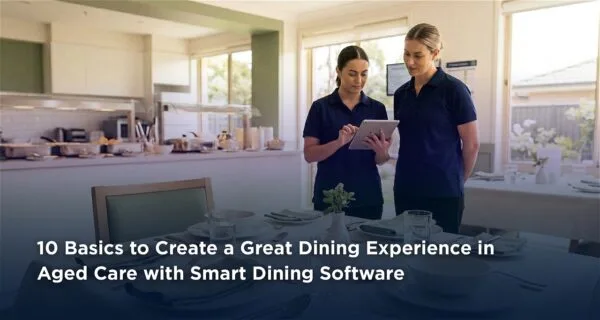
The lunch service has just started. The kitchen is running on time. But the agency cook brought in for the shift has no idea that the resident in Room 14 has a texture-modified diet, that Room 22 requires thickened fluids, or that three residents on the east wing have a sesame allergy that wasn't on any list she was handed this morning.
Nobody made a mistake. The information existed. It just wasn't where it needed to be.
That's the gap smart dining software is built to close – and in aged care, the cost of that gap goes well beyond a missed preference.
Why Dining in Aged Care Is More Complex Than It Looks
For many residents, food is one of the few things they still choose for themselves. That gives the dining operation a dual function: it's a clinical responsibility and a quality-of-life one, playing out three times a day across a full resident cohort.
Under ACQSC Standard 6, aged care providers must demonstrate that food and nutrition meet residents' needs, preferences, and clinical requirements. The standard doesn't only ask that food be safe. It asks that resident choice be respected, dietary needs be documented and followed, and evidence be available when an assessor asks for it.
Paper-based systems were never built to carry that reliably.
Where Traditional Dining Systems Break Down
Most aged care facilities didn't set out to build a complicated dining operation. They built what made sense at the time: handwritten preference sheets, a printed weekly menu, and verbal briefings at shift start.
The problem isn't the intent. It's what happens when the pressure increases. A larger resident cohort. More complex dietary profiles. Higher compliance expectations. Agency and casual staff who weren't around for the original briefing and have nothing to work from.
Dietary Information That Doesn't Follow the Resident
When dietary requirements live in a folder at the nurses' station, they don't automatically reach the kitchen. When a resident's needs change after a hospital discharge, a new speech pathology assessment, or an updated allergy record, fixing one document doesn't fix the system. Information fragments across paper files, verbal handovers, and individual memory.
Menus That Don't Reflect Resident Choice
A printed menu without recorded alternatives or a feedback mechanism fails the resident choice requirement under Standard 6. If there is no documented record of what a resident preferred, declined, or requested, the facility has no evidence of person-centred care when the assessment comes.
Food Safety Records That Don't Hold Together
Temperature logs, allergen matrices, fridge checks, and supplier records. On paper, all of these require manual entry across separate documents by different staff members. The records land in different formats, in different locations, and at different levels of consistency. When an assessor asks to see them together, what exists on paper rarely matches what was actually done.
No Visibility After the Service
Managers and care leads often don't know how a meal service went until someone raises it at the next handover. Whether residents ate well, who declined, or whether texture-modified meals went to the right people – none of that surfaces without a system designed to capture it.
A Real-Life Example
Picture an 80-bed aged care facility in South Australia. The kitchen runs three services daily with a team of four. Dietary profiles are maintained in a folder updated by the care coordinator, and a printed copy goes to the kitchen at the start of each week.
During a mid-week ACQSC assessment, the assessor asks to see how the facility tracks resident meal preferences and dietary compliance across a rolling period. The kitchen has the current week's print-out. The care coordinator has a folder from the previous quarter. Neither shows how individual resident choices were recorded, updated, or acted on over time.
The assessor notes the gap. Not because the care was poor – but because the system couldn't demonstrate that it wasn't.
Purpose-built aged care dining software makes that demonstration possible.
Read more about creating a better dining experience in aged care with smart dining software here:
https://centrimlife.com.au/blog/10-basics-to-create-a-great-dining-experience-in-aged-care-with-smart-dining-software/