
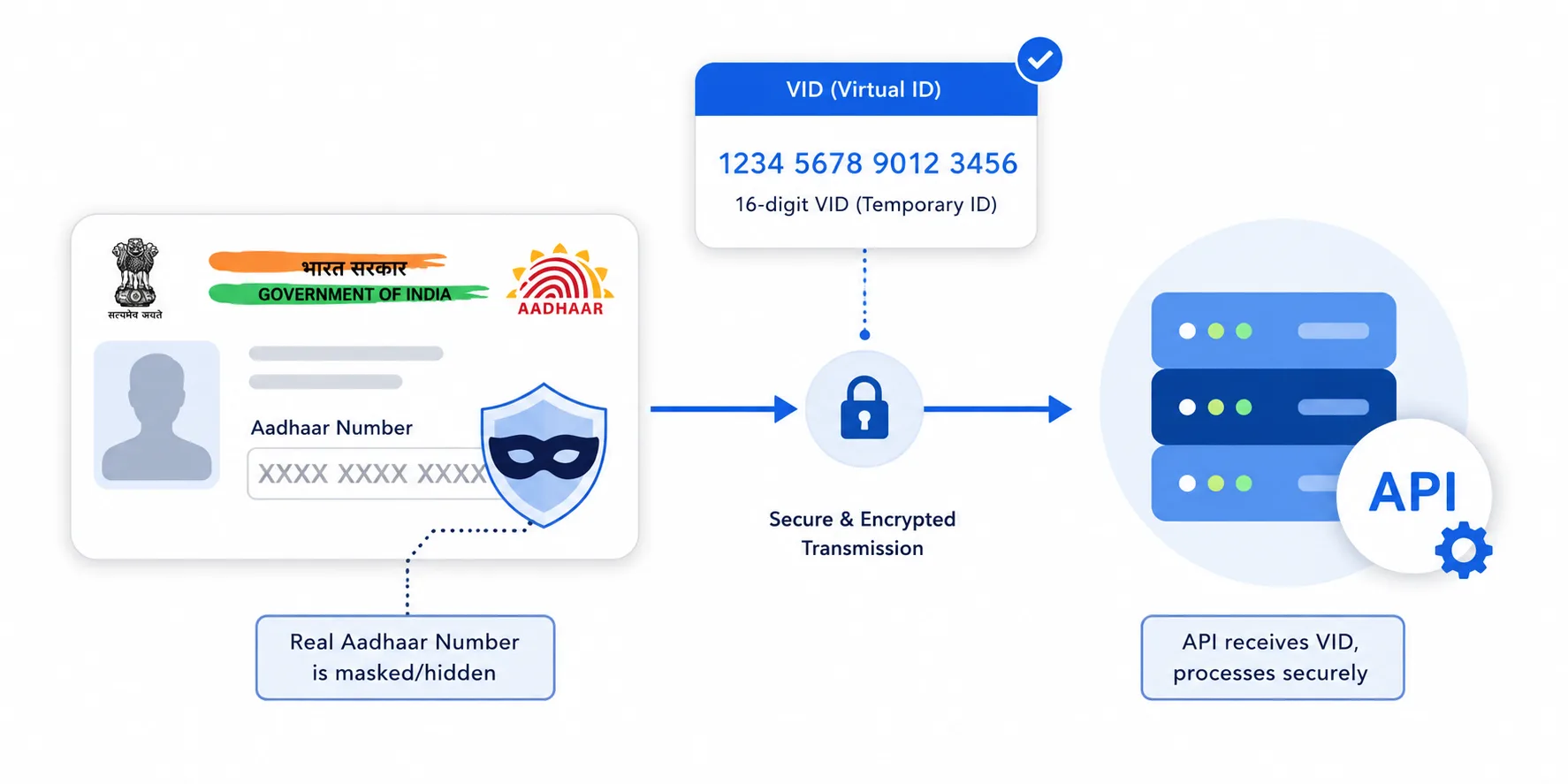
If you've ever generated an Aadhaar OTP and noticed an option to use a "Virtual ID" instead of your Aadhaar number, you've already brushed up against one of UIDAI's quietest but most useful privacy tools. Most people skip past it. Most explainers online skip it too — which is a little odd, given how often it shows up in KYC forms, banking apps, and telecom SIM verifications.
So let's actually talk about it: what a Virtual ID (VID) is, why UIDAI built it, and — since this is the part almost nobody covers — how identity verification APIs are expected to handle it on the backend.
What Exactly Is a Virtual ID (VID)?
A Virtual ID is a temporary, 16-digit number that UIDAI generates against your 12-digit Aadhaar number. You can use it anywhere Aadhaar authentication is accepted — banks, telecom operators, insurance companies, government portals — without ever revealing your actual Aadhaar number to that service provider.
Think of it as a disposable stand-in. The service provider sends the VID to UIDAI's servers for verification. UIDAI internally maps it back to your real Aadhaar number, verifies your identity, and sends back a result. The company on the other end never sees or stores your Aadhaar number at all — just your VID, along with whatever limited demographic details (name, address, photo) the transaction requires.
A few things worth knowing about how VID behaves:
- It's temporary and revocable. You can regenerate it as often as you like.
- Only one VID is active at a time. Generating a new one instantly kills the old one.
- It cannot be reverse-engineered back to your Aadhaar number — UIDAI has confirmed this isn't mathematically possible.
- It's generated through the official myAadhaar portal or the mAadhaar app, using your registered mobile number and OTP.
UIDAI introduced VID back in 2018 as an added privacy layer, and it made VID acceptance mandatory for every Authentication User Agency (AUA). In plain terms — if a bank, NBFC, or fintech's KYC form outright refuses to accept a VID and insists only on the Aadhaar number, that's technically a compliance gap on their end, not a limitation of the system.
Why "Zero Aadhaar Number" Matters More Than It Sounds
The phrase "Zero Aadhaar Number" is really just a way of describing what VID achieves in practice: zero exposure of the actual Aadhaar number during a transaction. For a country where Aadhaar sits at the center of banking, telecom, and government service access, that's a meaningful privacy guarantee — not a technicality.
For end users, it means one less permanent identifier floating around in some company's database, waiting to be part of the next data breach headline. For businesses running KYC at scale, it means designing systems that treat the Aadhaar number and the VID as functionally interchangeable inputs — because legally, they have to be.
How Verification APIs Actually Handle VID
This is where things get genuinely interesting from a technical standpoint, and where most consumer-facing articles stop short.
When a KYC or identity verification API accepts an Aadhaar input field, that field usually needs to intelligently handle both a 12-digit Aadhaar number and a 16-digit VID — without asking the end user which one they're entering. Here's roughly how that works under the hood:
1. Input length detection. Since Aadhaar numbers are 12 digits and VIDs are 16, the API layer typically differentiates the two purely based on input length before routing the request appropriately to UIDAI's authentication infrastructure.
2. Same downstream authentication flow. Whether the input is an Aadhaar number or a VID, the actual authentication request — whether it's OTP-based e-KYC, biometric authentication, or demographic verification — follows the same UIDAI protocol. UIDAI resolves the VID to the underlying Aadhaar number on its end; the requesting API never needs to see or store that mapping.
3. No caching of the resolved Aadhaar number. A well-built verification API is designed to pass the VID straight through to UIDAI and receive back only the authentication result and permitted demographic fields — never a resolved Aadhaar number. This matters for compliance: storing an Aadhaar number you weren't explicitly given (by reverse-deriving it) would defeat the entire purpose of VID and create regulatory risk.
4. Regeneration handling. Because a VID gets invalidated the moment a new one is generated, APIs that support recurring or multi-step verification flows need to account for the possibility that a previously used VID may no longer be valid on a retry. Good API design surfaces a clear, specific error here rather than a generic authentication failure — it saves both the developer and the end user a lot of confusion.
5. Consistent audit logging. From a compliance standpoint, systems need to log which identifier type (Aadhaar or VID) was used for each verification event, since regulators and auditors increasingly expect visibility into VID adoption rates as part of data minimization practices.
What This Means for Businesses Doing KYC
If you're a bank, NBFC, fintech, or any regulated entity running Aadhaar-based KYC, the practical takeaway is simple: your verification stack — whether built in-house or through an API-first identity verification platform — needs to treat VID as a first-class input, not an edge case bolted on later. Rejecting VID inputs, or silently degrading the user experience when someone enters one, isn't just a UX miss. It runs against UIDAI's own mandate.
Platforms like Surepass build this handling directly into their Aadhaar verification APIs, so businesses don't have to reinvent VID-Aadhaar interoperability themselves every time they integrate KYC into a new product.
FAQs
Ques: Is VID the same as Aadhaar number?
Ans: No. VID is a temporary, regenerable 16-digit number that maps internally to your permanent 12-digit Aadhaar number. It can be used in place of the Aadhaar number for authentication, but it isn't the same identifier.
Ques: Can a company store my VID like they would an Aadhaar number?
Ans: Generally, the same data protection expectations apply — VID should still be treated as sensitive personal information and handled per DPDP Act and UIDAI data-minimization guidelines, even though it doesn't directly expose your Aadhaar number.
Ques: How often can I regenerate my VID?
Ans: As often as you want, through the myAadhaar portal or mAadhaar app. Each new VID immediately invalidates the previous one, so only one stays active at a time.
Ques: Do all KYC and verification APIs support VID automatically?
Ans: They're supposed to, since UIDAI mandates VID acceptance for all Authentication User Agencies. In practice, this depends on how well the API or platform has implemented UIDAI's specification — which is why it's worth checking before integrating one into your KYC flow.