
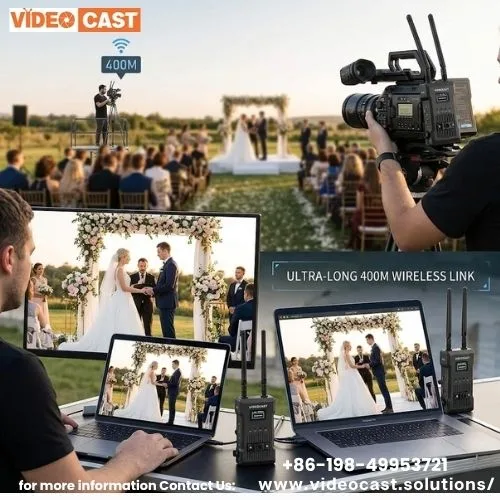
Whether you are a cinematographer on a sprawling outdoor shoot, a live event director managing multiple camera angles, or a sports broadcaster tracking fast-moving action, one challenge remains universal: getting a clean, reliable video signal from your camera to your monitor or switcher — without a cable running across your set.
A wireless video transmission system solves exactly this problem. At the heart of modern productions today sits the HDMI transmitter — compact, powerful, and increasingly capable of covering extraordinary distances. The latest generation of systems boasts an operational range of up to 400 metres, redefining what a long range transmitter can achieve on location.
What is a Wireless Transmitter and Receiver System?
A wireless transmitter and receiver system is a two-part solution designed to carry video signals through the air rather than over physical cables. The transmitter connects directly to your camera's HDMI or SDI output, converts the signal into a radio frequency (RF) broadcast, and the receiver — placed at your monitor, director's station, or video switcher — decodes it back into a usable video feed in real time.
Modern systems operate across several frequency bands — typically 5 GHz or 60 GHz — chosen for their capacity to handle high-bandwidth video data with minimal interference. The result is a seamless, low-latency connection that mirrors what a physical cable would provide, minus the trip hazards and range limitations.
Understanding the 400m Transmitter
The phrase 400m transmitter refers to a wireless video system rated for line-of-sight signal transmission across distances of up to 400 metres (approximately 1,312 feet). This represents the upper tier of consumer and prosumer wireless video equipment - and it dramatically expands the creative and logistical possibilities for production teams.
At 400 metres, a director can position a camera at the opposite end of a football stadium, atop a building, or deep within a natural landscape - while maintaining full visual oversight from a central production hub. For drone operators, this means the ground monitor receives a clean feed even as the drone climbs and manoeuvres.
Line-of-Sight vs. Real-World Range
It is important to understand that the 400m figure typically refers to line-of-sight (LOS) conditions — an unobstructed path between transmitter and receiver. In real-world environments with walls, trees, vehicles, or crowds, effective range will be reduced. Many professional systems compensate through directional antennas, antenna diversity, and adaptive frequency hopping.
The HDMI Transmitter Explained
An HDMI transmitter is the most common type of wireless video sender for camera operators, as HDMI remains the standard output on the majority of mirrorless cameras, cinema cameras, DSLRs, and camcorders. It plugs into the HDMI port on your camera and immediately begins broadcasting the signal wirelessly.
The paired HDMI receiver decodes this signal and outputs it through another HDMI port to your monitor, TV, or capture device - completing the wireless chain with no compression artefacts if the system uses a lossless or visually lossless codec.
Key Technical Features to Look For
- Resolution support: Ensure the HDMI transmitter handles your camera's full output - 1080p, 1080p60, or 4K30/60.
- Latency: Mission-critical monitoring applications require sub-frame latency. Look for systems advertising under 1ms to 60ms glass-to-glass delay.
- HDCP compatibility: For broadcast and streaming workflows, HDCP-compliant systems prevent signal drop-outs on encrypted sources.
- Battery life: A compact HDMI transmitter mounted on a camera must balance weight with runtime — look for at least 3–5 hours of operation per charge.
- Frequency stability: Systems with dynamic frequency hopping adapt automatically to interference, maintaining signal integrity in crowded RF environments.
What Makes a Long Range Transmitter Different?
A standard wireless video system might cover 30–100 metres reliably. A long range transmitter — designed for 200m, 300m, or 400m operation - differs in several fundamental ways:
Higher Transmission Power
Long range systems operate at higher RF output power levels (within legal limits per region), increasing the signal strength that can reach a distant receiver without degradation.
Advanced Antenna Design
Where short-range systems use omnidirectional antennas, long range transmitters typically incorporate high-gain directional antennas or MIMO (Multiple Input, Multiple Output) antenna arrays. These focus the signal in a specific direction, dramatically extending effective reach.
Robust Encoding
Over longer distances, signal packets are more vulnerable to corruption. Long range transmitters use forward error correction (FEC) and robust encoding schemes to reconstruct any lost data before it reaches the receiver output, maintaining picture quality.
Interference Resilience
The more distance a signal travels, the more opportunity it has to encounter interference. Professional long range systems include automatic frequency selection, whitespace detection, and channel bonding to navigate busy RF environments.
Top Use Cases for a 400m Wireless Video System
1. Live Sports Broadcasting
Sports production demands flexible camera positioning — on the pitch, high in the stands, at the finish line. A 400m transmitter lets technical directors place cameras wherever the action dictates, with instant signal return to the OB truck or broadcast hub.
2. Outdoor Film and Commercial Production
Large-scale film productions frequently work across vast locations — beaches, deserts, mountain terrain — where running cable is impractical. A wireless transmitter and receiver system keeps the director's village connected to every camera unit on set.
3. Drone and Aerial Cinematography
Drone operators rely on wireless video return to monitor framing and exposure from the ground. A long range transmitter ensures that the feed remains stable even as the aircraft climbs, banks, and distances itself from the operator.
4. Concert and Live Event Production
Large venues present significant cabling challenges. An HDMI transmitter mounted on a roving camera provides the vision mixer with a clean, uninterrupted feed regardless of where the operator moves within the venue.
5. Corporate and Conference AV
In conference halls and auditoriums, a wireless HDMI system eliminates floor cables between presenter podiums and AV racks — improving both safety and the aesthetics of the space.
How to Choose the Right Wireless Transmitter and Receiver
With a wide range of systems available — from sub-£200 consumer units to professional broadcast-grade rigs costing several thousand pounds — selecting the right wireless transmitter and receiver requires clarity on your specific needs.
- Define your maximum working distance. If you rarely exceed 100m, you do not need — or want to pay for — a 400m transmitter
- Assess your RF environment. Urban locations with dense Wi-Fi networks benefit most from systems with aggressive frequency management.
- Match to your camera outputs. Verify HDMI version compatibility (1.4 vs. 2.0) and whether you need SDI support as well.
- Consider weight and form factor. A transmitter riding a gimbal or drone must be as light as possible; weight on a studio camera matters less.
- Check latency specifications. For focus pullers and directors monitoring performance, low latency is non-negotiable.
- Review battery and power options. Confirm whether the unit accepts NP-F batteries, USB-C power, or requires proprietary packs.
Setting Up Your 400m HDMI Transmitter — Best Practices
Even the best HDMI transmitter will underperform if set up incorrectly. Follow these best practices to maximise range and reliability:
- Position transmitter and receiver antennas with clear line-of-sight wherever possible.
- Avoid placing the transmitter directly against the camera body — even a short extension arm improves antenna performance significantly.
- Conduct a pre-shoot frequency scan to identify and avoid congested channels.
- Use a tripod or pole mount for the receiver antenna rather than leaving it on a table — height reduces ground-level multipath interference.
- Keep the transmitter away from other RF-emitting accessories (radios, wireless audio, Wi-Fi routers) by at least 30cm.
- Test at full operational range before the shoot, not on the day of.
Frequently Asked Questions
1. Does a 400m transmitter work through walls?
Not reliably. The 400m specification assumes open line-of-sight conditions. Walls, particularly concrete or metal-reinforced structures, significantly reduce effective range. For through-wall applications, consider a dedicated 5 GHz mesh system instead.
2.What is the difference between an HDMI transmitter and an SDI transmitter?
HDMI transmitters accept the HDMI signal native to most cameras and consumer monitors. SDI transmitters use the broadcast-standard SDI connection, which is more robust for long cable runs and common in professional broadcast equipment. Many long range systems support both.
3.Is a wireless transmitter and receiver system legal to use?
Yes, in most jurisdictions — but output power and permitted frequency bands are regulated. Always verify that the system you purchase is approved for use in your country. In the UK, Ofcom-approved 5 GHz equipment operates freely; in the USA, FCC Part 15 rules apply.
4.Can I use multiple wireless systems simultaneously on the same shoot?
Yes. Most professional long range transmitter systems support multi-channel operation, allowing several transmitter-receiver pairs to operate simultaneously on different frequencies without interfering with each other.
5.What latency should I expect from a 400m wireless video system?
This varies widely by system and compression method. Uncompressed or visually lossless systems can achieve sub-1ms latency. Compressed systems using H.264 or H.265 typically introduce 60–200ms of delay — acceptable for monitoring but not for real-time focus pulling.
Conclusion
A wireless video transmission system built around a capable HDMI transmitter and matching receiver is no longer a luxury reserved for major broadcast productions. Today, compact and affordable 400m transmitter solutions bring professional-grade, long range transmitter capability to independent filmmakers, event videographers, and corporate AV teams alike.
Choosing the right system means understanding your range requirements, RF environment, camera outputs, and latency tolerances — then matching those needs to a system built to meet them. Invest in the right wireless transmitter and receiver setup, and you will gain not just freedom of movement, but a fundamentally more creative and efficient production workflow.
For more information Contact Us:
- Email: [email protected]
- Phone: +86-198-49953721